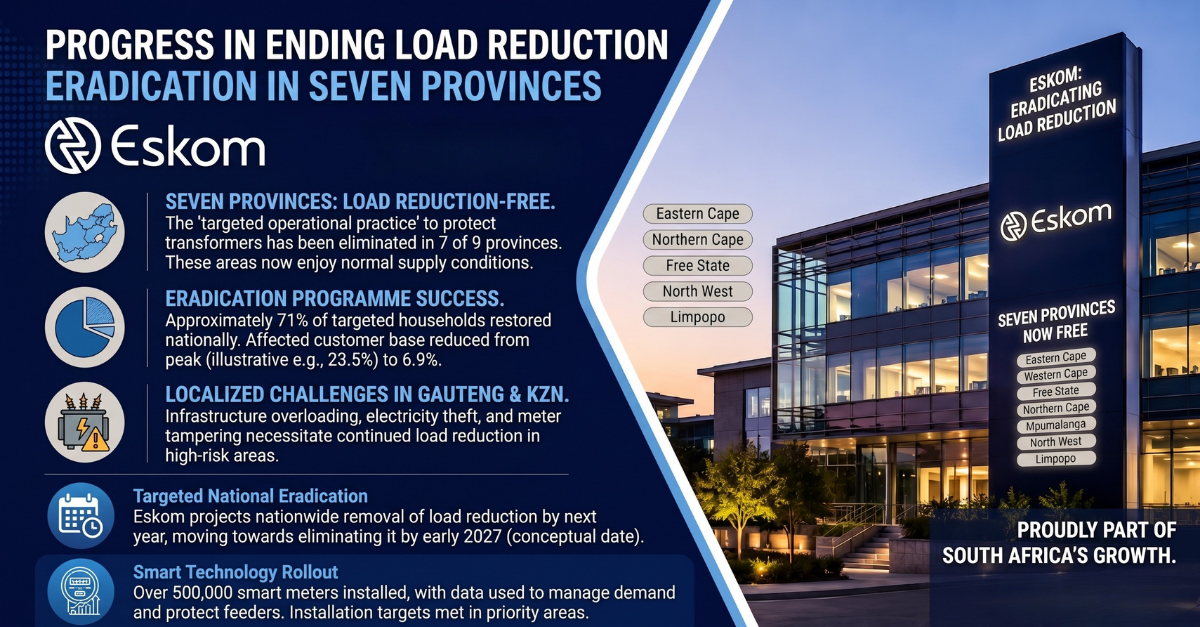
In a brief statement released on 20 August 2026, Eskom said it will not lower load shedding in seven provinces that it classifies as “key” for the national grid. The utility did not name the provinces, nor give a timeline for when the current level of scheduled power cuts might change.
Load shedding, the practice of deliberately turning off electricity to keep the grid stable, has been a feature of South Africa‘s power landscape for more than a decade. When Eskom says it will not reduce load shedding, it means that the amount of electricity that will be turned off each day will remain at the present level, whatever stage that may be.
For owners of small and medium enterprises, the announcement is a reminder that the power supply risk that has shaped business planning since the early 2000s is still very much alive. A manufacturing firm in Gauteng that relies on a steady flow of electricity to run its production line cannot count on a sudden improvement in supply. Likewise, a retail outlet in the Eastern Cape that has invested in a diesel generator will still need to budget for fuel and maintenance because the cuts are not expected to ease.
What makes the statement noteworthy is not the number of provinces, the utility has previously listed all nine provinces in its load-shedding maps, but the fact that Eskom is explicitly ruling out a reduction. In recent weeks the utility has been under pressure from industry bodies that argue the current load-shedding schedule is harming economic recovery. By saying there will be no further reduction, Eskom is effectively saying that the constraints on generation, transmission or fuel supply that forced the current schedule are not expected to improve in the short term.
There are a few practical implications for SMEs operating in the affected provinces. First, contingency planning cannot be postponed. Companies that have delayed buying backup generators, installing battery storage or negotiating load-shedding contracts with suppliers should treat the Eskom statement as a green light to move forward. Second, cash-flow forecasts need to incorporate the cost of power interruptions, whether that is lost production time, spoilage of perishable goods or the extra expense of running a generator during peak load-shedding periods.
Third, the announcement may influence credit decisions. Banks that assess loan applications often look at a business’s exposure to load shedding as a risk factor. A clear signal from Eskom that the situation will not improve could lead lenders to tighten credit terms for firms in the seven provinces, or to require additional guarantees.
It is also worth noting that Eskom’s statement is a claim by the utility itself. The regulator, the National Energy Regulator of South Africa (NERSA), has not issued a separate comment confirming the forecast. Until an independent body corroborates the outlook, the information remains unverified beyond Eskom’s own communication.
In the broader picture, the announcement comes at a time when the country is still grappling with a series of power-related challenges. The ageing coal fleet, delayed renewable projects and a backlog of maintenance work have all contributed to the current supply-demand gap. While the government has pledged to increase generation capacity, the timeline for new plants to come online stretches into the next few years. For now, the grid’s operating limits are set by the amount of electricity that can be reliably produced and transmitted.
For the SME community, the practical takeaway is simple: expect the same level of load shedding for the foreseeable future in the seven provinces mentioned by Eskom, and plan accordingly. That may mean revisiting operating hours, securing more reliable backup power, or even exploring alternative locations for critical processes if the cost of power interruptions becomes prohibitive.
In the end, the statement is less a surprise than a confirmation of a status quo that many businesses have already learned to live with. The real question for entrepreneurs is not whether the cuts will stop, but how they can keep the lights on, and the cash register ringing, despite them.