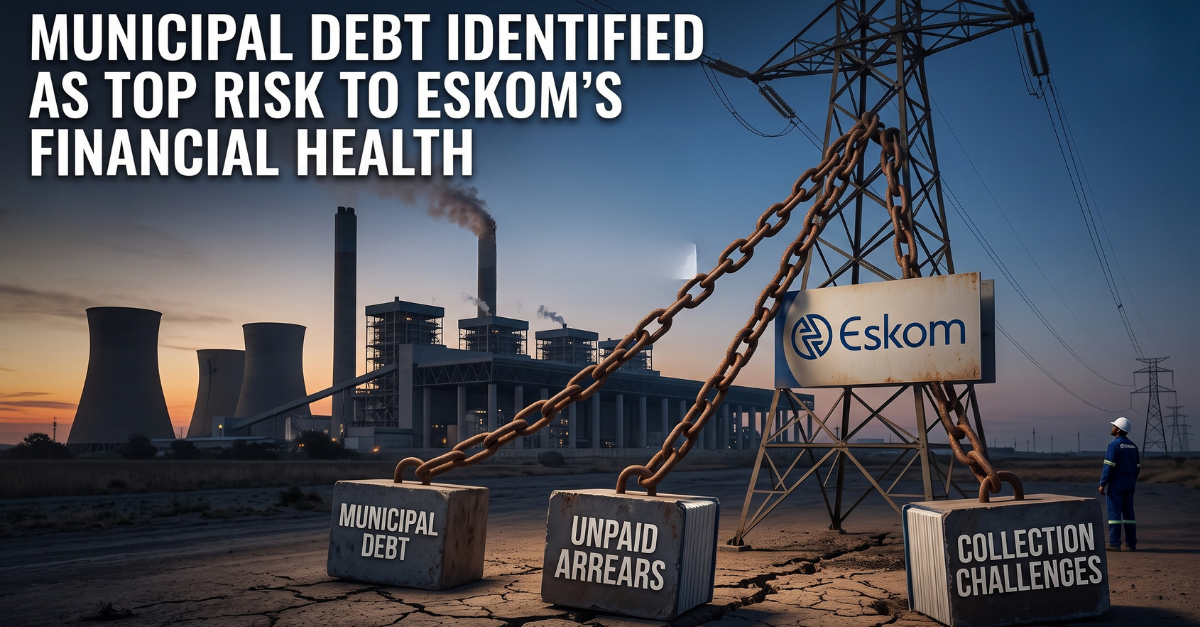
Jacaranda FM reported that municipal debt has emerged as the biggest threat to Eskom‘s financial sustainability, according to the broadcaster’s coverage of the issue.
Municipal debt refers to the money that local government authorities owe to Eskom for electricity supplied to households, businesses and public services. When those arrears pile up, the utility receives less cash to cover operating costs, service its own debt and invest in new capacity. The claim that this is the “biggest threat” is a company-level assessment, not an independently verified ranking.
Why municipal arrears matter
Eskom already carries a large balance sheet of debt, estimated at over R400bn, much of which is classified as non-performing. Load shedding, maintenance backlogs and volatile commodity prices have strained the utility’s cash flow for several years. In that context, the roughly R200bn owed by municipalities, a figure that has been cited in recent annual reports, represents a significant short-term funding gap. When municipalities delay payments, Eskom must either borrow more, raise tariffs or cut back on maintenance, each option feeding into the same cycle of financial stress.
Why Eskom cannot simply cut off a non-paying municipality
It is worth understanding why this problem has festered rather than resolved itself through the obvious remedy of disconnecting non-paying customers. Eskom supplies bulk electricity to a municipality, which then resells it to households and businesses in that area and is contractually and legally responsible for paying Eskom regardless of whether it successfully collects from its own residents. Cutting supply to an entire municipality, rather than to an individual non-paying household, means punishing paying residents and businesses alongside non-paying ones, which is precisely why disconnections tend to be politically fraught, legally contested, and used only as a last resort, even when arrears run into the billions. That asymmetry, Eskom bears the financial risk of a municipality’s poor revenue collection, without an easy way to enforce payment without collateral damage, is the structural core of the problem.
For small and medium enterprises, the knock-on effect can be tangible. Unreliable power supply raises operating costs, forces firms to invest in backup generators and can erode profit margins. In sectors such as manufacturing and retail, where electricity is a core input, prolonged load shedding can shrink sales and delay expansion plans. The municipal debt issue therefore does not stay confined to balance-sheet numbers; it filters down to the day-to-day decisions of business owners.
What remains unclear from the Jacaranda FM piece is the exact timeline for any remedial action. The utility has previously warned that without a concerted effort to clear municipal arrears, its ability to meet long-term obligations could be compromised. However, the broadcaster did not provide details on whether the government or the municipalities themselves have agreed on a repayment schedule, nor did it cite any recent policy measures aimed at addressing the shortfall.
Analysts have pointed out that the municipal debt problem is partly a symptom of broader fiscal challenges faced by local authorities, many of which struggle with their own revenue collection and service delivery mandates. The National Treasury has, in past statements, urged municipalities to prioritise electricity payments, but enforcement mechanisms have been limited. Until a clear framework is put in place, Eskom may continue to see its cash inflows squeezed, which could translate into higher tariffs for end-users or further reliance on external financing.
In summary, the claim from Jacaranda FM highlights a real pressure point for Eskom: the arrears from municipalities are large enough to be described as the utility’s biggest current threat. While the statement aligns with known figures on municipal debt, the story does not confirm any concrete steps being taken to resolve the issue. Business owners should watch for any policy announcements that could affect power pricing or supply reliability in the coming months, particularly given that the structural mismatch between who bears the financial risk and who can enforce payment shows no sign of an easy institutional fix.