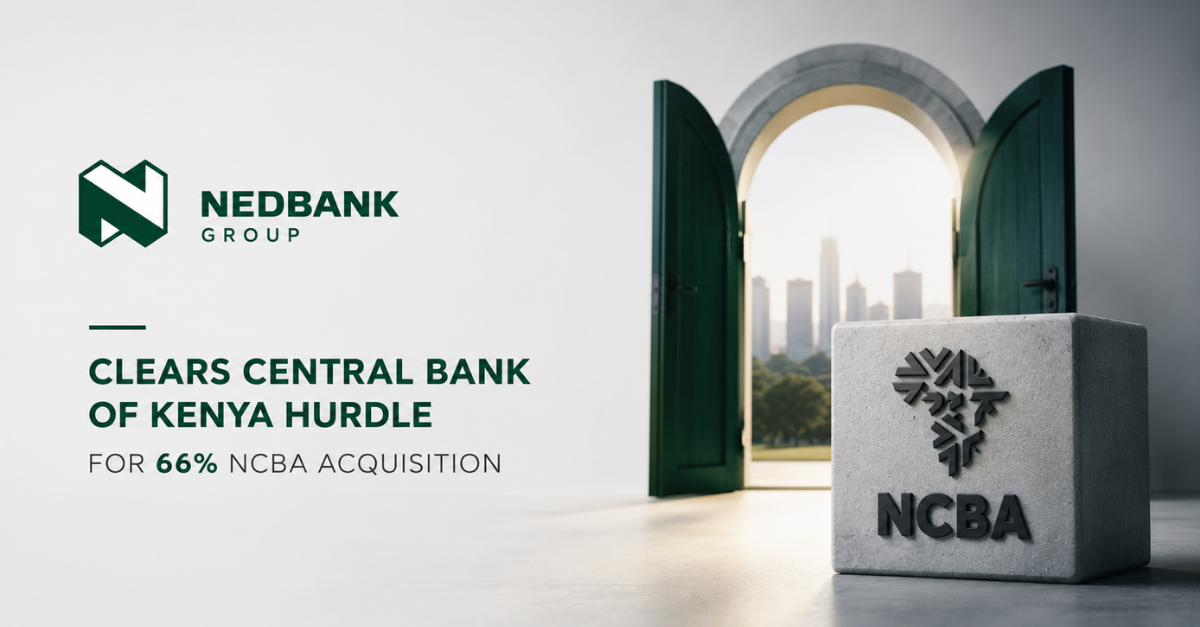
Moneyweb reports that the Central Bank of Kenya has given its formal approval to Nedbank Group’s offer to acquire about 66% of NCBA Group Plc. The regulator’s sign-off removes the most visible legal obstacle to the deal, but the transaction still faces standard closing conditions such as shareholder consent and final pricing details.
In banking parlance, an “offer to acquire” means a company proposes to buy a specified portion of another company’s shares, usually at a price set out in a formal document. Here, Nedbank is seeking a controlling stake, roughly two-thirds, in NCBA, which would give it voting power over the Kenyan lender’s board and strategy.
The approval matters most to two groups of readers. First, corporate and small-business customers of NCBA may see changes in product offerings, credit terms or digital platforms as the South African parent aligns the bank with its broader regional strategy. Second, investors and analysts who track cross-border banking activity will note that a South African bank is moving deeper into East Africa, a region that has attracted foreign capital for its relatively high growth rates.
Nedbank Group, one of South Africa’s three major banks, has been expanding its footprint beyond the country for several years. Its parent, Old Mutual, has a long history of pan-African investments, and the NCBA deal would be the most significant acquisition in the group’s recent history. NCBA Group, formed in 2019 from the merger of NIC and CBA, is a leading Kenyan bank with a strong retail presence and a growing corporate franchise.
Regulatory clearance from the Central Bank of Kenya is a prerequisite for any foreign entity seeking a controlling interest in a local bank. The regulator’s role is to ensure that the acquiring party has the financial strength, governance standards and risk-management capacity to protect depositors and maintain financial stability. By granting approval, the Central Bank has signalled that it believes Nedbank meets those criteria.
While the approval is a clear step forward, the deal is not yet final. The parties must still satisfy shareholder approval in both South Africa and Kenya, and they will need to agree on the exact purchase price and financing structure. Those details are typically disclosed in a later filing or press release.
Potential impact on the regional banking landscape
If the acquisition proceeds, Nedbank will become a major foreign shareholder in Kenya’s banking sector. That could intensify competition for other regional players such as KCB Group and Equity Bank, especially in areas like SME lending, trade finance and digital banking services. For South African SMEs that operate in East Africa, a stronger Nedbank presence could mean easier access to cross-border financing and a single point of contact for banking needs across two markets.
Conversely, the deal may raise concerns among Kenyan regulators about foreign influence over domestic credit allocation. The Central Bank of Kenya’s approval suggests it has weighed those concerns against the benefits of additional capital and expertise that Nedbank can bring.
In the broader context, the transaction reflects a trend of South African banks looking beyond the relatively saturated home market to tap growth in other African economies. Similar moves have been seen with Standard Bank’s expansion in Nigeria and FirstRand’s stake in a Tanzanian lender. For SMEs, the key takeaway is that banking services are becoming more regional, and the competitive dynamics may shift as larger banks consolidate their positions across borders.
Until the final agreements are signed and the share transfer is completed, the market will watch for any updates on pricing, financing and integration plans. Both Nedbank and NCBA have indicated that they will keep shareholders informed as the process moves forward.