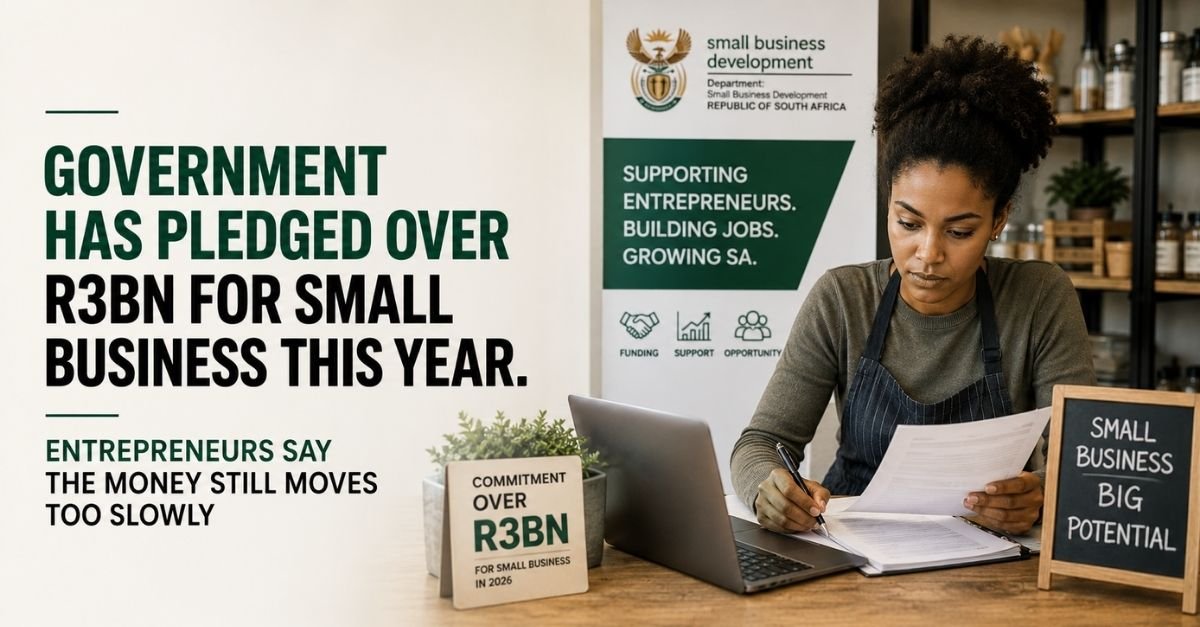
On paper, small business owners in South Africa have never had this many government funds to apply to at once. The Department of Small Business Development’s 2026/27 budget runs to more than R3 billion, split across seven distinct programmes, and the flagship Township and Rural Entrepreneurship Programme just had its per-applicant funding limit tripled, from R1 million to R3 million. In practice, according to the same reporting that surfaced the budget breakdown, many of the entrepreneurs the money is meant to reach say the operating environment has not gotten meaningfully easier.
Where the R3 billion is actually going
The allocations, reported by Vutivi Business, break down into seven separate pools: R710 million for the Township and Rural Entrepreneurship Programme itself, R314.3 million for business infrastructure support, R300 million each for a new women’s enterprise fund, a youth entrepreneurship fund and an innovation fund aimed at commercialising scalable business ideas, R215 million for an Asset Assist Programme, and R53.5 million specifically ring-fenced for informal micro-enterprises, the spaza shops, backyard mechanics and home-based traders who rarely appear in a company register at all.
Small Business Development Minister Stella Ndabeni-Abrahams framed the spending in structural terms rather than as short-term relief: “Small enterprises are the largest employer in this economy. They are the entry point into economic participation” for South Africans. That framing matters, because it positions the budget as an attempt to fix a labour-market problem, the near-total absence of entry-level jobs for people without formal qualifications or connections, through the small-business channel rather than through direct employment schemes.
The gap between an allocation and a disbursed rand
The department’s own track record gives a sense of scale: more than R829 million was disbursed to over 111,000 MSMEs (micro, small and medium enterprises) through the Township and Rural Entrepreneurship Programme in the previous financial year, an average of roughly R7,500 per recipient, well below the R1 million ceiling that applied at the time, let alone the new R3 million limit. That gap between the maximum an applicant is theoretically eligible for and what the average recipient actually received is itself a useful, if unglamorous, piece of context: a headline “R3 million” figure describes the ceiling of a range, not a typical outcome.
It is against that backdrop that entrepreneurs quoted in the same reporting continue to demand “faster funding approvals, reduced bureaucracy and more reliable infrastructure support” — a specific, recurring complaint rather than a general grumble about hard times. Government funding programmes of this kind typically require an applicant to compile a business plan, financial projections, tax clearance, and supporting documentation before a case officer even begins assessing eligibility, a process that can run for months for an applicant with an accountant on retainer and considerably longer for a first-time applicant filling in the forms alone. For a small business managing its own cash flow week to week, a funding decision that takes four to six months to arrive is often functionally equivalent to no funding at all: the working-capital problem it was meant to solve has usually either resolved itself or forced a closure by the time the money lands.
Why this matters beyond the specific funds
South Africa’s small business sector carries an outsized share of the country’s employment expectations relative to its access to capital, a mismatch that shows up every time a new fund is announced with fanfare and a modest disbursement total follows a year later. None of the seven programmes described here have published a formal average processing time or approval rate, so it is not possible from public reporting to say precisely how much slower this year’s expanded funds are moving relative to their predecessors, only that the same structural complaint, speed and paperwork rather than the size of the pot, keeps recurring across successive budget cycles.
For an entrepreneur deciding whether it is worth applying to any of these seven funds, the practical takeaway is to treat the headline ceiling, R3 million, R300 million, R710 million, as the size of the door rather than a guarantee of what walks through it, and to weigh the real cost of the months-long application process against how urgently the capital is actually needed. Where a business can survive on its own working capital for the length of a government approval cycle, waiting can still pay off. Where it cannot, the same reporting suggests these programmes remain a slower lifeline than their budget totals imply.