Sales of Chinese and Indian vehicle brands at Motus, South Africa’s largest motor dealership group, grew more than 200% in the year to June 2026, according to Business Day. Chinese brands alone now account for more than a fifth of new passenger and light commercial vehicle sales in the country. Motus itself sells roughly one in every five new cars sold in South Africa, giving its numbers unusual weight as a read on the whole market rather than one dealer’s own performance.
The scale of the shift shows up across Motus’s full results: group new vehicle sales rose 12% to 96,099 units in South Africa for the year, against 11% growth to 128,160 units globally, with the Chinese and Indian segment growing many times faster than the market around it. The same pattern is visible in Motus’s other markets: Chinese-brand sales rose more than 300% in the UK and 44% in Australia over the same period.
Why Motus thinks most of the 22 brands won’t make it
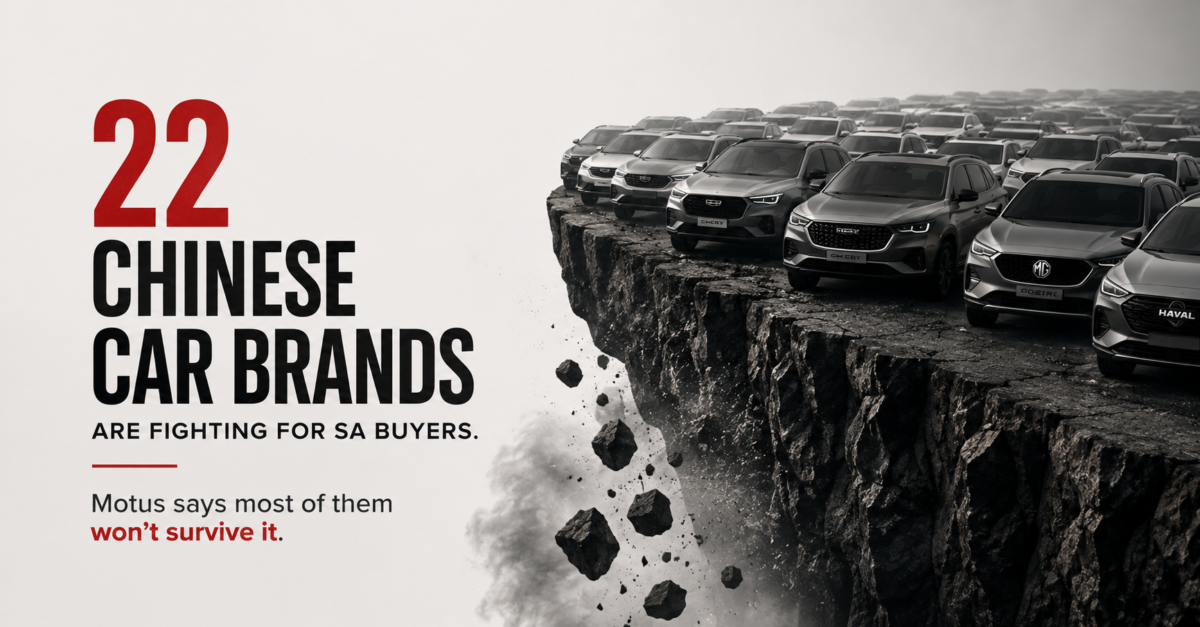
What makes this more than a routine sales update is what Motus itself expects to happen next. Roughly 22 Chinese car brands are currently competing for South African buyers, and chief financial officer Brenda Baijnath told Business Day the group expects consolidation, with some brands “falling away while the more established manufacturers expand their presence.” That is a genuinely unusual thing for a dealer group to say about the very segment driving its own growth: Motus is not warning that Chinese brands as a category will fail, it is betting that the market cannot sustainably support 22 separate entrants and picking which ones it believes will survive the shakeout.
Motus’s own brand selection reflects that bet already. Rather than spreading across the full field of Chinese entrants, the group has concentrated on Chery (and brands within the Chery group), GWM and Haval, and MG and Baic. Baijnath was explicit about the selection criteria: “We went rather for the established brands, where there’s customer acceptance,” and added that “price that is driving a lot of the decisions but, most importantly, it’s also around quality.” That is a distributor deliberately avoiding the newest, least-proven entrants in a crowded field, on the view that brand survival, not just short-term sales momentum, is what determines whether a dealership relationship pays off over years rather than one strong season.
Why 22 brands competing for one market segment is not sustainable on its own terms
It is worth explaining why a number like “22 brands” is itself the tell here, independent of any single brand’s own performance. A national vehicle market the size of South Africa’s, roughly 96,000 new units a year through Motus’s own network, can only profitably support so many separate distribution networks, each needing its own dealer footprint, parts supply chain, service infrastructure and marketing spend to reach genuine scale. Every additional brand fighting for a slice of the same demand thins the volume available to all of them, and a brand that cannot reach the sales volume needed to justify a full dealer and parts network in South Africa specifically, regardless of how it is doing globally, is a brand at risk of quietly withdrawing or being absorbed, exactly the outcome Motus’s own executives are now forecasting in public.
The established incumbents are not standing still either. Hyundai, Kia, Toyota and Renault are responding to the Chinese and Indian push by refreshing their own model ranges and reviewing pricing, according to the same reporting, rather than ceding the value segment of the market without contest.
What this means beyond the showroom floor
For South African businesses adjacent to the motor trade, from independent service centres to parts importers to fleet management companies, the practical question this raises is which of the current crop of Chinese brands is actually likely to still have a dealer network and parts supply chain in three to five years. A service provider or parts supplier that builds a relationship around a brand that does not survive the coming consolidation faces exactly the kind of stranded-investment risk Motus’s own comments are implicitly flagging. Motus’s own brand selection, concentrated rather than scattered across the full 22, is itself a useful signal for anyone in the wider trade trying to make the same bet with far less market intelligence than South Africa’s largest dealer group has at its disposal.