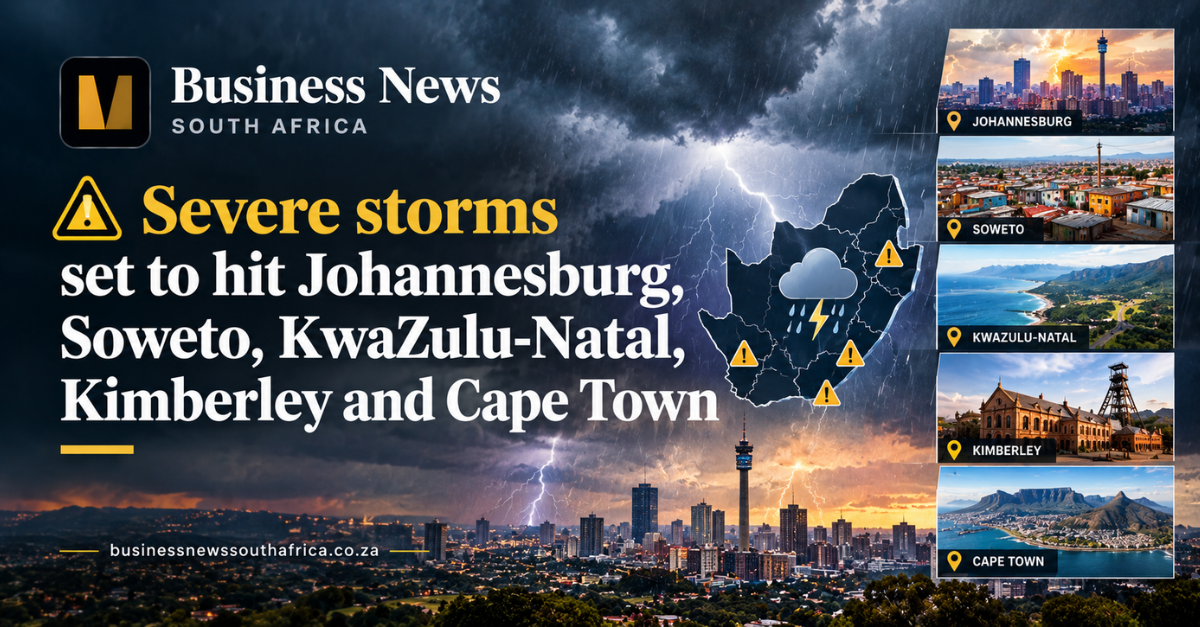
According to a NOWiNSA alert, severe storms are expected to sweep across Johannesburg, Soweto, KwaZulu-Natal, Kimberley and Cape Town in the coming days. The warning comes with a reminder that heavy rain, gusty winds and possible flash flooding are typical accompaniments of such systems.
For owners of small and medium enterprises, the headline is more than a weather note, it signals a set of practical challenges. Power outages can cripple point-of-sale terminals, halt production lines and force staff to work from home or not at all. Road closures and flooded arteries often delay deliveries of raw material and finished goods, squeezing cash flow at a time when many businesses already operate on thin margins.
While the alert does not specify exact dates or intensity, the pattern of past storms offers a useful guide. The 2022 floods in KwaZulu-Natal, for example, caused widespread damage to warehouses and forced many retailers to suspend trading for several days. In Gauteng, strong winds have historically toppled temporary structures and damaged signage, leading to unplanned repair costs.
SME owners can mitigate some of the risk by reviewing contingency plans. A backup power source, whether a generator or a battery-based inverter, can keep essential equipment running during load-shedding or grid failures. Insurance policies that cover flood damage should be checked for any exclusions, and stock levels may need to be adjusted to avoid stock-outs if transport routes become impassable.
Local authorities usually issue road-closure notices and flood-risk maps ahead of the worst conditions. Keeping an eye on municipal updates and the South African Weather Service’s real-time forecasts can give businesses a few extra hours to secure premises, move inventory to higher ground or inform customers of potential delivery delays.
It is also worth noting that the storm season in South Africa runs from November to March, with the peak typically in January and February. This timing often coincides with the financial year-end for many companies, a period already fraught with budgeting pressures. An unexpected disruption could therefore have a knock-on effect on quarterly reporting and cash-flow projections.
At present, the exact path and severity of the storms remain unconfirmed. The NOWiNSA notice does not provide a timeline, and no official statement from the South African Weather Service has been linked to the alert. Business owners should therefore treat the warning as a prompt to prepare, rather than a definitive forecast of damage.
In the meantime, trade bodies such as the Small Business Institute have urged members to share resources and support each other, especially in regions where infrastructure is most vulnerable. Collaborative approaches, from joint procurement of generators to shared logistics networks, can soften the blow of any weather-related disruption.
Why weather risk is increasingly a business-continuity issue, not just an operations one
Insurers and risk consultants have increasingly treated severe-weather disruption as a business-continuity category in its own right, distinct from routine property risk, precisely because the costs compound: a flooded delivery route does not just delay one shipment, it can cascade into missed customer commitments, spoiled perishable stock and contractual penalties that outlast the storm itself by days or weeks. That compounding effect is why larger South African retailers and logistics firms increasingly model weather risk alongside load-shedding risk in their own continuity planning, treating both as recurring operational hazards to be planned around rather than rare events to be reacted to after the fact.
The five regions named in this alert also span very different infrastructure realities, which matters for how seriously a given business should weigh the warning. A storm disrupting Johannesburg’s inland road network affects freight and logistics differently to one hitting Cape Town’s coastal or KwaZulu-Natal’s flood-prone low-lying areas, where drainage capacity and historical flood damage are already well-documented risk factors. A business with operations or suppliers across more than one of these regions is effectively exposed to several distinct weather risks at once, not one uniform national event.