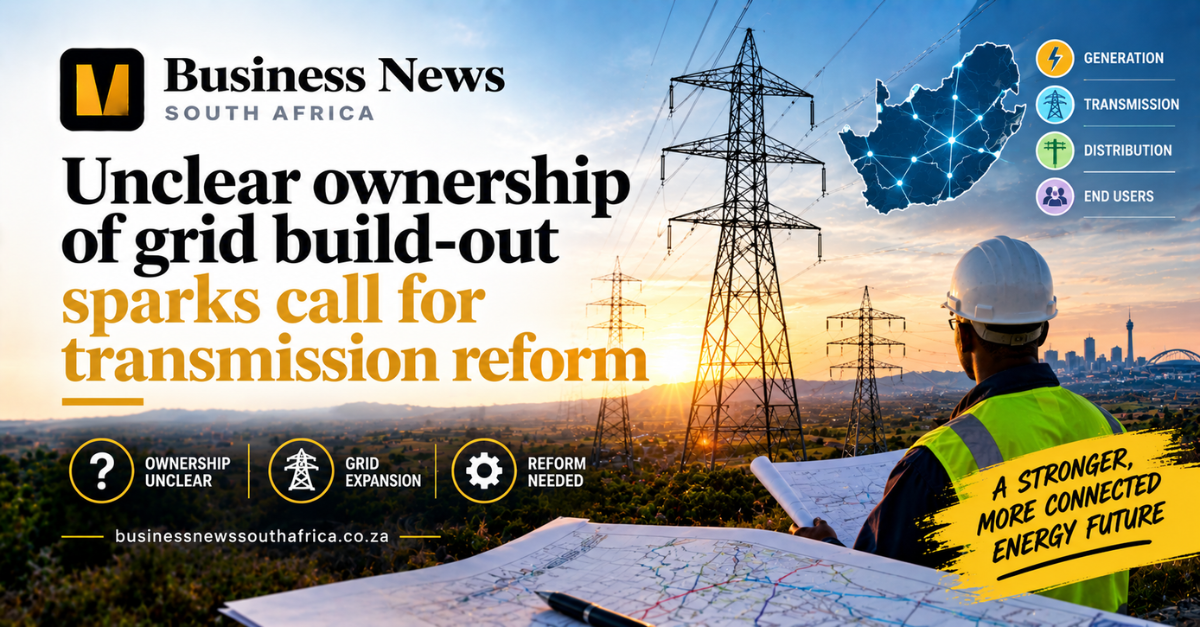
Green Building Africa reported that the lack of clarity on who will own South Africa’s grid build-out is prompting renewed calls for transmission reform. The uncertainty matters most to businesses that depend on reliable power, from small manufacturers to retail outlets, because without a clear ownership and funding model new transmission projects risk delay or cancellation.
Why ownership matters for businesses
Transmission refers to the high-voltage network that moves electricity from power stations to the distribution companies that deliver it to end-users. A grid build-out is the expansion of that network to connect new generation capacity, such as wind farms or solar parks, to the national system.
The country has been battling load-shedding for several years, and new generation capacity is being added faster than the existing transmission lines can handle. In response, the government unbundled parts of Eskom and created a separate transmission entity, but the report notes that the precise ownership of the new build-out remains undefined.
Industry observers quoted in the article say that a clear policy on who will fund, own and operate the new transmission assets is essential for attracting the financing needed to complete the projects. The government has not yet confirmed the final ownership structure, leaving the claim unverified.
Until the ownership question is resolved, investors may hesitate, and the delay could prolong power shortages that hurt small and medium-size enterprises across the economy.
How transmission systems are typically organised
In most jurisdictions the transmission function is treated as a natural monopoly because the cost of duplicating high-voltage lines is prohibitive and the physical network must be coordinated to maintain system stability. Because of this, the sector is usually subject to a regulatory framework that separates the technical operation of the network from the commercial decisions about ownership and investment. The regulator sets performance standards, approves tariffs and monitors compliance to ensure that the network remains reliable and that users are charged fairly.
Ownership models vary around the world. Some countries keep the entire transmission network in public hands, allowing the state to raise capital through sovereign borrowing or budget allocations. Other jurisdictions have moved to a mixed model where a state-owned transmission company operates the grid but private investors hold equity stakes, often through a public-private partnership. A third model involves fully privatised transmission assets that are owned by investors who must meet strict reliability standards imposed by the regulator.
Each model has implications for how projects are financed. A publicly owned entity typically accesses low-cost government funding, which can lower the overall cost of new lines but may be subject to political budgeting cycles. Private ownership relies on commercial financing, which requires a clear revenue stream, usually in the form of regulated tariffs that are approved by the regulator. Hybrid arrangements blend these sources, using a combination of equity, debt and government guarantees to spread risk.
Financing the grid build-out
When a new transmission corridor is planned, the project sponsor must develop a detailed business case that outlines the expected capital expenditure, operating costs, and the revenue that will be earned from transmitting electricity. The revenue is usually derived from a tariff that is set by the regulator based on the cost of building and operating the asset, plus an allowed return on investment. Because the tariff is regulated, investors need confidence that the regulator will honour the approved rates for the life of the asset, which can be several decades.
In the absence of a defined ownership structure, the business case becomes uncertain. Potential lenders and equity investors look for clarity on who will own the asset, who will be responsible for debt service, and how the tariff will be collected and distributed. If the government has not announced whether the transmission entity will be fully state-owned, partially privatised or operated under a partnership, lenders may demand higher risk premiums or refuse to commit capital altogether.
Higher financing costs translate into higher tariffs for the distribution companies that purchase the transmission services. Those distribution companies, in turn, pass the cost on to end-users, including businesses that rely on electricity to run production lines, refrigeration, lighting and information technology. For a small manufacturer, an unexpected increase in electricity cost can erode profit margins and limit the ability to invest in growth. For a retail outlet, frequent outages or voltage fluctuations can damage equipment, reduce customer footfall and increase operating expenses.
Regulatory certainty and investment confidence
Regulators play a central role in providing the certainty that investors need. By publishing clear rules on how transmission assets will be valued, how tariffs will be set and how disputes will be resolved, the regulator reduces the perceived risk of a project. In many markets, the regulator also publishes a long-term plan that outlines the expected expansion of the transmission network, the timelines for new projects and the criteria for selecting projects for funding.
When the ownership question is left open, the regulator cannot finalize a tariff methodology because the cost base of the asset is unknown. This creates a feedback loop: investors wait for a tariff, the regulator waits for an ownership decision, and the government delays the decision while weighing political and economic considerations. The result is a stalled pipeline of projects, which in the South African context means that new generation capacity cannot be fully utilised because the physical link to the grid is missing.
Impact on everyday business operations
For a business owner, the reliability of the electricity supply is a core operating requirement. Unplanned outages force managers to keep backup generators running, which incurs fuel costs, maintenance expenses and environmental compliance burdens. Generators also produce noise and emissions that can affect workplace conditions and community relations.
When transmission constraints cause load-shedding, businesses may be forced to shut down production for hours or days. This interrupts supply chains, leads to missed delivery deadlines, and can damage relationships with customers. In sectors such as food processing, pharmaceuticals and electronics, even short interruptions can spoil inventory, compromise product quality and trigger regulatory penalties.
Beyond the direct cost of outages, uncertainty about future electricity pricing makes strategic planning difficult. Companies that are considering expansion, capital investment or relocation need to model future operating costs. If the tariff for transmission services is likely to rise because of delayed projects and higher financing costs, the projected return on investment for new facilities may fall below acceptable thresholds, causing businesses to postpone or cancel expansion plans.
Broader economic implications
The transmission bottleneck does not affect only individual firms; it has a cumulative effect on the national economy. When new renewable projects such as wind farms and solar parks cannot connect to the grid, the country misses out on cleaner energy, lower fuel import bills and the job creation associated with renewable construction and operation. The inability to move electricity efficiently also hampers regional development, as areas with abundant renewable resources remain under-utilised.
Moreover, the perception of an unstable power sector can influence foreign direct investment decisions. Multinational corporations often assess the reliability of infrastructure as part of their risk analysis. If investors view the transmission ownership issue as a sign of policy volatility, they may allocate capital to other markets where the regulatory environment is more predictable.
Potential pathways to resolve the ownership question
One approach that governments have taken in other jurisdictions is to establish a dedicated transmission holding company that is owned jointly by the state and private investors. This model allows the state to retain strategic control while leveraging private sector expertise and capital. The holding company can then contract with the regulator to set tariffs that reflect the blended cost of capital.
Another pathway is to fully corporatise the transmission function, turning it into an independent commercial entity that operates under a licence from the regulator. In this scenario, the entity raises debt and equity in the capital markets, subject to the regulator’s oversight of tariff levels. The advantage of this model is that it creates a clear commercial incentive to operate efficiently, but it also requires a robust legal and regulatory framework to protect consumers from excessive price increases.
A third option is for the government to retain ownership but to issue long-term bonds that are specifically earmarked for transmission projects. By separating the financing stream from the general budget, the government can provide investors with a transparent source of repayment, which may lower borrowing costs. This approach also allows the state to maintain direct control over strategic assets while still attracting external capital.
Regardless of the model chosen, the key elements that must be communicated to the market are the timeline for decision-making, the criteria for selecting the ownership structure, and the mechanisms that will ensure that tariffs remain affordable while providing a reasonable return to investors. Clear communication reduces speculation, aligns stakeholder expectations and accelerates the mobilisation of capital.
What business owners can do now
While the policy debate continues, businesses can take proactive steps to mitigate risk. Conducting an energy audit can identify opportunities to reduce consumption, improve efficiency and lower exposure to tariff changes. Investing in on-site renewable generation, such as rooftop solar, can provide a degree of self-sufficiency and protect against supply interruptions.
Companies can also engage with industry associations that lobby for transparent transmission policy. Collective advocacy can amplify the voice of the business community and encourage faster resolution of ownership issues. Maintaining open lines of communication with electricity suppliers can help businesses stay informed about upcoming changes to tariffs or supply conditions.
Finally, incorporating flexibility into financial planning, such as building contingency reserves for potential electricity price hikes, can improve resilience. By modelling different scenarios, from stable tariffs to higher cost environments, businesses can develop strategies that preserve cash flow and protect profitability.
Conclusion
The question of who will own South Africa’s grid build-out is more than a technical detail; it is a decisive factor that influences the speed at which new transmission lines are constructed, the cost of electricity, and the reliability of power for every enterprise that depends on it. Without a clear ownership and funding framework, investors remain cautious, financing becomes more expensive, and the inevitable delays threaten to extend the period of load-shedding that already challenges the nation’s economic growth.
For business owners, the stakes are clear. Reliable power underpins production, service delivery and competitive pricing. Uncertainty in the transmission sector translates into higher operating costs, operational disruptions and reduced confidence in long-term planning. By understanding the typical structures of transmission ownership, the financing mechanisms involved, and the regulatory safeguards that can provide certainty, businesses can better assess the risks and take steps to protect themselves while the policy debate moves forward.
Resolving the ownership issue will require decisive action from the government, a transparent regulatory process and constructive engagement with the private sector. When those elements align, the transmission network can expand to meet the growing supply of renewable generation, reduce the frequency of load-shedding, and create a more stable environment for South African businesses to thrive.