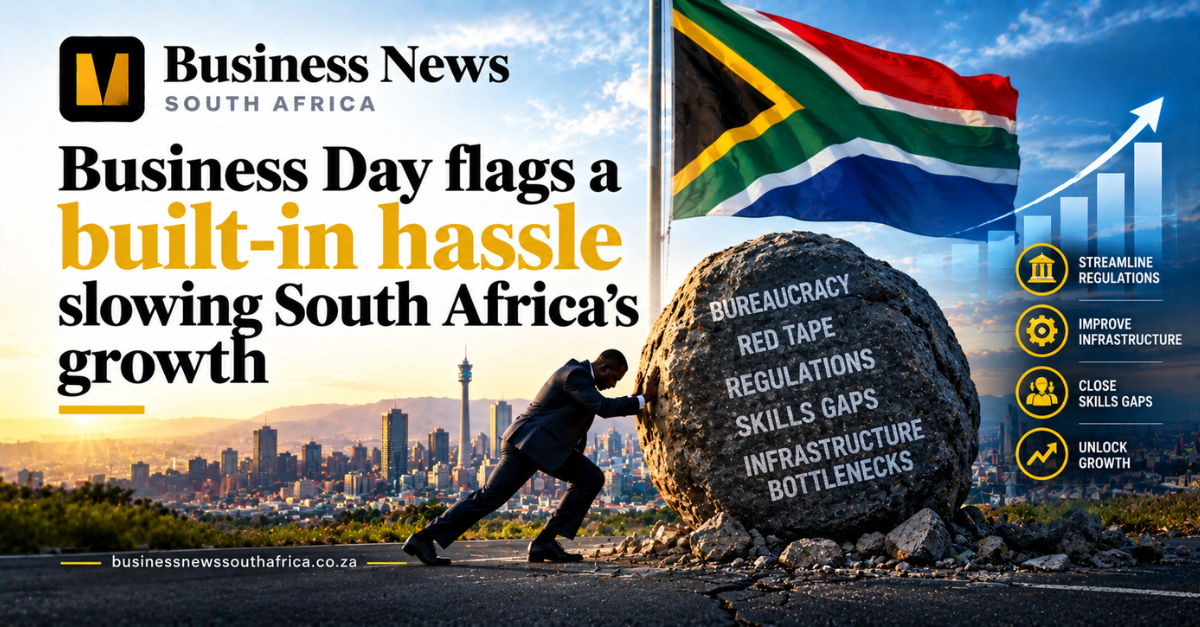
The Business Day column by Luncedo Mtwentwe, titled “The built-in hassle that’s holding South Africa back”, points to a persistent obstacle that the author believes is dragging down the country’s economic performance.
While the piece does not name the specific problem, the phrase “built-in hassle” is commonly used to describe structural issues such as lengthy regulatory procedures, frequent power cuts, or a shortage of skilled labour. Each of these factors adds a layer of cost and uncertainty for businesses that must navigate them on a daily basis.
For small and medium-size enterprises, the impact can be immediate. A delay in obtaining a licence, an unexpected outage, or a gap in technical expertise can turn a profitable project into a loss-making one. The column suggests that these frictions are not occasional glitches but built-in features of the operating environment.
South Africa’s growth figures have been modest in recent years, with the International Monetary Fund noting a slowdown to around 1.5 % annual GDP growth. Analysts have linked this trend to the same types of systemic barriers that the column highlights. Recent policy announcements, such as the rollout of the National Development Plan, aim to cut red tape and improve infrastructure, but progress has been uneven.
In short, the column serves as a reminder that without addressing the underlying hassle, the country may continue to see limited investment and slower job creation, outcomes that directly affect the bottom line of every entrepreneur and SME owner.
What commentary like this usually points to
Business commentary using language like a “built-in hassle” or structural drag on growth in the South African context most often refers to a recurring shortlist of frictions: the time and cost of regulatory compliance and licensing, the reliability of electricity and municipal services, persistent skills shortages in technical occupations, and the administrative burden of South Africa’s labour law framework for employers. None of these is unique to any one sector, which is precisely why they show up repeatedly in World Bank and local business-confidence surveys as the barriers South African firms cite most often when asked what limits their growth, rather than any single named policy failure.
What makes this kind of structural friction different from a one-off shock like a commodity price swing or a currency move is persistence: a business can hedge or wait out a currency shock, but a recurring multi-week permitting delay or an unreliable power supply has to be built into the cost base and operating plan of every affected business indefinitely, which is why economists tend to treat these frictions as a tax on growth rather than a cyclical headwind that will simply pass.
Surveys of South African business owners conducted by organisations such as the Bureau for Economic Research have repeatedly found that regulatory and infrastructure-related constraints rank above tax rates or interest rates as the factor most likely to be cited when firms are asked what is limiting their own investment plans. That pattern, a structural constraint outranking a cyclical one, is consistent with the kind of built-in, everyday friction a column like this is most likely describing, even without the piece naming a specific culprit.
The practical difficulty for any SME owner reading a column like this is that structural friction rarely shows up as a single line item on a set of accounts. It surfaces instead as a slightly longer time-to-market than a competitor in a country with faster permitting, a slightly higher effective labour cost once compliance overhead is included, or a slightly larger buffer a business has to hold against the next unplanned outage. Individually small, cumulatively these frictions are a large part of why South African productivity growth has lagged that of comparable emerging markets over the past decade, even in years when headline GDP growth has looked broadly stable.