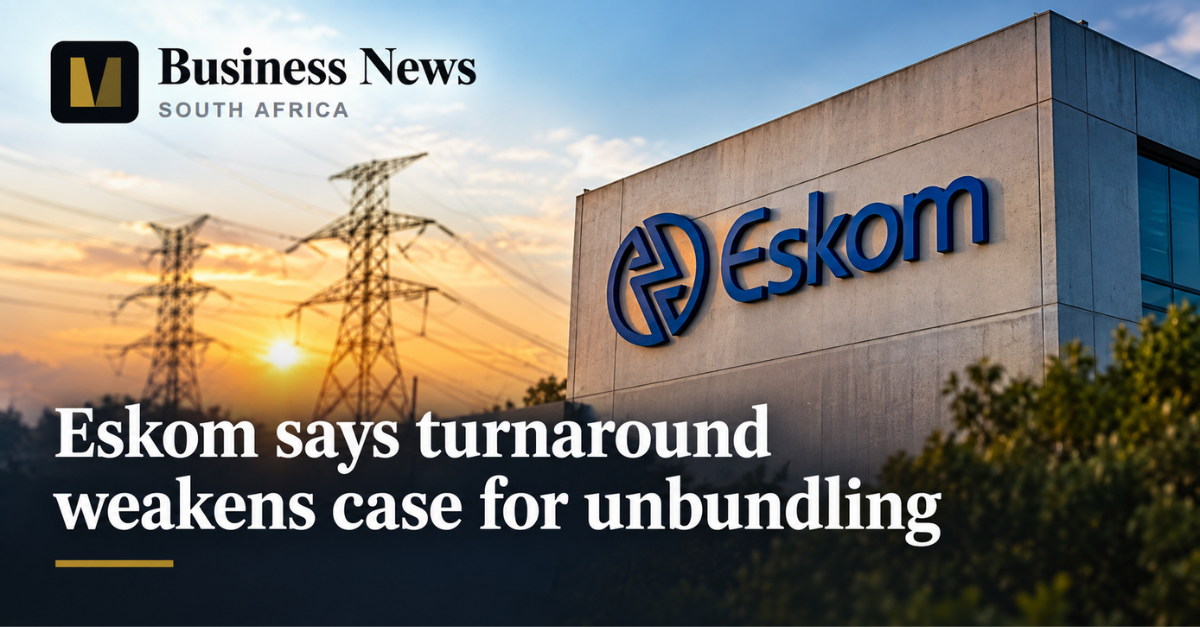
In a statement to the press, Eskom, South Africa‘s state-owned power generator, said its recent financial recovery and lower load-shedding levels undermine the argument for breaking the utility into separate generation, transmission and distribution businesses.
Eskom described its turnaround as a return to profitability after years of losses, a reduction in its debt burden and an improvement in the reliability of electricity supply. The company did not provide exact figures, but the claim marks a shift from the bleak outlook that dominated its annual reports for most of the past decade.
Unbundling, in this context, means separating Eskom’s three core functions into distinct companies that would each have their own balance sheets and governance structures. Proponents argue that this could create competition, attract private investment and make each unit more accountable. Critics warn that splitting a heavily indebted utility could spread risk, increase costs for consumers and complicate coordination of the national grid.
Why the debate matters to small businesses
For the owner of a small manufacturing plant or a retail outlet, the reliability of electricity is a daily concern. Load-shedding, scheduled power cuts that have become a routine in many parts of the country, forces businesses to buy expensive diesel generators or invest in battery storage. If Eskom can keep the lights on more consistently, the immediate pressure on these costs eases.
On the other hand, a split could open the door for private players to enter the generation market, potentially offering cheaper power contracts. Yet the transition could also bring new tariffs while the new entities sort out debt repayments. The net effect on a small business’s electricity bill is therefore uncertain.
The timing of Eskom’s statement is notable. The utility has been working with the National Treasury and the Department of Public Enterprises on a debt-restructuring plan that aims to reduce its borrowing costs. At the same time, the government’s broader energy policy is under review, with discussions about expanding renewable capacity and improving grid infrastructure.
Analysts point out that Eskom’s improved performance does not automatically solve the structural challenges that have plagued the utility for years, ageing power stations, a skills shortage and a legacy of under-investment. The company’s claim that these issues are now under control is, at this stage, a self-assessment that will need independent verification.
For entrepreneurs and SME owners, the key takeaway is to watch how Eskom’s financial health evolves over the next few quarters. If the utility continues to post profit and keep load-shedding at bay, the pressure to unbundle may lessen, preserving the status quo of a single, albeit struggling, supplier. If the turnaround stalls, the government may revive the split as a way to inject fresh capital and competition into the power sector.
In the meantime, businesses can mitigate risk by diversifying their energy sources where possible, for example, by installing solar panels or negotiating fixed-price contracts with independent power producers. Such steps reduce dependence on Eskom’s performance, whether the utility stays whole or is broken up.
What would actually settle this debate
Eskom’s own claim that its turnaround weakens the case for unbundling is, notably, an argument the utility has an obvious institutional interest in making, since a single, unified Eskom is the entity making the statement about its own future structure. The counterargument from unbundling proponents does not really depend on Eskom’s current financial health at all: it rests on the separate claim that competition and independent governance in generation specifically would produce better long-run outcomes than a single vertically integrated monopoly, regardless of how well that monopoly happens to be performing in any given year. That is why a temporary run of good results, however genuine, does not fully resolve the structural question either side is actually arguing about, and why the debate is likely to resurface again the next time Eskom’s performance dips, whatever the outcome of the current turnaround.