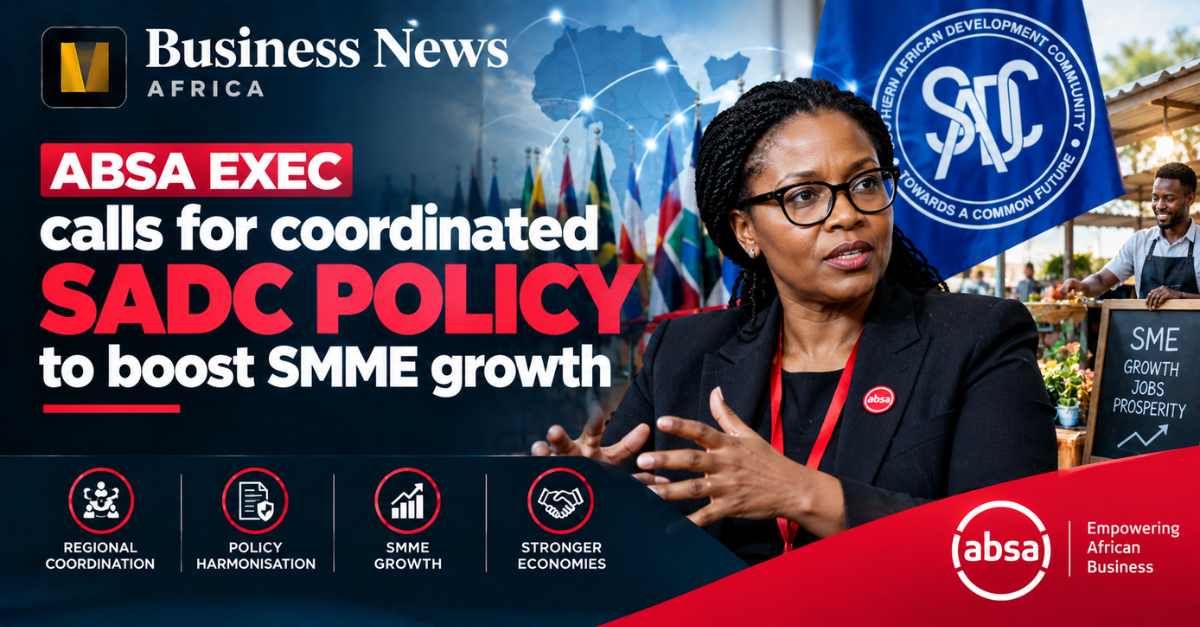
During a Moneyweb podcast recorded after the 46th SADC Summit, Dudu Ramela asked Faizal Mkhize, managing executive for business development at Absa Business, why the summit fell short on small, micro and medium enterprises (SMMEs). Mkhize replied that the summit should have put SMMEs at the heart of its agenda, because the sector is already recognised as a major source of jobs and growth in the region.
According to Mkhize, the current policy guidelines for SADC SMME development exist, but they are not being implemented in a coordinated way. He described the situation as “an infancy stage” of coordination, meaning that individual countries are still working in isolation, which hampers progress on shared challenges such as high youth unemployment and informal sector growth.
The Absa executive highlighted two practical ideas. First, a clearer understanding of regional value chains, the series of activities that turn raw inputs into finished products, would allow each country to focus on its core competencies. For example, what works well in Botswana might not suit Mozambique, but both could benefit from a common framework that maps where each economy adds the most value. Second, he called for “structured plans” that align government support, financing, and skills development across borders, rather than letting each nation tackle its own obstacles alone.
Why the coordination matters to you as an SME owner
If you run a small manufacturing unit in Zambia or a retail outlet in South Africa, the lack of regional policy harmony can translate into higher costs, fragmented market access and difficulty securing cross-border finance. Mkhize argued that a coordinated approach could reduce those frictions by standardising regulations, simplifying export procedures and creating joint funding facilities that are easier for SMEs to tap.
He also pointed to East Africa as a reference point. In Kenya and Tanzania, he said, there is “clear evidence” of progress driven by technology adoption and targeted government programmes that have helped entrepreneurs launch and scale businesses more efficiently. While the SADC region is not yet at that level, the example shows that a focused, technology-enabled strategy can yield tangible results.
For SMEs, the practical takeaway is to stay alert for any upcoming regional initiatives that aim to harmonise standards or introduce shared financing mechanisms. Absa’s own programmes, which Mkhize mentioned in passing, already try to support SMMEs through mentorship and access to capital, but their impact will be magnified if the broader policy environment becomes more cohesive.
In the meantime, business owners can start preparing by mapping their own value chains and identifying which regional partners could complement their operations. By understanding where a neighbouring country has a comparative advantage, an SME can position itself to benefit from future trade agreements or joint ventures that a coordinated SADC policy might eventually facilitate.
The conversation also touched on the informal nature of many SMMEs in the region. Ramela noted that a large share of the sector operates outside formal registration, which makes it harder to collect reliable data and to design effective policy. Mkhize agreed, saying that better data collection and a willingness to include informal traders in structured programmes are essential steps toward a more inclusive growth story.
Why regional SMME coordination is harder than it sounds
The “infancy stage” Mkhize describes is a familiar pattern in regional economic blocs generally, not a uniquely SADC failing: aligning SMME policy across member states requires each government to accept common standards, reporting formats and, often, revenue-sharing arrangements that can look like a loss of national control over a politically sensitive area, small business support, even when the aggregate regional benefit is clear. The European Union took decades to build anything resembling harmonised small-business policy across its own member states, and it did so with far deeper fiscal and political integration than SADC currently has, which is a useful benchmark for how much patience a coordinated SADC SMME framework is likely to require before it produces measurable results.
The East African comparison Mkhize draws is also worth treating carefully rather than as a simple model to copy: Kenya and Tanzania’s progress has been driven substantially by mobile money infrastructure, M-Pesa chief among it, that reached maturity in those markets years before comparable systems existed in most SADC states, meaning any transplant of that success needs the same digital-payments foundation in place first, not just the policy coordination layered on top of it.