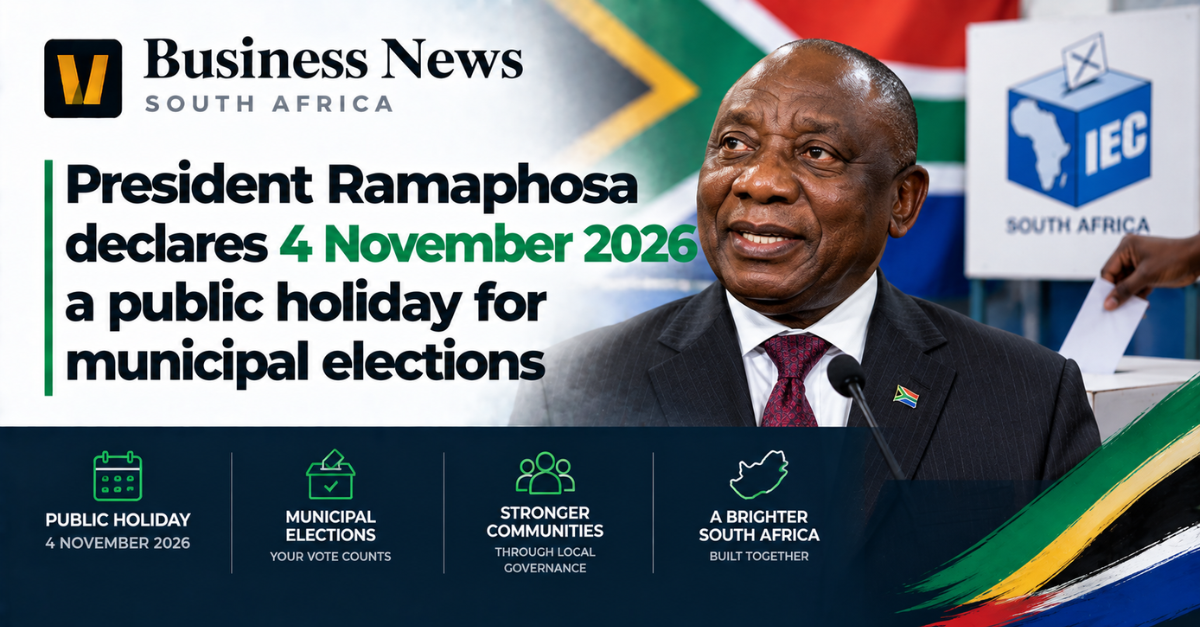
Shop owners in townships and malls alike will see their cash registers idle on 4 November 2026, the day South Africa will pause to vote in local government elections. The pause is not a surprise, President Cyril Ramaphosa formally announced the day as a public holiday after the Minister of Cooperative Governance and Traditional Affairs, Velenkosini Hlabisa, gazetted the election date in August.
The presidential declaration was made under Section 2A of the Public Holidays Act, which allows the President to declare a day a public holiday nationwide or locally by publishing a notice in the Government Gazette. The law has been used for every election date since the end of apartheid, so the move simply completes the legislative process.
Why the Public Holidays Act matters to businesses
The Public Holidays Act is a piece of legislation that balances the nation’s need for collective observance with the practical realities of commerce. It defines which days are automatically recognised as holidays, such as Freedom Day and Workers’ Day, and it also provides the mechanism for ad-hoc holidays, like election days, to be added. For an employer, the Act sets out the entitlement of employees to a day off with pay, unless the employee is required to work. In that case, the Act mandates that the employee receive either overtime pay at a premium rate or a compensatory day off. This framework gives business owners a clear legal baseline for budgeting labour costs around any newly declared holiday.
Because the Act is published in the Government Gazette, the announcement is legally binding and cannot be altered without a further notice. This certainty is valuable for retailers who must plan inventory, staffing and promotional activities weeks in advance. The fact that the election holiday was announced several months ahead gives merchants the opportunity to adjust their cash-flow forecasts, negotiate with suppliers and communicate any changes to their customers.
Implications for retailers and small businesses
For a small retailer, a public holiday can be a double-edged sword. On the one hand, employees are entitled to a day off with pay, which adds a labour cost if the business chooses to stay open and pay overtime. On the other hand, public holidays often bring higher foot traffic as consumers have a free day to shop, especially in urban centres where shopping malls become social hubs.
Owners will need to decide whether to close, operate with reduced staff or stay open with premium rates. The decision will hinge on the nature of the business, the typical Saturday-Sunday sales pattern and the cost of paying overtime under the Basic Conditions of Employment Act. Those that can afford to stay open may capture extra sales, but they must also manage inventory and security on a day when many other businesses are closed.
Supply chains may feel a ripple effect. Delivery firms and wholesalers often schedule shipments around public holidays to avoid delays. Small manufacturers that rely on daily deliveries could see a one-day slowdown, which may require advance planning to keep shelves stocked.
Another practical concern is the impact on staff morale. Employees who have been working long hours during the load-shedding season may welcome the guaranteed day off, which could improve retention and reduce absenteeism in the weeks that follow.
While the holiday is national, some municipalities may choose to keep essential services running, such as pharmacies and petrol stations. Small business owners in those sectors will need to coordinate with local authorities to understand any special operating permits that may be required.
Overall, the extra day off is likely to be a modest disruption rather than a major shock. Most SMEs already plan for the occasional public holiday, and the election date was deliberately set outside the festive season to limit broader economic impact.
Electoral logistics and the business environment
The Electoral Commission of South Africa (IEC) confirmed the holiday after concerns were raised that the election could clash with the matric examination period, as many schools serve as voting stations. Committee chairperson Mmusi Maimane said the IEC, after consulting the Department of Basic Education, expects only minimal disruption to matriculants because the day will be a public holiday.
Choosing 4 November also aims to boost voter turnout. Historically, elections held on weekdays see lower participation, while a public holiday removes the work-day barrier for many voters. Higher turnout can lead to more representative local councils, which in turn affect municipal service delivery, a factor that directly influences small businesses that rely on local infrastructure.
Local government councils are responsible for a range of services that matter to retailers, including road maintenance, waste collection, licensing and the regulation of market spaces. When councils are elected, the policies that follow can shape the cost of doing business, the speed of permit approvals and the reliability of utilities. For this reason, the election day is not only a civic event but also a strategic moment for business owners who monitor the political landscape.
Strategic steps for business owners ahead of the holiday
Business owners should use the lead-time before November to review staffing rosters, communicate any changes to customers, and adjust cash-flow forecasts for the lost sales day. Those who decide to stay open can market special promotions to attract shoppers looking for a reason to leave the voting booth early. Promotional tactics might include limited-time discounts, loyalty-card bonuses or bundled offers that encourage higher basket values.
In addition, retailers can coordinate with local delivery partners to schedule inbound stock either before the holiday or immediately after, thereby avoiding stock-outs. For businesses that depend on perishable goods, a clear plan for refrigeration and waste management on a non-operational day can prevent loss.
Human-resource planning is equally important. Managers should confirm which employees will be granted the statutory day off, which will work overtime and which may be offered a compensatory day later in the month. Clear communication reduces the risk of disputes and helps maintain a positive workplace atmosphere.
Finally, owners should keep an eye on any municipal notices regarding road closures, traffic management or security patrols that often accompany election day activities. Such notices can affect customer access to retail locations, especially in townships where public transport routes may be altered for the movement of ballot boxes and election officials.
Broader economic context
South Africa’s economy has been navigating a period of uncertainty marked by fluctuating exchange rates, intermittent load-shedding and global supply-chain pressures. In this environment, any scheduled interruption, even a single public holiday, is scrutinised by business owners for its potential impact on profitability. However, the predictable nature of a legislated holiday allows for more accurate budgeting than an unexpected disruption would.
Moreover, the public holiday aligns with a broader pattern of using civic events to stimulate economic activity. Past election holidays have shown that when retailers stay open, they can capture a measurable uplift in sales, especially in sectors such as food-service, entertainment and personal care. The uplift is driven by consumers who have discretionary time and are looking for convenient ways to spend it.
For small businesses that operate on thin margins, the decision to open or close will often be guided by a cost-benefit analysis that incorporates the overtime premium stipulated by the Basic Conditions of Employment Act, the expected increase in foot traffic, and the additional costs of security and utilities on a day when many neighboring establishments are closed.
In summary, the declaration of 4 November 2026 as a public holiday for local government elections is a legally grounded, procedurally transparent step that fits within South Africa’s established framework for managing civic events. While it introduces a brief pause in regular commercial activity, it also offers an opportunity for retailers to engage customers, boost short-term sales and reinforce employee goodwill. By planning ahead, aligning staffing and supply-chain arrangements, and leveraging targeted promotions, small business owners can turn the holiday from a potential disruption into a strategic advantage.