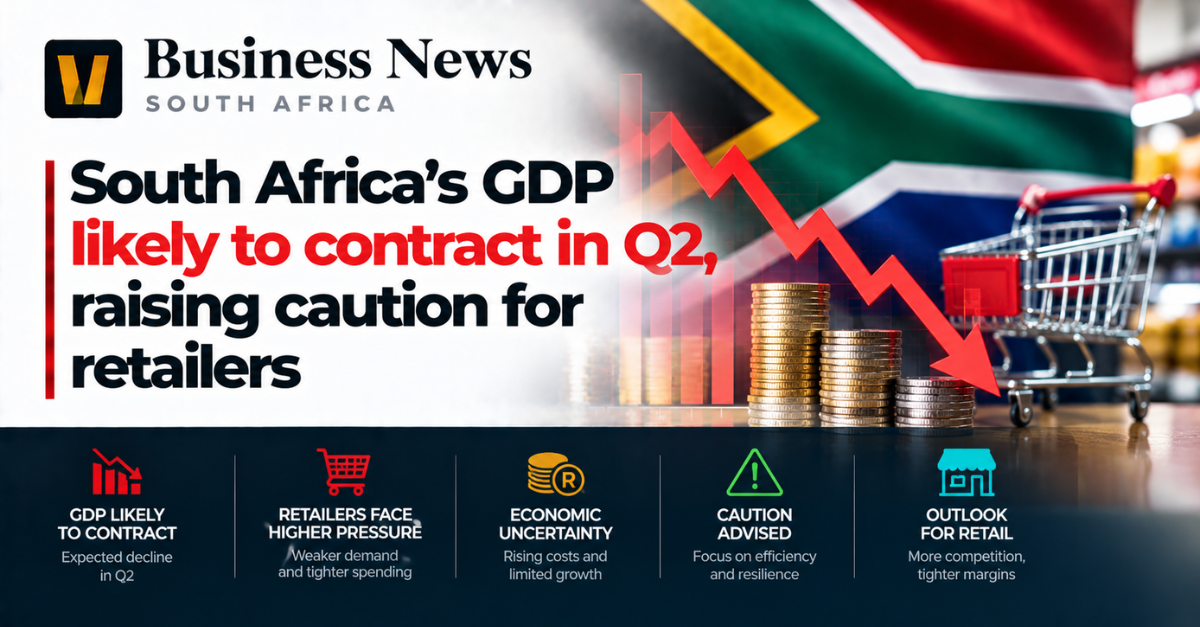
When the morning rush at a Cape Town boutique thinned to a trickle, the owner wondered whether the dip was a blip or the start of a longer slump. The answer may be in the nation’s latest growth forecast.
According to a Bloomberg survey of 14 economists, the median view is that South Africa’s gross domestic product (GDP, the total value of goods and services produced) shrank 0.1% in the second quarter, reversing the 0.5% expansion recorded three months earlier.
The shift follows the escalation of the war in Iran, which has pushed up Brent crude oil prices and the cost of agricultural inputs. The Strait of Hormuz, a narrow waterway that handles about one fifth of the world’s seaborne oil and liquefied natural gas, saw traffic restrictions, tightening supply and feeding higher costs into the economy.
Adding to the pressure, the South African Reserve Bank lifted its policy rate by 25 basis points (one quarter of a percentage point) in May. A basis point is one hundredth of a percent, so the move represents a modest but measurable tightening of borrowing costs.
“For the most part, we’ve had very weak high-frequency data throughout the quarter; sentiment has been quite subdued,” said Keabetswe Mojapelo, head of economic research at Old Mutual Ltd. Her comment reflects a pattern of softer retail sales, weaker industrial output and cautious consumer confidence.
Manufacturing output fell 1.5% and mining output fell 2.7% in the same period, according to the same survey. Those sectors together account for almost a fifth of South Africa’s GDP, so their contraction feeds directly into the overall slowdown.
Despite the headwinds, Mojapelo noted that consumer-facing sectors have shown resilience, but warned, “it’s really touch and go. We’re going to get the true impact of rising inflation and the little tightening we had in monetary policy.” Inflation has been above the central bank’s 3% target since March, eroding purchasing power for households.
The upcoming monetary policy committee (MPC) meeting on 23 September will weigh the trade-off between weak growth, a strong rand and persistent inflation. Morgan Stanley economist Andrea Masia said in a note that the MPC is likely to keep rates unchanged, noting that “fading inflation-shock momentum suggests oil prices are no longer propagating widely”.
Not all forecasters see a contraction. John Loos, an independent economist, expects the economy to keep growing, albeit more slowly, and believes the main drag will be a slowdown in real consumer spending. “I don’t think a contraction yet, but still positive,” Loos said, adding that higher inflation and a slightly higher interest rate will keep households cautious.
Retail and wholesale trade data illustrate the pressure on the shop floor. Retail sales rose a modest 0.4% in the quarter, while wholesale trade fell 4.2%. For small and medium-sized retailers, the numbers signal that foot traffic and bulk orders are not keeping pace with inventory costs.
What the slowdown means for small retailers
Owners of clothing stores, grocery outlets and hardware shops should expect tighter margins as input costs rise and consumers stretch their budgets. Managing stock levels, negotiating better terms with suppliers and focusing on value-oriented promotions could help offset the dip in demand.
Investment decisions are also likely to stay tentative. Mojapelo cautioned that gross-capital-formation, spending on new equipment and infrastructure, may remain suppressed because of lingering uncertainty and the cost of financing.
In practical terms, retailers can watch three indicators closely: the Reserve Bank’s interest-rate decision, oil-price trends that affect transport and input costs, and consumer-confidence surveys that signal willingness to spend. A shift in any of these could either deepen the slowdown or provide a foothold for recovery.