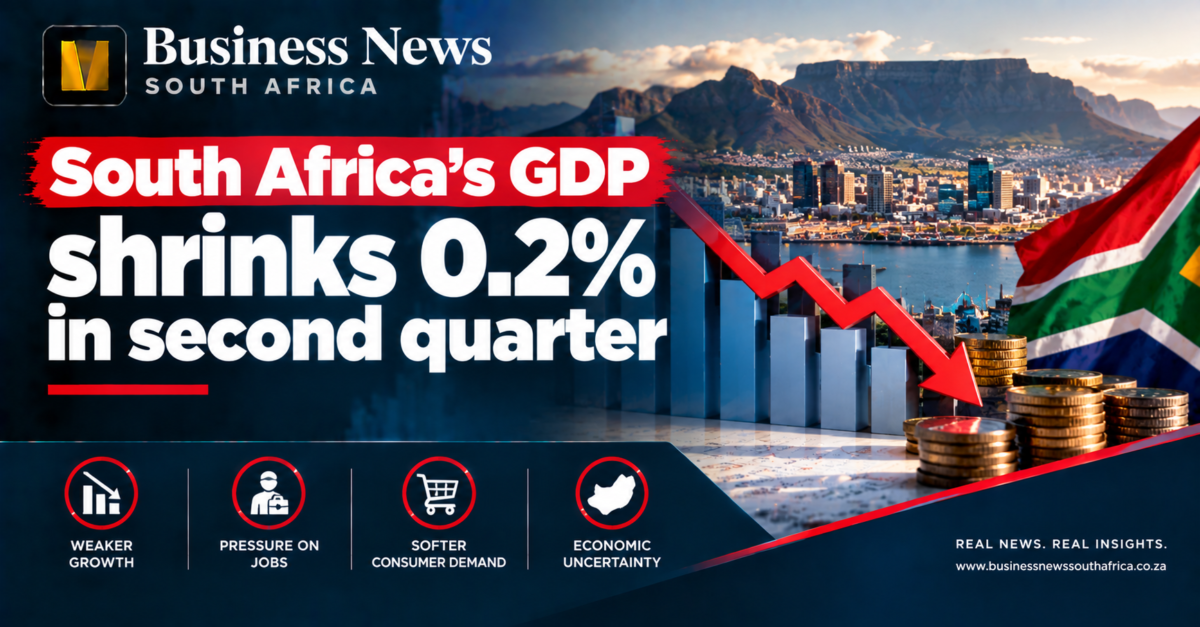
When the quarterly figures landed, the headline was stark: gross domestic product, the total value of all goods and services produced, fell by 0.2% in the second quarter. The announcement came from the South African Government News Agency, which relayed the official statistics.
A contraction of this size means the economy produced slightly less than it did three months earlier. In plain terms, businesses on average sold fewer products or delivered fewer services, and the overall economic pie got a little smaller.
For owners of small and medium enterprises, the signal is worth a closer look. A dip in GDP often translates into lower consumer confidence, which can reduce spending on non-essential items. Retailers may see fewer footfalls, manufacturers might face weaker orders, and service providers could experience tighter budgets from corporate clients. In a market already coping with high electricity tariffs and a credit environment that many describe as tight, even a modest slowdown can tighten cash flows.
Why the numbers matter
GDP is a broad barometer, but it does not tell the whole story. The contraction does not mean every sector is shrinking; some may still be growing while others fall faster. However, the aggregate figure influences policy decisions. A weaker output reading can prompt the Treasury to reconsider fiscal spending, while the Reserve Bank watches it as one of many inputs when setting interest rates.
Analysts note that a 0.2% decline is small in absolute terms but noteworthy because it follows a period of near-stagnation. When growth stalls, the risk of a longer-term slowdown rises, especially if external pressures such as commodity price volatility or global demand weakness persist.
For SMEs, the immediate concern is access to finance. Lenders often tighten criteria after a slowdown, fearing higher default risk. Companies that rely on short-term credit lines may find borrowing costs edging up, or approval processes lengthening. The practical effect is that businesses need to be more diligent about cash management, perhaps delaying expansion plans or renegotiating supplier terms.
On the supply side, manufacturers may see inventory build-ups if demand softens, leading to potential price cuts or reduced production runs. Retailers could respond by offering promotions to stimulate sales, which can erode margins. Service firms, especially those tied to discretionary spending such as tourism or hospitality, may need to adjust staffing levels or shift focus to more resilient client segments.
While the contraction is modest, the broader economic context cannot be ignored. South Africa continues to grapple with load-shedding, which raises operating costs for many businesses, and a labour market where unemployment remains high. These structural challenges mean that even a small dip in output can have outsized effects on profitability and employment at the micro level.
Looking ahead, the government has not yet detailed any specific policy response. Historically, the Treasury has used a mix of infrastructure spending and targeted support programmes to cushion downturns. The Reserve Bank, meanwhile, monitors inflation and growth trends before adjusting its policy rate. Small business owners should keep an eye on any announcements that could affect tax rates, subsidies, or credit facilities.
In the meantime, the prudent course for SMEs is to review budgets, strengthen relationships with lenders, and explore ways to diversify revenue streams. Those that can adapt quickly to shifting demand are better positioned to weather the current dip and emerge stronger when growth resumes.
What a quarterly growth figure does and does not tell you
Quarterly GDP is assembled from the production side, adding up the value added by each industry, then seasonally adjusted so that predictable annual patterns, harvests, holiday trading, the December shutdown, do not masquerade as real movement. The published change is measured against the previous quarter rather than the same quarter a year earlier, which makes it responsive and quick to turn, and also noisier than the annual comparison. Modest revisions in later releases are routine rather than a sign that anything was wrong the first time.
The phrase most likely to appear in commentary over the coming weeks is technical recession, which conventionally means two consecutive quarters of contraction. It is a definition of convenience rather than a threshold at which anything in particular happens. An economy can satisfy it while large parts of it grow, or miss it while a specific sector is in real trouble.
That is the practical point for anyone running a business rather than trading the market. The headline is an average across agriculture, mining, manufacturing, construction, trade, transport, finance, government and personal services, and those components rarely move together. A single aggregate can be dragged into negative territory by one heavy industry while the sector a given firm actually sells into holds up, or the reverse. The table of industry contributions underneath the headline is usually the more informative page.
Timing matters too. National accounts describe a quarter that has already closed, so by the time the figures are published the period being measured is several months in the past. Most businesses feel a slowdown in their own order books well before it is confirmed in a statistical release, which makes the release more useful for confirming and sizing a trend than for spotting one.