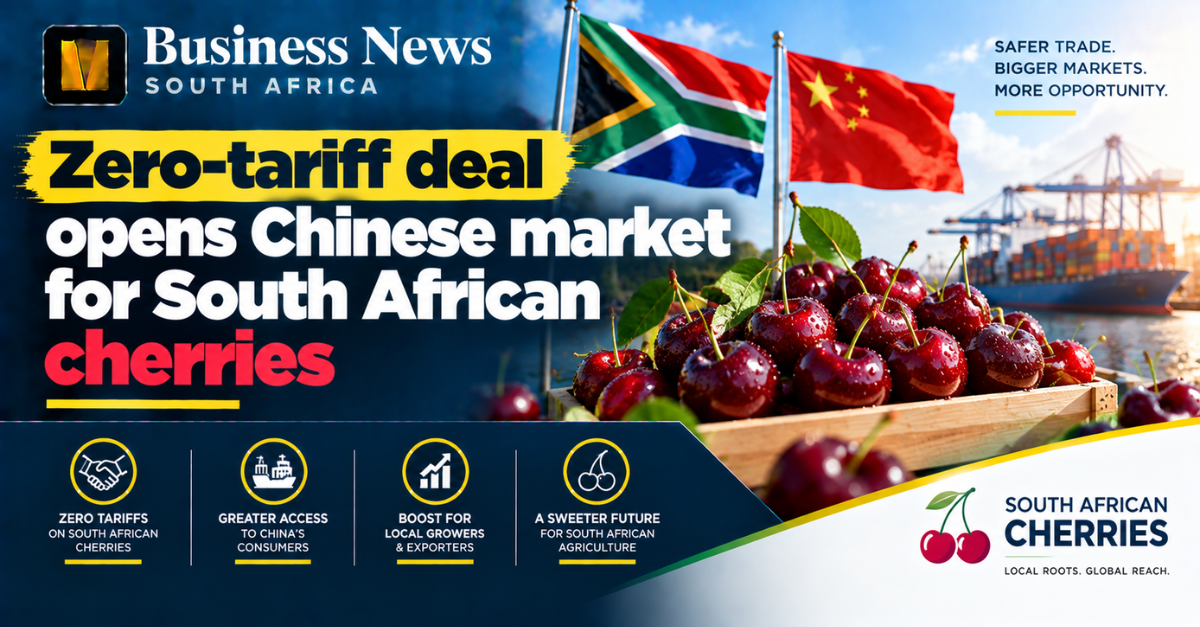
South African cherry growers may soon see their fruit on supermarket shelves in Beijing without the extra cost of import duties. Agriculture Minister Wille Aucamp signed a protocol in Beijing that gives the fruit a 0% tariff, that is, no tax levied by China when the cherries cross its border, for the first time.
The agreement was sealed at the ninth Sanitary and Phytosanitary (SPS) Ministerial Meeting, a forum where countries negotiate health and safety standards for agricultural trade. According to the minister, the protocol is the second market-access deal with China signed within a year, a pace he called “groundbreaking”.
What the deal means for growers
China is the world’s largest importer of cherries, buying about 586,900 tonnes in 2025, a market worth roughly US$3.3 billion, or around R52.8 billion at current exchange rates. By removing the tariff, South African exporters can price their fruit more competitively, potentially increasing sales volumes.
Minister Aucamp estimates the new access could create around 600 jobs in the cherry supply chain, from orchard workers to packhouse staff. The sector’s harvest this year is expected to be about 3,006 tonnes, a modest figure but one that could expand if demand from China materialises.
Wandile Sihlobo, chief economist at the Agricultural Business Chamber of South Africa (Agbiz), said the scientific checks for the protocol have been cleared and that exports will not cannibalise the domestic market. “We will have volume for domestic consumption and for exports,” he noted, adding that the export route should help the industry grow over the long term.
The protocol follows a string of recent agricultural trade wins. In the previous weeks, South Africa secured market access for red meat in Egypt, broke a decade-long stalemate with India over citrus, and saw the United States extend the African Growth and Opportunities Act (AGOA) to December 2028. Those deals, together with the cherry protocol, represent a rapid series of openings for the country’s farm sector.
During the Beijing meeting, Aucamp also met Zhang Zhu, China’s Minister of Agriculture and Rural Affairs. Both ministers reaffirmed a commitment to cooperate on biosecurity issues such as Foot and Mouth Disease and hinted that a similar zero-tariff protocol for South African blueberries is nearing finalisation. A draft protocol for blueberries has already been submitted by China for South Africa’s review, and Aucamp urged local teams to speed up negotiations with a view to signing before year-end.
For small-scale growers, the deal could mean a new export avenue that justifies investment in higher-yield varieties, better irrigation, and post-harvest handling. However, the minister cautioned that the scientific aspects have only recently been cleared; growers will still need to meet Chinese phytosanitary standards, which may require additional certification costs.
While the cherry protocol promises new revenue streams, the broader impact will depend on how quickly exporters can scale up production and meet quality requirements. If successful, the Chinese market could become a regular destination for South African cherries, reducing reliance on traditional European buyers and smoothing price volatility caused by seasonal fluctuations.
Why a fruit export protocol takes years
A zero tariff headline describes the last step of a process that is mostly not about tariffs at all. Before any country agrees to accept a fresh agricultural product from another, it runs a pest risk analysis: an assessment of which insects, diseases and other organisms could travel with that commodity, how likely establishment would be in the importing country, and what damage would follow. That analysis is scientific work, it is slow, and it is the reason market access negotiations for a single fruit are measured in years rather than months.
What emerges is the protocol, and a protocol is an operating manual rather than a permission slip. It typically specifies which orchards and packhouses are registered and inspected, the treatment the fruit must undergo, often cold treatment at a defined temperature for a defined period, how consignments are traced back to a specific block of trees, and what happens to the whole programme if an interception occurs at the destination port.
That last provision is the one growers watch. Access negotiated over years can be suspended over a single detection, so the compliance burden is not a formality to clear once. It is a permanent operating condition, and it falls hardest on smaller growers, for whom registration, monitoring, treatment capacity and audit costs are a fixed overhead spread across a smaller volume.
The counter season advantage, and its limit
The structural reason Southern Hemisphere fruit finds buyers in the Northern Hemisphere is timing. Harvests fall in the months when Northern producers have nothing to sell, so the trade is complementary rather than directly competitive, and prices in that window reflect scarcity rather than glut.
The limit on that advantage is that it is not exclusive. Every Southern Hemisphere producer is working the same calendar into the same window, so the competition is with Chile, Argentina, Australia and New Zealand rather than with local growers in the destination market. Where several of them expand into the same season at once, the scarcity premium compresses, and the countries that hold their position tend to be the ones competing on consistency, cold chain reliability and arrival quality rather than on price.
The risk that comes with a large buyer
A single market large enough to transform an industry is also large enough to destabilise it. Concentration cuts both ways: it delivers volume and price at first, and it hands the buyer considerable leverage later, because a grower base that has planted for one destination cannot quickly redirect a perishable crop when demand, currency or policy in that destination shifts.
The standard mitigation is unglamorous and it works. Keep more than one export market open even when one is clearly better, maintain the domestic channel rather than abandoning it, and treat a new market as an addition to the mix rather than a replacement for it. That is a harder discipline to hold when the new market is paying well, which is precisely when it matters.