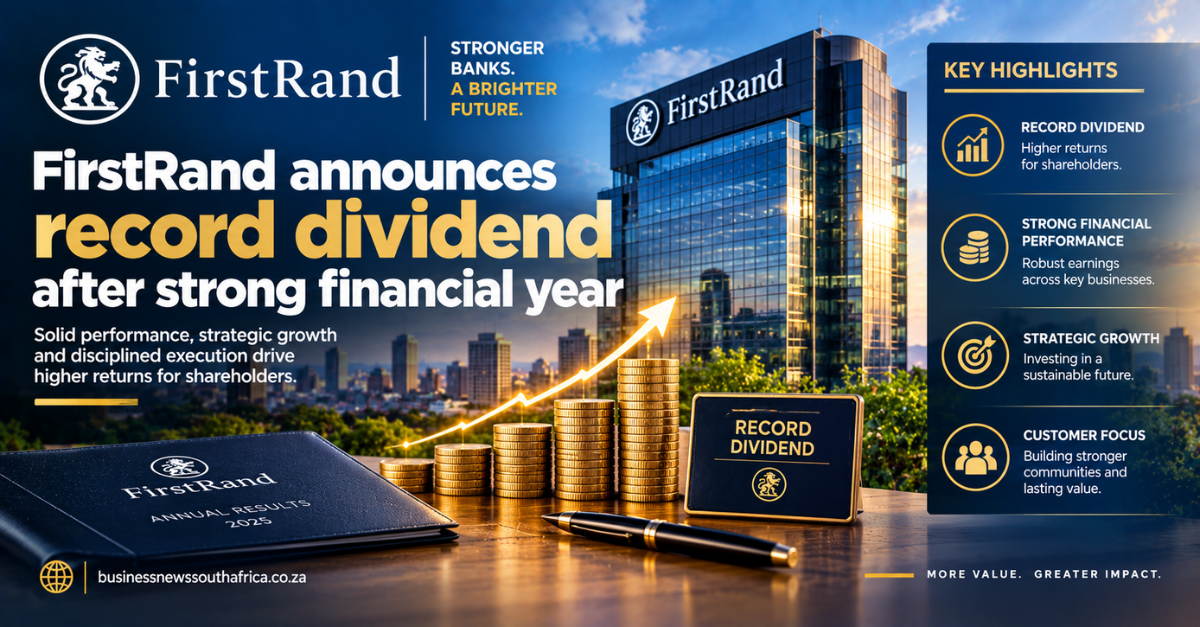
FirstRand, one of South Africa’s largest banking groups, said it will pay a record dividend following what the company describes as a strong financial year. The announcement was made by Mary Vilakazi, executive head of FirstRand, during a recent interview with Moneyweb.
For shareholders, a dividend is a cash distribution taken from a company’s profit. When a firm calls a payout “record”, it means the amount per share is higher than any previous distribution. The move is often read as a sign that the board is confident about future earnings and wants to reward investors.
For small business owners, the relevance of a bank’s dividend policy may not be immediately obvious. However, the health of the banking sector can affect loan terms, credit availability and the overall cost of capital. A bank that is confident enough to increase payouts is likely to have a solid capital base, which can translate into more stable financing conditions for SMEs.
Context within the South African banking landscape
FirstRand operates under the umbrella of the “Big Four” banks, alongside Standard Bank, Absa and Nedbank. Over the past few years the sector has grappled with high interest rates, load-shedding-related disruptions and tighter credit risk assessments. Despite these headwinds, FirstRand reported that its earnings were strong enough to justify a historic dividend.
The company did not disclose specific profit figures in the interview, but the term “strong year” typically reflects growth in net interest income, the earnings a bank makes from the difference between interest earned on loans and interest paid on deposits, as well as stable non-interest income from fees and trading activities.
Mary Vilakazi noted that the bank’s risk-adjusted return on capital remains solid, a metric that measures how efficiently a bank generates profit relative to the risk it takes on. While the exact numbers were not released, a solid return on capital is a key indicator that the bank can sustain higher payouts without jeopardising its ability to absorb future losses.
In the broader market, a record dividend can put upward pressure on a bank’s share price, as investors seek the higher yield. The Johannesburg Stock Exchange (JSE) often reacts to such announcements, with trading volumes typically increasing in the days following a dividend declaration.
For entrepreneurs who hold shares in FirstRand or other banks, the higher dividend could improve cash flow, especially if they rely on dividend income to fund business operations. For those without direct shareholdings, the signal of a resilient banking sector may encourage confidence when seeking financing or negotiating interest rates.
It is worth noting that dividend policy is a balance. While a larger payout rewards shareholders, it also reduces the amount of retained earnings that a bank can reinvest in growth initiatives, such as digital banking platforms or expanding branch networks. The decision to pay a record dividend suggests that FirstRand believes its current capital position is strong enough to support both shareholder returns and ongoing investment.
Analysts will be watching how the dividend compares to the payouts of FirstRand’s peers. If other major banks maintain lower distributions, FirstRand’s move could set a new benchmark for the sector. Conversely, if the broader market follows suit, the overall yield on banking stocks could rise, offering more attractive returns for investors.
In summary, FirstRand’s record dividend reflects a confident outlook after a year of solid earnings. While the exact financial details remain undisclosed, the announcement underscores the bank’s stable position within a challenging economic environment. Small business owners should keep an eye on such signals, as they can influence the cost and availability of financing in the months ahead.