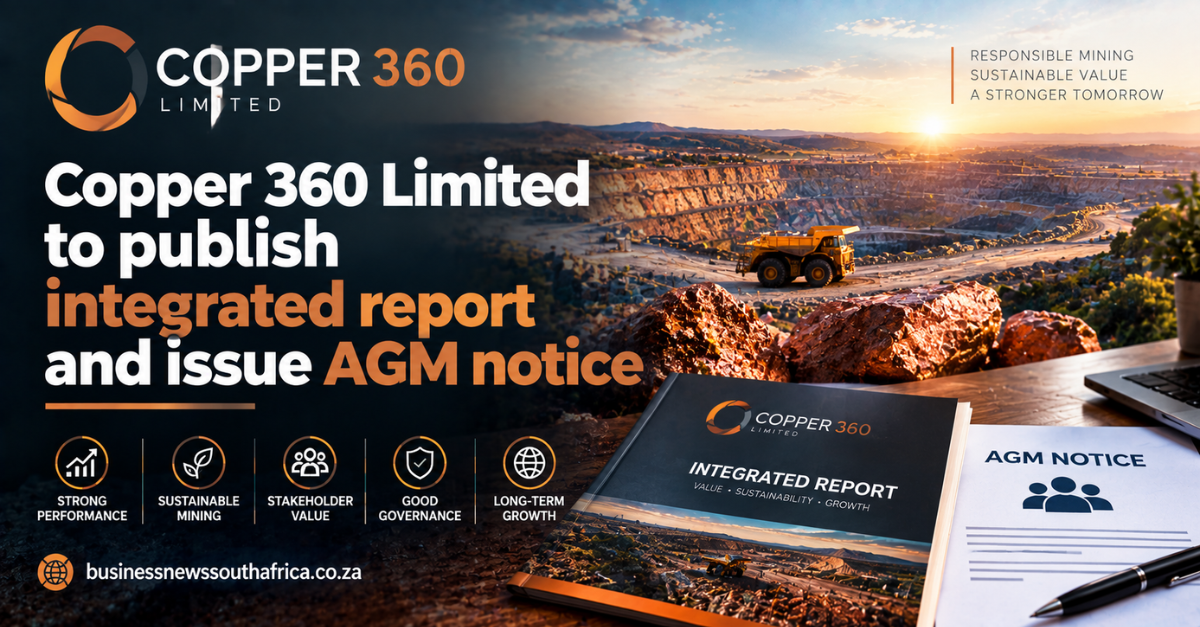
Moneyweb reported that Copper 360 Limited announced it will publish its integrated report and has issued a notice for its upcoming annual general meeting (AGM).
An integrated report combines the company’s financial statements with information on environmental, social and governance (ESG) performance. The JSE requires listed companies to produce such a report each year, giving investors a single document that shows how the business creates value over time.
For shareholders, including small investors who may hold copper stocks as part of a diversified portfolio, the integrated report offers a clearer view of the company’s profitability, cash flow and how it manages risks such as commodity price swings or regulatory changes.
Why the AGM matters
The AGM is the forum where shareholders can vote on matters such as the appointment of directors, approval of the financial statements and any changes to the company’s constitution. It also gives the board an opportunity to answer questions from investors, which can be especially useful for smaller shareholders who rely on direct communication rather than analyst coverage.
Copper 360 operates in a sector that has seen rising global demand for copper, driven by electric vehicles and renewable-energy infrastructure. At the same time, South African miners continue to navigate load-shedding, labour negotiations and fluctuating exchange rates. The timing of the report and AGM therefore provides a snapshot of how the company is positioning itself amid these broader challenges.
Investors will be able to download the integrated report from Copper 360’s website once it is posted, and the AGM details, including date, time and venue, will be included in the formal notice that the company must send to all registered shareholders.
What is actually worth reading in an integrated report
Integrated reports are long, and most of the length is not where the information is. A reader who opens one looking for the story is usually better served by three specific sections than by the narrative at the front, which is written by people whose job includes making the year sound coherent.
The going concern statement is the first. Directors have to state whether they believe the company can continue trading for the foreseeable future, and the language they choose when they are less than fully confident is unusually revealing, because it is one of the few places in the document where the legal exposure of overstating things outweighs the commercial temptation to.
Related-party transactions are the second. This is where a report discloses business done with directors, major shareholders or entities connected to them. For a smaller company these arrangements are often entirely legitimate and sometimes the reason the company is funded at all, but they are also where governance problems surface first, and the disclosure is mandatory precisely because the incentive to leave it out is obvious.
Remuneration is the third, and it is the section most directly connected to the meeting. The point is not the size of the numbers, it is whether what management is paid for lines up with what shareholders want to happen.
Why the meeting is the leverage, and why it is usually wasted
An annual general meeting is the one scheduled occasion on which the people who own a company can compel the people running it to answer a question in public. Most of that leverage goes unused, because attendance at smaller companies’ meetings is thin and votes are often submitted by proxy without much scrutiny of what is being approved.
South African listed companies operate under a governance code that separates the votes into two kinds, and the distinction is not widely understood by smaller shareholders. Some resolutions are binding, including the appointment of directors and auditors. The vote on remuneration policy is advisory, meaning a company can lose it and proceed anyway. That sounds toothless and largely is, in the immediate sense, but a substantial vote against a remuneration policy is a public signal that boards do generally act on, because the alternative is being asked about it every year.
For a shareholder in a smaller resources company, the practical version of all this is simple enough. The report tells you whether the business can fund itself and who it is doing business with. The meeting is where you get to say something about it. Both arrive once a year, and the notice is the thing that tells you when.