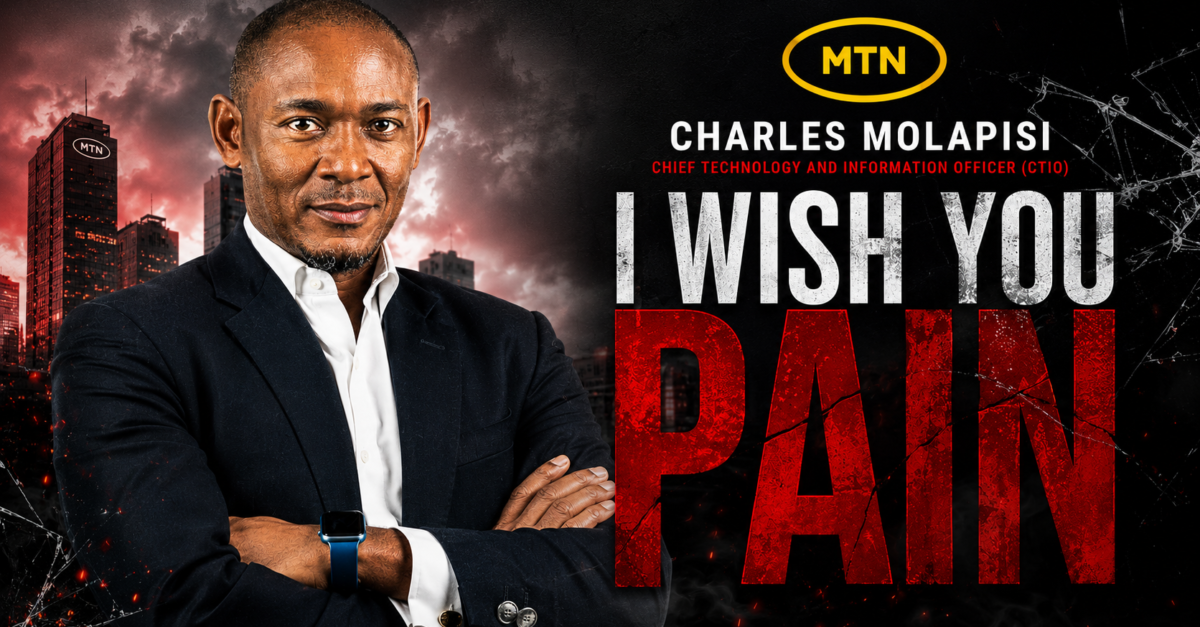
Every so often an executive pay disclosure buries the real story under a mountain of numbers, and then the executive goes on a podcast and hands the story back with a headline attached for free. MTN has disclosed that its chief technology and information officer, Charles Molapisi, received total remuneration of R41.795 million for the 2025 financial year, remuneration meaning the full sum of cash salary, bonuses and other incentives paid out. On its own, that is a fairly ordinary large-company disclosure. What makes it a story is that Molapisi then told a podcast audience he wishes his team pain and suffering, because he believes hardship builds successful people.
The pay package, before the podcast
The package breaks down into a base salary of R11.484 million, short-term annual bonuses, and long-term incentives, pay linked to performance over several years, which rose sharply to R20.69 million after the share price used for vesting climbed from R124.60 to R202.20. MTN says the jump from R26.333 million in 2024 was driven mainly by that higher long-term incentive payout and the stronger share price, alongside a decision to raise the performance weighting for executives to 70%, meaning a larger share of pay now depends on hitting group targets rather than simply holding the role. Because Molapisi served as a prescribed officer for only ten months of the financial year, his base salary and short-term incentives were calculated for that shorter period, not a full twelve months.
MTN is South Africa’s largest mobile network, and its pricing and service quality touch a huge number of small enterprises that depend on reliable connectivity to function at all. The pay disclosure itself does not change a retailer’s cost of goods, but it does signal the group’s focus on retaining senior technical talent amid real competitive pressure. Worth noting alongside the headline pay number: MTN reported total group performance of 106.57% of target, while the South African unit managed only 41.39%, a gap that could plausibly shape how much investment flows into local infrastructure versus other markets in the group’s footprint.
Then came the podcast
On the SMWX podcast, Molapisi said he wishes his team pain and suffering because he believes hardship builds successful people, framing it explicitly as a personal view rather than corporate policy. It did not land as intended. The remark drew genuine criticism and raised fair questions about leadership tone at a company whose technology division presumably wants to attract, not repel, skilled engineers in a competitive local talent market.
Molapisi moved into the Group CTIO role from CEO of MTN South Africa after a restructuring, and his annualised base salary is set to rise 3.7% to R11.909 million in 2026, a change MTN links to inflation rather than performance. He has also pointed to community work, including a campaign that raised R142,000 for a digital laboratory at his hometown primary school, a detail that sits somewhat awkwardly alongside the pain-and-suffering remark without necessarily contradicting it.
For SME owners whose businesses run on MTN’s network, the pay package and the podcast comment are both, in their own way, worth filing away as signals: one about how MTN is incentivising the people building its technology roadmap, the other about the tone being set at the top of that same technology function. Neither directly changes a small business’s bill this month, but both shape the kind of organisation MTN is becoming, and that eventually does.
Executive pay disclosures at this scale are a fairly standard feature of JSE-listed company reporting, required precisely so shareholders can see how incentive structures are shaping leadership behaviour, and a R41.8 million package is not, on its own, unusual for a group of MTN’s size operating across dozens of markets. What turns a routine disclosure into a genuine talking point is almost always the human element layered on top of it, in this case a senior technology leader publicly framing hardship as something he actively wishes on the people reporting to him. Corporate South Africa has had its share of leadership-tone controversies before, and they tend to matter less for the specific remark than for what they reveal about whether an organisation’s stated values and its actual internal culture are pointing in the same direction.