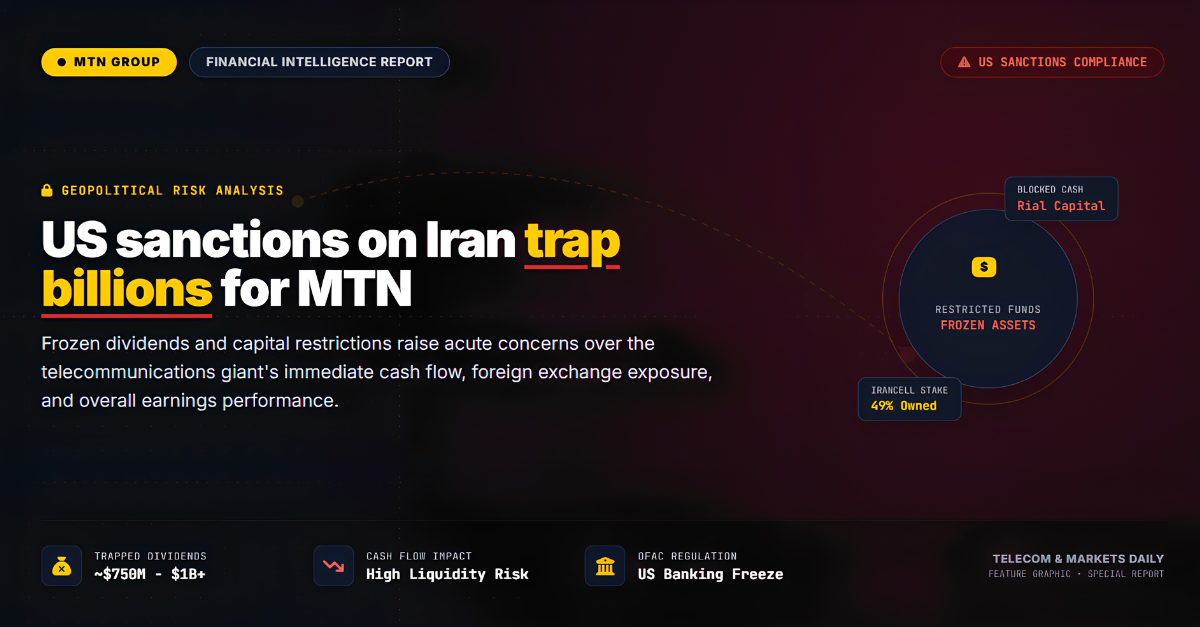
MTN has learned, the hard way, that operating across dozens of countries occasionally means getting caught in the crossfire of someone else’s foreign policy. According to innovation-village.com, US sanctions on Iran have trapped billions in assets belonging to the South African telecom group MTN, a reminder that a multinational’s balance sheet can be held hostage by geopolitics it had nothing to do with.
Sanctions are government measures that restrict trade and freeze assets tied to a targeted country. In this case, the United States has expanded its restrictions on Iranian entities, which means any foreign company holding money or equipment inside Iran can suddenly find those resources locked up, regardless of how long they had been operating there or how the money was earned.
What MTN has actually said, and what it has not
MTN, which runs mobile networks across Africa and the Middle East, has confirmed the sanctions have left certain funds inaccessible. What the company has not disclosed is the exact amount involved, the currency, or precisely which assets are affected, which leaves the scale of the problem, for now, entirely undefined from the outside.
If the frozen funds represent cash MTN would otherwise be using for operations or investment, the company could feel real pressure on cash flow. In practical terms that could mean slower network roll-outs, delayed upgrades, or a more cautious approach to dividend payments, outcomes that would land on shareholders and customers alike, though none of that is confirmed, only a plausible read of what a large trapped sum typically forces a company to do.
For South African businesses that rely on MTN’s network, a slowdown in investment could eventually mean higher costs or a dip in service quality, though how much of that materialises depends entirely on the size of the amount actually trapped, a figure nobody outside MTN currently has. It is the kind of story where the headline number matters enormously and remains, for now, missing.
MTN’s exposure to sanctioned or geopolitically volatile markets is not new. The group has built much of its growth story on operating in frontier and emerging markets across Africa and the Middle East that larger, more risk-averse telecom operators tend to avoid, a strategy that has delivered strong subscriber growth over the years precisely because MTN was willing to go where others would not. That same willingness is what occasionally exposes it to exactly this kind of geopolitical risk, assets caught up in sanctions regimes it has no ability to negotiate directly, since sanctions are a matter between governments, not between MTN and Washington. It is the underside of the same strategy that built the company’s footprint in the first place.
MTN has said only that it is reviewing the situation, without offering a timeline for when, or whether, the assets might eventually be released. Sanctions regimes can loosen, tighten, or simply persist for years depending on decisions made far outside any company’s control, and until Washington and Tehran’s diplomacy moves, MTN’s frozen funds stay exactly where geopolitics left them.
US secondary sanctions in particular have a long history of catching companies with no American ownership or operations simply because they touch the global dollar-clearing system that almost every cross-border transaction eventually runs through. That is the mechanism that gives sanctions their reach far beyond US borders, and it is why multinationals operating in sanctioned or high-risk jurisdictions typically build compliance teams specifically to track evolving restrictions, rather than treating sanctions risk as a one-time legal check. Whether MTN’s Iranian exposure was fully hedged against exactly this outcome, or whether this is a genuine surprise to its treasury function, is not something the source material addresses, and it is the kind of detail that would only come out if MTN chooses to disclose more in a future results announcement.