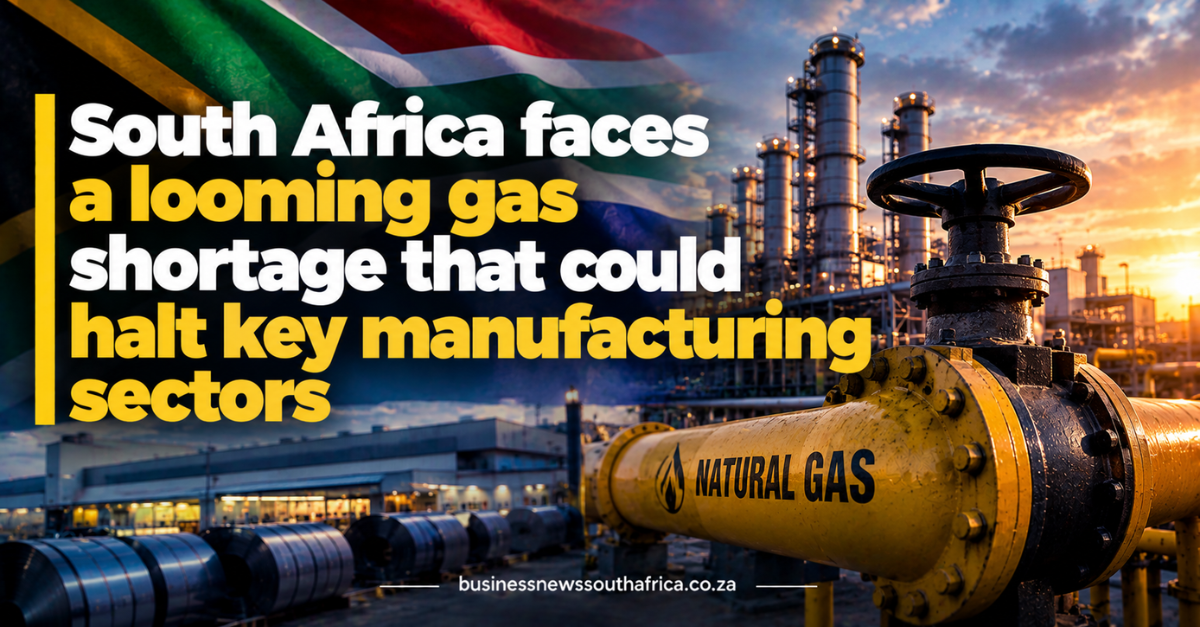
In a quiet corner of a glass plant in Gauteng, the hum of furnaces has been replaced by a low-key waiting game. Executives are staring at a calendar that shows a steep drop in gas supply around 2030, a scenario they call a “gas cliff”.
Thomas Shaw, chief commercial officer of Ardagh Glass Packaging-Africa, told BusinessTech that the country only reacts when a crisis is already on the ground. “It’s frightening how much investment has been put on hold because nobody knows if there is going to be gas beyond 2030 and at what price,” he said.
The industries that rely on gas, glassmakers, tile manufacturers, food processors and others, account for about 8% of South Africa’s gross domestic product and generate roughly R700 billion in annual output. They also provide around 75,000 jobs. Almost all of their gas comes from Sasol’s fields in central Mozambique.
Sasol warns that in two years’ time the Mozambican fields will be able to meet only its own internal demand. That leaves the rest of the country scrambling for a supply that may not exist.
Private-sector attempts to bridge the gap have hit a classic chicken-and-egg problem. TotalEnergies, together with the South African Gigajoule Group, has been planning a liquefied natural gas (LNG) import terminal in Matola. LNG, natural gas that has been cooled to a liquid for easier transport, requires a steady flow of customers to make the investment worthwhile. “We need at least three years to develop a project like that,” said Magali Pailhé, head of Total’s exploration and production business in South Africa.
The government’s long-term energy plan does see gas as a transition fuel, targeting 16 gigawatts (GW) of gas-fired power generation by 2039. It is currently reviewing bids for 2 GW of privately funded gas-fired plants, while Eskom, the national power utility, is weighing a 3 GW plant at Richards Bay. That project would need an LNG terminal and a new pipeline to the industrial hub of Gauteng, but no such pipeline exists yet.
Exploration of domestic gas reserves has stalled amid legal battles. In August, the country’s highest court blocked Shell from renewing an offshore exploration licence off the Wild Coast, ending a five-year dispute with environmental activists. Industry leaders have asked the government to set up specialist courts for oil and gas matters, but no progress has been reported.
As a stopgap, Sasol has applied to the energy regulator to set pricing for methane-rich gas (MRG) produced from coal. MRG, a gas with a high proportion of methane, a potent greenhouse gas, would be cheaper than imported LNG but raises climate concerns. Sasol CEO Simon Baloyi acknowledged the trade-off, asking whether the country would rather push 700,000 people out of work.
Julian Singonzo, managing executive for sustainability at Premier, South Africa’s biggest bread producer, called the MRG proposal “not a sustainable long-term solution from a security-of-supply, economic or environmental perspective”. He added that the pricing could be higher than imported LNG, eroding profit margins.
Brandon Wood, chief executive of Italtile, said gas is “critical” to its manufacturing processes and warned that any disruption would force the company to halt production. The Industrial Gas Users Association Southern Africa (IGUA-SA) has asked President Cyril Ramaphosa’s office to create a task team, mirroring the one that dealt with the electricity crisis, to address the looming shortage.
For small and medium-sized manufacturers, the stakes are immediate. A prolonged gas shortfall could push up the cost of running ovens, kilns and dryers, which would either be passed on to consumers or force firms to delay expansion plans. Companies should monitor the upcoming government tenders for gas-fired plants, explore alternative fuels such as biomass or solar-thermal heat, and engage with the proposed task team to voice their needs.
Until a coordinated solution emerges, South Africa’s gas-dependent sectors face a period of uncertainty that could ripple through the broader economy.