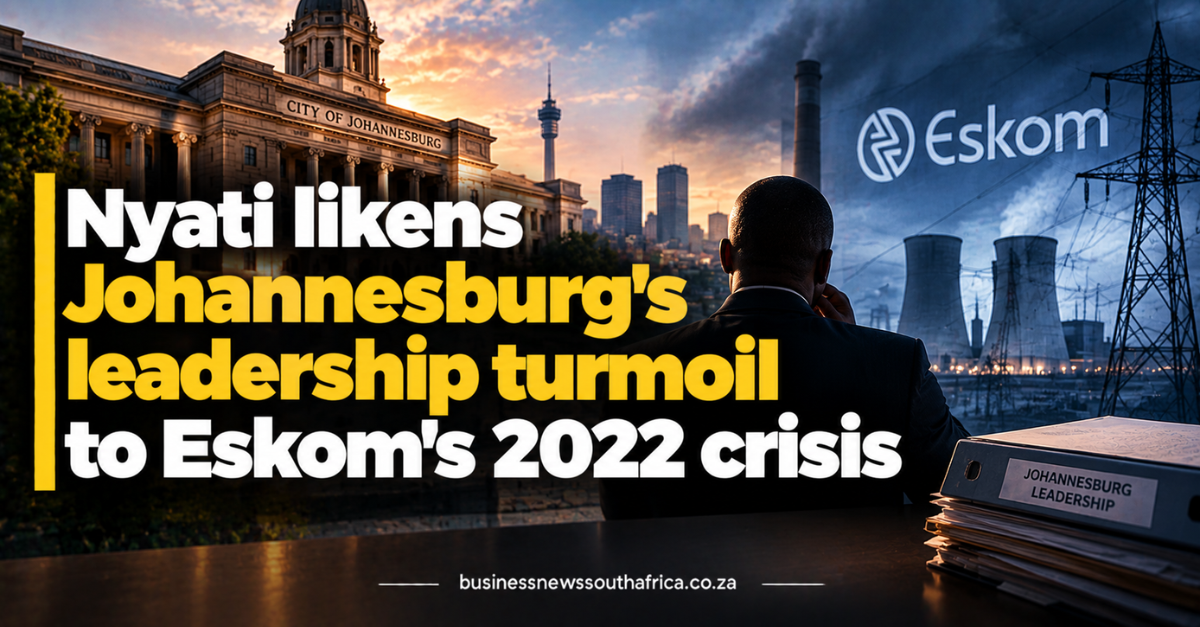
In the boardroom of the Johannesburg municipal council, tension hangs like a low-voltage line. According to Inside Politic, Nyati said the city’s leadership crisis mirrors the turmoil that engulfed Eskom four years ago.
The comparison is more than rhetorical. Eskom’s 2022 crisis involved a cascade of governance failures, spiralling debt and chronic load-shedding that rippled through every sector of the economy. If Johannesburg’s own governance challenges follow a similar pattern, the ripple could reach construction sites, retail outlets and the countless small enterprises that rely on stable municipal services.
Johannesburg is South Africa’s economic engine, home to the majority of the country’s corporate headquarters and a dense network of small and medium-size enterprises. The city’s revenue base is already under pressure from unpaid rates, service delivery backlogs and a strained cash-flow position. A leadership vacuum, whether through political infighting, delayed appointments or contested policy direction, can stall critical infrastructure projects, delay building approvals and weaken the city’s ability to coordinate with the national regulator Nersa on power reliability.
How municipal finance and service delivery normally function
Municipalities in South Africa collect rates and service charges from property owners, businesses and households to fund water, electricity, waste management and road maintenance. Those collections are processed through a budgeting cycle that begins with a draft fiscal plan, moves to public consultation, and ends with council approval. Once approved, the budget guides procurement, tendering and the allocation of funds to departments that oversee specific service areas. The process is designed to provide predictability for businesses that depend on timely permits, reliable utilities and consistent road conditions.
When a council experiences a leadership impasse, the normal rhythm of that cycle can be disrupted. Delays in appointing key officials may postpone the finalisation of the budget, which in turn can stall payments to contractors and defer the release of capital for new projects. For an SME that is waiting for a building permit, a postponed budget can translate into a waiting period that extends beyond the usual timeframe, increasing holding costs and eroding confidence in the municipality’s ability to deliver.
The role of Nersa and the importance of power stability
Nersa, the national energy regulator, oversees the licensing, pricing and reliability standards for electricity providers across the country. While Eskom remains the dominant generator, Nersa’s regulatory framework ensures that supply contracts, load-shedding protocols and emergency response plans are transparent and enforceable. Municipalities that maintain regular communication with Nersa are better positioned to anticipate supply constraints, negotiate load-shedding schedules that minimise impact on commercial districts, and coordinate backup power solutions for critical services.
When a city’s leadership is uncertain, the frequency and quality of those coordination meetings can decline. A weakened dialogue may result in less timely information about scheduled power cuts, leaving businesses to react rather than plan. For a retailer that depends on refrigeration, or a manufacturing unit that runs on continuous power, the cost of unplanned generator fuel can erode profit margins and, in extreme cases, force temporary shutdowns.
Practical implications for South African business owners
For an SME owner, the practical stakes are clear. A delayed permit can push a new shop opening by months, while an unreliable electricity supply can increase operating costs and force reliance on expensive generators. In the worst-case scenario, a prolonged governance impasse could echo the load-shedding cycles that forced many businesses to curtail production during Eskom’s peak crisis.
Beyond immediate operational concerns, the uncertainty can affect strategic decisions such as expansion, investment in new technology, or hiring. When cash flow from municipal contracts becomes unpredictable, businesses may adopt a more conservative stance, postponing capital expenditures that would otherwise stimulate growth. The broader economic environment can feel the chill as confidence in the city’s ability to support commerce wanes.
What should business leaders watch for?
First, any announcement of new mayoral appointments or cabinet reshuffles within the Johannesburg municipality. Leadership changes often bring shifts in policy priorities, budget allocations and the speed at which pending applications are processed. Second, updates on the city’s budget reconciliation process, which could signal whether cash-flow constraints are deepening. A budget that requires significant adjustments may indicate that revenue collection is lagging or that expenditures are outpacing forecasts.
Finally, any coordination meetings between the city and national energy regulators, as these will indicate how seriously the power-supply risk is being managed. Regular reporting on load-shedding schedules, backup power arrangements and infrastructure upgrades can reassure businesses that the municipality is taking proactive steps to mitigate disruption.
Risk mitigation strategies for SMEs
Until more concrete details emerge, the comparison remains a warning sign rather than a confirmed diagnosis. SMEs would do well to review contingency plans for power interruptions, keep an eye on municipal tender calendars and consider diversifying energy sources where feasible. Investing in solar panels, battery storage or entering into power-purchase agreements with independent generators can reduce reliance on municipal supply and provide a buffer against unexpected outages.
Maintaining open lines of communication with local business chambers and municipal liaison officers can also provide early insight into policy shifts or upcoming infrastructure projects. By staying informed, businesses can adjust timelines, negotiate more favourable contract terms and align their operational plans with the city’s evolving service delivery schedule.
In addition, firms should assess their insurance coverage to ensure that losses arising from power interruptions or delayed permits are adequately protected. Some insurers offer specialised policies that address business interruption caused by municipal service failures, and reviewing those options can add an extra layer of resilience.
Long-term outlook for Johannesburg’s business climate
Johannesburg’s reputation as a hub for innovation, finance and trade has been built on a foundation of relatively stable municipal services and a proactive regulatory environment. If the current leadership challenges are resolved quickly, the city can return to its usual pace of project approvals, infrastructure upgrades and collaborative planning with national regulators. That would restore confidence among investors and enable SMEs to pursue growth opportunities without the shadow of uncertainty.
If, however, the impasse persists, the city may experience a gradual erosion of its competitive advantage. Prolonged delays in service delivery can encourage businesses to relocate to other metros where governance is perceived as more reliable. The cumulative effect could be a slowdown in job creation, reduced tax revenue and a feedback loop that further strains municipal finances.
For now, the prudent approach for business owners is to monitor the political and administrative signals coming from the council, to engage with industry groups that track municipal performance, and to embed flexibility into operational plans. By doing so, they can navigate the present turbulence while positioning themselves to benefit from any eventual stabilisation of Johannesburg’s leadership.
For ongoing coverage of how municipal governance intersects with energy reliability, see our Energy & Infrastructure section.
Editor’s note: Nyati is Mteto Nyati, Eskom’s board chairperson since November 2023, who is widely credited with the utility’s turnaround from the rolling blackouts of 2022 by replacing nearly half of Eskom’s power station managers under its Generation Recovery Plan. His comparison carries weight specifically because he has direct, first-hand experience of what that kind of leadership vacuum did to Eskom before the recovery began.