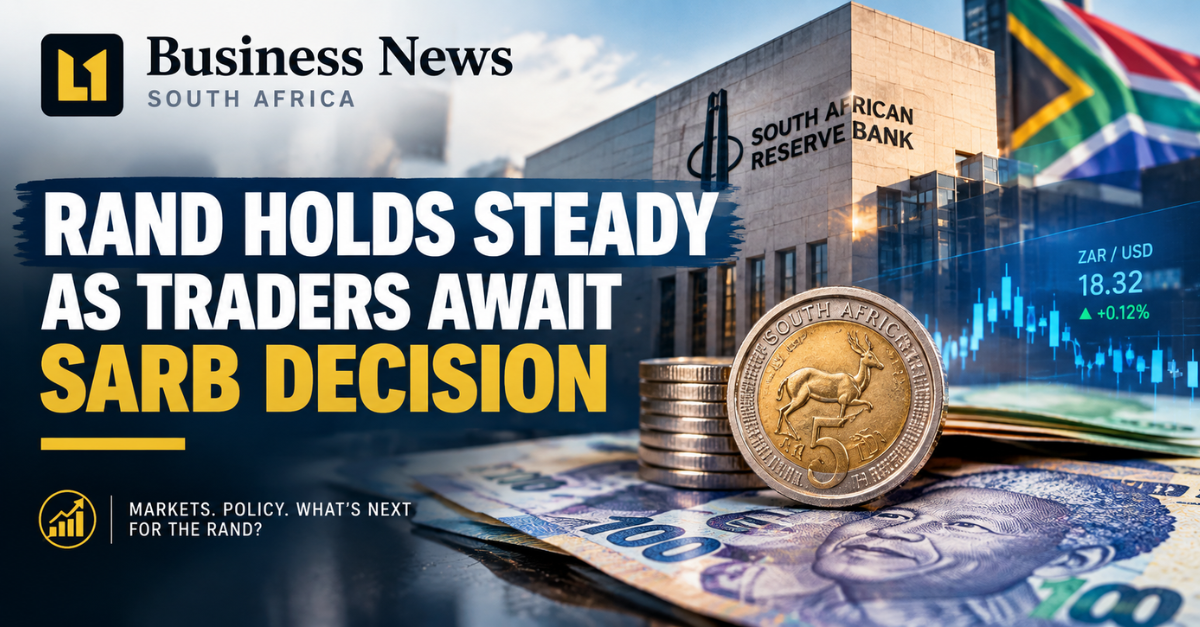
On the trading floor, screens flicker with the same figure: the rand, unchanged from the previous session. The calm is less a sign of confidence than a pause while market participants wait for the South African Reserve Bank’s (SARB) next policy signal.
According to Finimize, the currency has held its ground despite the usual chatter around interest-rate expectations. The SARB, South Africa’s central bank, meets regularly to set the repo rate, the benchmark that influences loan costs for businesses and consumers alike. A decision to hold, raise or cut rates can ripple through import prices, debt servicing and even the cost of raw materials for small manufacturers.
For SMEs that import goods, a stable rand means the rand-to-dollar exchange rate does not add surprise costs to invoices. For those with variable-rate loans, it reduces the risk of sudden payment spikes. In that sense, the current steadiness offers a brief window of predictability, even if the broader economic backdrop, high inflation and occasional power cuts, remains challenging.
The SARB’s next move is being watched closely because any shift in policy could alter the currency’s trajectory. A rate hike would typically strengthen the rand by attracting foreign capital, while a cut could weaken it, raising the price of imports. Traders are therefore positioning themselves for both outcomes, balancing the desire for a stable exchange rate against the need for monetary policy that tames inflation.
While the rand’s pause is welcome, it is not a guarantee of long-term stability. Global commodity prices, capital flows and domestic fiscal policy continue to exert pressure. Companies that rely on imported inputs should still consider hedging strategies to protect against future swings.
For a deeper dive into how central-bank decisions affect currency markets, see the South African Reserve Bank website. Market data can be followed on the Johannesburg Stock Exchange. More coverage of currency trends is available in our Markets & Finance section.
Why the market is watching the SARB so closely right now
The South African Reserve Bank operates under an explicit inflation target band of 3% to 6%, and its Monetary Policy Committee’s decisions are watched closely by currency traders because the rand’s relative attractiveness to foreign capital depends heavily on how South Africa’s real interest rate, the repo rate minus inflation, compares to other emerging markets competing for the same investment flows. A currency holding steady ahead of a policy decision is common: traders generally avoid taking large positions immediately before a scheduled announcement that could move the rand sharply in either direction, preferring to wait for the actual decision before committing capital. For SMEs with variable-rate business loans, the practical takeaway is the same regardless of which way the SARB moves: understanding your own exposure to a rate change before the announcement lands puts you in a better position to respond quickly than waiting to react afterward.
South Africa’s rand has historically ranked among the more actively traded emerging-market currencies globally, which means its moves are driven as much by broad shifts in global risk appetite, capital flowing toward or away from emerging markets as a group, as by South Africa-specific news, a dynamic worth remembering before attributing any single day’s rand move entirely to local factors.
The next scheduled SARB Monetary Policy Committee meeting will be the key event to watch for businesses trying to plan around exchange-rate and borrowing-cost uncertainty in the weeks ahead.
In the meantime, exporters and importers alike are advised to keep a close eye on both local inflation data and global risk sentiment, since either could shift the rand’s trajectory well before the SARB’s next scheduled announcement.