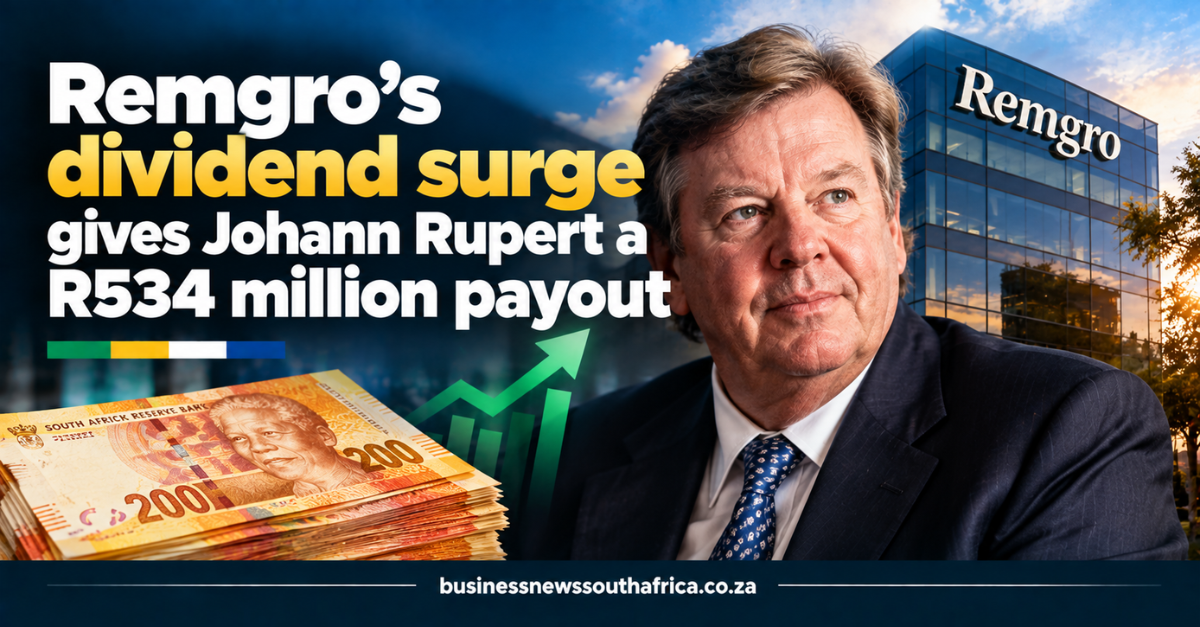
When the dividend cheque arrived, the figure on it could have been a headline in its own right, R534 million. That is the amount the Remgro chairman, Johann Rupert, is set to receive after the investment holding announced a 42% rise in earnings and a total dividend of 1 145 cents per share for the year to June 2026.
Remgro, the investment vehicle controlled by the Rupert family, posted headline earnings of R11.140 billion, up from R7.827 billion a year earlier. Headline earnings per share, the profit per share before one-off items, climbed from R14.09 to R20.03. The group attributed the surge to stronger performance across several of its key investee companies, including Mediclinic, Rainbow, CIVH, OUTsurance Group and Heineken Beverages.
What the numbers mean
The board declared an ordinary dividend of 595 cents and a special dividend of 550 cents, totalling 1 145 cents per share. Both ordinary and unlisted B ordinary shares qualify for the payout. A 20% dividend withholding tax applies, leaving a net dividend of 916 cents per share. After tax, Rupert’s share of the payout is estimated at roughly R427 million, though the headline figure of R534 million is often quoted in the media.
Remgro’s earnings were buoyed by a R1.367 billion contribution from Mediclinic, helped by an operational turnaround and a one-off tax benefit in Switzerland. Other contributors included a R610 million boost from Rainbow, R412 million from CIVH, R332 million from OUTsurance Group and R161 million from Heineken Beverages. TotalEnergies added R424 million, largely from a one-off Transnet pipeline cost refund that Remgro received a share of.
One-off items, items that are not expected to recur, added R1.023 billion to headline earnings, meaning the underlying growth, stripped of those items, would still be about 29%. The group also noted higher financial income from a larger cash balance, partly due to the proceeds from selling its stake in FirstRand Limited.
On the downside, RCL Foods contributed a negative R368 million, and FirstRand paid lower dividends after the disposal.
Remgro’s board said the company remains solvent and liquid, with sufficient capital and reserves after the dividend payment to support operations for the foreseeable future.
For investors, the payout highlights the power of a diversified holding company that can channel earnings from a range of sectors, health care, insurance, beverages and energy, into a single dividend stream. The 20% withholding tax means that retail investors receive a net yield that is lower than the headline figure, a factor to consider when comparing dividend yields across the market.
While the scale of Rupert’s payday is unlikely to affect the day-to-day decisions of most small business owners, the story does illustrate how dividend policy can drive shareholder returns in a high-tax environment. Companies that generate strong cash flow and can afford generous payouts may become attractive to investors seeking income, even as the broader economy grapples with load-shedding and inflation.
Remgro’s results also come at a time when South African companies are under pressure to balance growth with fiscal prudence. The board’s confidence in its liquidity position may reassure shareholders, but the reliance on one-off items reminds investors to look beyond headline numbers.
For a deeper look at dividend tax rules, see the South African Revenue Service. The full results can be found on Remgro and were reported by BusinessTech. For market data, visit the JSE.
Remgro’s structure as a diversified investment holding company means a single strong year across several unrelated investee companies, rather than one standout business, tends to drive a result like this. The group’s spread across healthcare, beverages, infrastructure and financial services is a deliberate hedge against a downturn in any one sector, which is also why its dividend has historically been less volatile than a single-sector JSE company’s. The JSE’s own SENS archive carries Remgro’s full results announcement for readers who want the underlying detail. For related coverage, see this site’s Markets and Finance coverage.