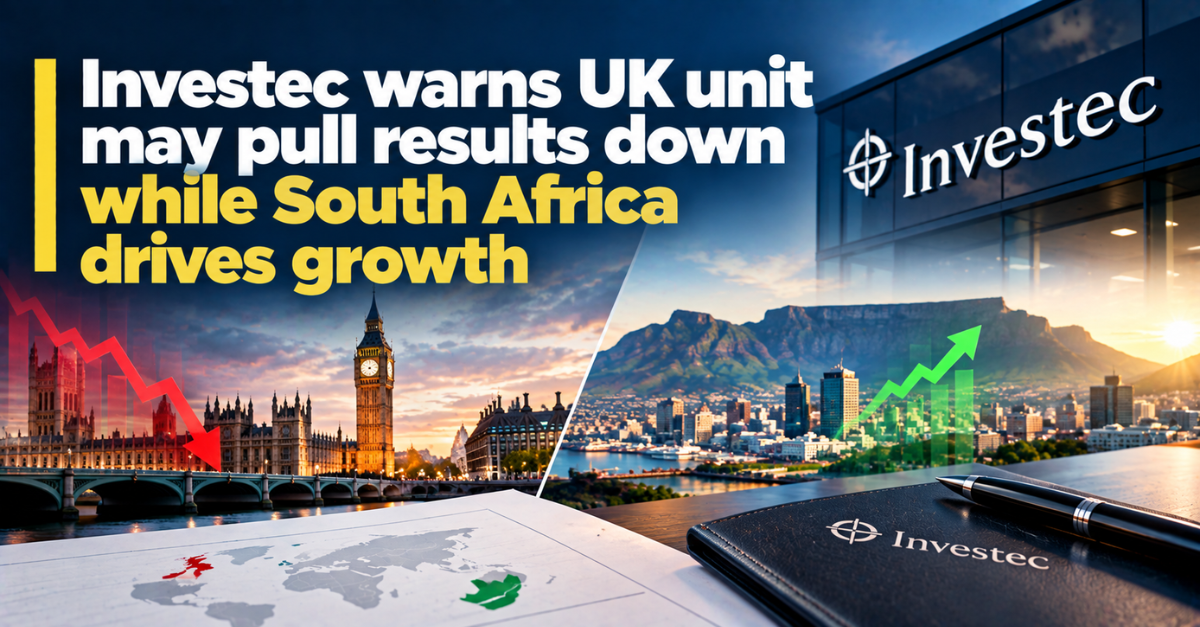
Investec told investors on 18 September that its South African operations are set to lift group earnings, but the UK specialist bank could shave a few percentage points off the overall result. For anyone with exposure to the bank, whether as a shareholder, a corporate client or a supplier, the split signals where the next wave of credit and investment activity may flow.
The statement, released as a trading update, says the group still expects adjusted earnings per share (profit per share after one-off items) to climb between 3% and 7% from the previous interim period, landing at roughly 40.5 pence. Headline earnings per share (the basic profit per share figure) is projected to rise 4% to 8% to a range of 38.1p to 39.7p.
In South Africa, the bank forecasts a 6% rise in operating profit measured in rand and a 14% rise when the same profit is expressed in pounds. The adjusted operating profit, the profit after removing unusual items, is expected to be up to 4% higher in rand terms and up to 14% higher in pound terms compared with the prior period.
By contrast, the UK specialist bank, which includes Investec’s stake in Rathbones, is expected to see operating profit fall 2% to 6% versus the previous period. The company put it as a 3% to 7% shortfall in adjusted operating profit for the UK arm.
Investec attributes the South African upside to three main drivers: higher activity levels, larger average advances (the amount of money lent per client) and strong net inflows into discretionary and annuity funds. Net interest income, the earnings from the spread between loan rates and funding costs, also benefited from a growing loan book and lower funding costs in the home market.
The wealth segment in South Africa saw funds under management jump about 13.8% since the end of March 2026, with discretionary and annuity funds attracting roughly R10.7 billion and non-discretionary inflows adding another R18.9 billion.
Investec’s dual listing on the London Stock Exchange and the Johannesburg Stock Exchange (JSE) means that any weakness in the UK side will be felt by investors on both markets. The bank’s guidance, first issued in May 2026, remains unchanged, a rare sign of confidence given the current volatility in the UK banking sector, where tighter credit conditions and higher regulatory costs have squeezed margins for many peers.
For small and medium enterprises that rely on Investec for financing, the message is mixed. The South African boost suggests more appetite for lending and potentially better terms locally, while the UK slowdown could translate into tighter credit for corporate clients operating in that market.
Investec’s own words underline the split: “The Specialist Bank adjusted operating profit is expected to be up to 4% ahead of the prior period in Rands and up to 14% in Pounds Sterling,” the company said, adding that the UK unit “is expected to be between 3% and 7% behind the prior period.” These are company claims until verified by the upcoming interim results.
Investors will be watching the next interim report closely to see whether the South African upside can fully offset the UK dip. In the meantime, the bank’s performance offers a snapshot of how dual-listed institutions balance growth across very different economic environments.
Read more about how dual-listed banks manage cross-border risk in our Retail & Consumer coverage.
Investec’s split performance reflects a wider pattern among dual-listed South African financial groups: domestic operations have generally outperformed UK and European units over the past two years, as local interest rates and credit demand held up better than expected while UK consumer and corporate lending stayed subdued. Investec’s own investor relations disclosures carry the full trading update once published in detail. For related coverage, see this site’s Markets and Finance coverage.