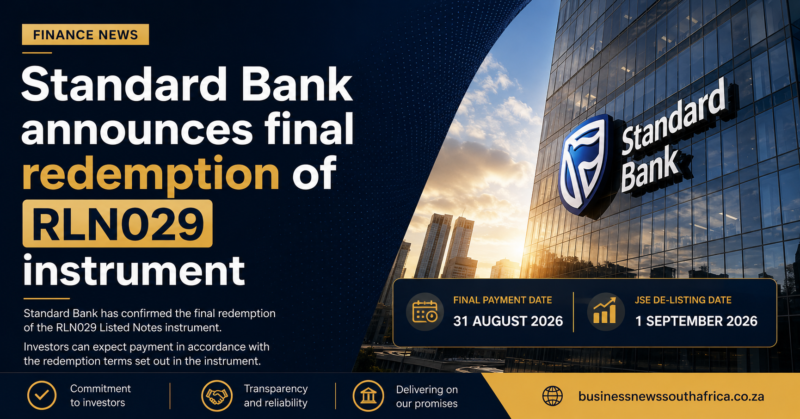
Standard Bank of South Africa Limited told investors, via a filing reported by Moneyweb, that its financial instrument identified as RLN047 will be fully redeemed. The bank described the action as a “final redemption”, meaning the last scheduled payment of the security’s principal will be made and the instrument will cease to exist. A financial instrument is a legally enforceable contract that creates a financial asset for one party and a financial debt liability for another. In corporate credit markets, final redemption marks the complete payoff of the underlying security, formally cancelling the contractual debt obligation between the bank and the debt holder.
For holders of RLN047, typically institutional investors, bond funds and other fixed-income buyers, the announcement signals that the cash they originally lent to the bank will be returned on the redemption date. No further interest payments will be made after that point. Institutional investors are organizations such as pension funds, asset management firms, life insurers, and collective investment schemes that manage aggregated funds. Fixed-income buyers focus on purchasing debt instruments that yield regular interest returns. The principal represents the initial capital sum provided by the lender, which remains distinct from the periodic interest, or coupon rate, paid over the term of the note.
Why banks redeem bonds
When market interest rates fall, issuers often choose to retire existing debt and, if needed, refinance at a lower cost. While Standard Bank did not disclose the reason for redeeming RLN047, the move fits a broader pattern in South Africa’s corporate bond market where several large borrowers have been retiring older issues to improve funding terms. Commercial bank debt instruments in South Africa are typically listed on formal platforms such as the Johannesburg Stock Exchange Debt Board. These listed notes enable banking groups to secure wholesale funding to support their balance sheet assets and broader lending portfolios.
Bank treasury operations run under strict regulatory frameworks overseen by the South African Reserve Bank Prudential Authority. These regulatory rules require commercial institutions to maintain specific liquidity ratios, manage funding maturity structures, and observe capital coverage mandates. As wholesale debt securities approach their scheduled maturity dates, their regulatory treatment under banking capital framework guidelines changes. Asset and liability management committees within commercial banks regularly assess whether to settle, extend, or refinance outstanding debt notes to keep balance sheet funding aligned with prevailing market conditions.
For South African small and medium enterprise owners and corporate executives, wholesale debt management by major commercial banks offers insights into broader banking sector liquidity. When a major tier-one bank systematically settles its debt instruments, it reflects orderly balance sheet management. Healthy liquidity within the commercial banking sector supports the availability of credit lines, asset finance structures, and operational working capital for growing businesses across the local economy. Stable bank capital structures also support predictable commercial lending conditions linked to the South African prime interest rate.
In addition, when institutional investors receive their repaid principal from redeemed corporate bonds, those liquidity allocations flow back into the South African capital market. Asset managers regularly reallocate returned capital into new debt listings, commercial paper, or short-term money market instruments. This continuous flow of capital helps maintain market liquidity, ensuring that funds remain available for broader enterprise funding, infrastructure development, and corporate capital expenditure.
The bank’s statement is a claim made by Standard Bank until independently verified by a third party. No additional details such as the redemption amount, coupon rate or exact date were provided in the source. Market participants and corporate treasurers reviewing statutory announcements must rely on subsequent exchange releases or audit disclosures to confirm exact settlement amounts and transactional timelines linked to the retirement of RLN047.