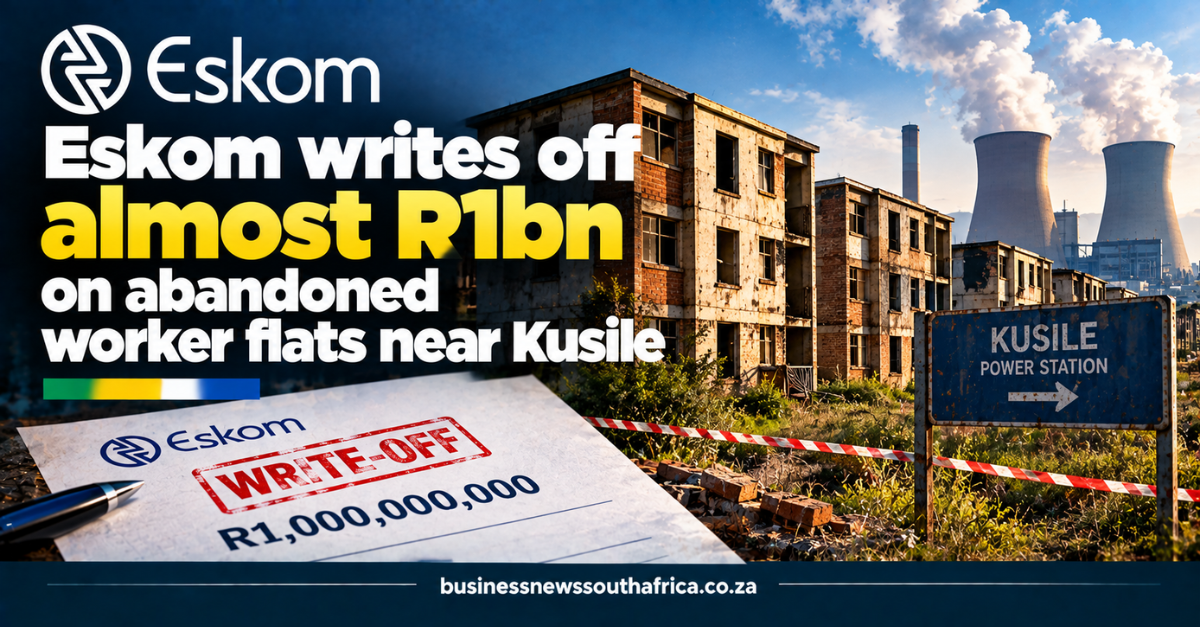
Three hundred and sixty-six concrete blocks sit silent on the outskirts of Kusile Power Station, their windows boarded and roofs unfinished. The flats were meant to house the artisans, builders and technical contractors who keep the coal-fired plant running, but they have never been lived in.
According to BusinessTech, Eskom spent almost R1 billion on the Ogies Housing Project before halting construction. The utility originally budgeted R160 million for the development, but by 2020 it had recorded an impairment write-down of R918 million, an accounting loss that reflects the reduced value of an asset that will not generate the expected benefit.
What went wrong?
Eskom says the failure stemmed from extreme project mismanagement and poor contract performance. The flats were intended to cut transport costs by letting workers live on-site instead of shuttling them from distant towns, a savings that never materialised. With the housing incomplete, Eskom continued to spend billions on rental accommodation and employee transport, a burden highlighted by Parliament in 2021.
The housing project was just one of several ancillary costs tied to the Kusile build-out. The power station itself, one of the world’s largest coal-fired plants, was slated for completion in 2017 at an estimated R121 billion. The 2026 annual report now pushes the finish line to 2028 and a total price tag of R233.4 billion, more than double the original estimate.
For small and medium-sized enterprises that rely on stable electricity, the ripple effect is clear. Higher capital costs for Eskom often translate into higher tariffs for commercial customers. When the utility’s balance sheet swallows unexpected write-offs, it tightens the fiscal space needed to invest in grid reliability, a factor that can exacerbate load-shedding and increase operating costs for businesses.
After the write-down, Eskom tried to sell the unfinished flats but found no buyer. Discussions are now underway with the Department of Human Settlements about converting the site into social housing, a move that could at least recoup some social benefit from the sunk cost.
While Eskom reported a profit of R30.3 billion for the year ended 31 March 2026, the utility also disclosed R4.9 billion in irregular expenditure for that year and a further R36.8 billion from previous periods. Auditors flagged concerns about the completeness of reporting under the Public Finance Management Act, underscoring ongoing governance challenges.
For entrepreneurs watching the energy sector, the lesson is stark: even well-intentioned cost-saving projects can become financial liabilities if execution falters. The abandoned flats serve as a concrete reminder that project oversight matters as much as the infrastructure itself.
In South Africa the electricity sector is dominated by a single state-owned utility that supplies the majority of national demand. Because of this concentration, any inefficiency or misstep at the utility can reverberate through the entire economy. The public sector framework requires that large capital projects undergo rigorous feasibility analysis, environmental assessments and competitive tendering before funds are released. When those processes are bypassed or poorly monitored, the risk of cost overruns and incomplete delivery rises sharply.
The Public Finance Management Act sets out the rules for how state entities must plan, spend and report on public money. It obliges entities to maintain internal controls, to disclose irregular expenditure and to seek corrective action when financial statements do not reflect the true value of assets. The act also empowers oversight bodies such as the Auditor-General to raise concerns about compliance. In the case of the Ogies Housing Project, the impairment write-down triggered an audit trail that highlighted both the scale of the loss and the weakness of the controls that allowed it to happen.
Project management in the utility sector typically follows a lifecycle that includes design, procurement, construction, commissioning and hand-over. Each stage is supposed to be governed by clear milestones, performance guarantees and risk-sharing mechanisms. When a project stalls, the financial exposure is not limited to the direct cost of the unfinished work; it also includes the opportunity cost of delayed benefits, the ongoing expense of alternative arrangements and the reputational damage that can affect future financing.
From a business owner’s perspective, the reliability of power supply is a non-negotiable input. Unplanned outages force firms to invest in backup generators, to adjust production schedules and to absorb higher operating costs. Those adjustments erode profit margins and can make the difference between growth and contraction. Moreover, when a utility raises tariffs to cover unexpected losses, the impact is felt most acutely by businesses that operate on thin margins, such as manufacturers, retailers and service providers.
The decision to explore a conversion of the vacant flats into social housing reflects a broader policy trend of repurposing stranded assets for public benefit. While the financial recovery from such a conversion may be modest, the social return can be significant, especially in a country where affordable housing remains a pressing challenge. Aligning the outcome of a failed utility project with a national housing objective also demonstrates how inter-departmental collaboration can mitigate the fallout of fiscal missteps.
Looking ahead, the experience of the Ogies Housing Project underscores the importance of robust governance, transparent procurement and diligent monitoring for any large-scale infrastructure initiative. For South African businesses, the story reinforces the need to stay informed about utility performance, to engage proactively with policy developments and to factor potential energy-related risks into strategic planning. By understanding the mechanisms that drive cost overruns and by advocating for stronger oversight, the private sector can help shape a more resilient and accountable energy landscape.
Read more about the broader implications for South Africa’s power sector in our Energy & Infrastructure coverage.