South Africa’s small business support system has spent the past two years being quietly rebuilt. The National Small Enterprise Amendment Act, signed into law in 2024, created the Small Enterprise Development Finance Agency (SEDFA) to absorb three separate legacy bodies, the Small Enterprise Financing Agency (sefa), the Small Enterprise Development Agency (Seda), and the Co-operative Banks Development Agency (CBDA), into a single funding and support entity. That merger is now well underway: 2025/26 was SEDFA’s first full financial year, and the application process, document checklist and turnaround times SME owners deal with have already shifted to reflect the new structure.
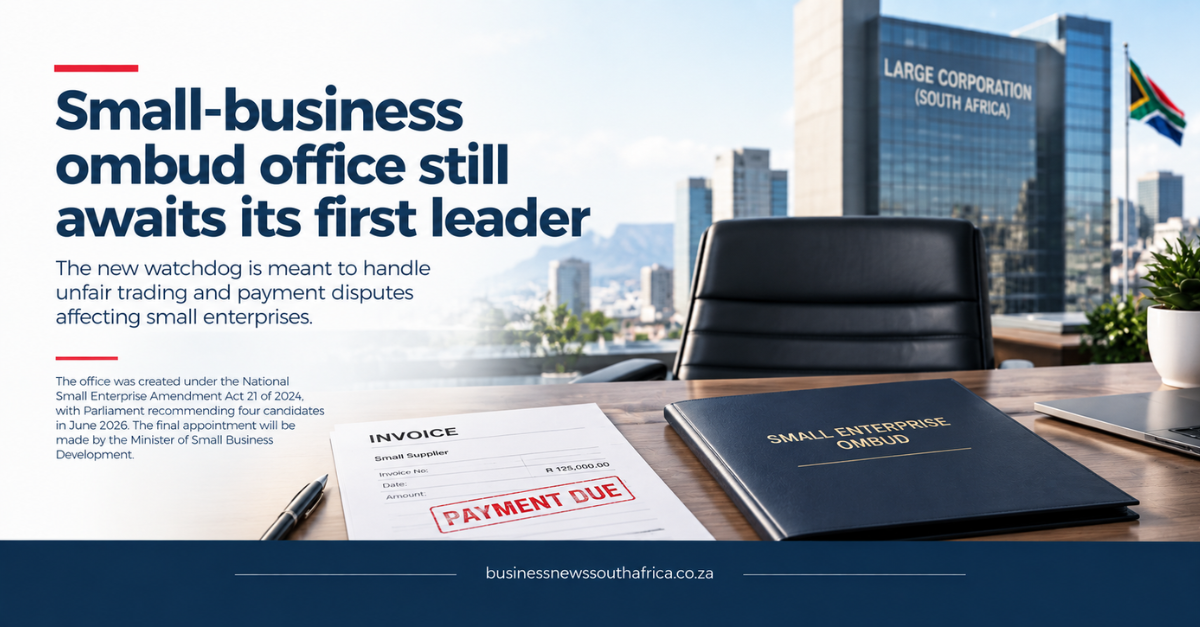
The other half of the Act, the part most directly aimed at protecting small suppliers from being squeezed by bigger, slower-paying customers, is still stuck. The Office of the Small Enterprise Ombud Service, created by the same legislation, does not yet have an Ombud in the job.
What the Ombud is actually meant to do
Late or non-payment by large corporate customers is one of the most common ways a small business’s cash flow gets strangled, and taking a big, well-resourced customer to court over an unpaid invoice is rarely realistic for a business with five employees and a lawyer it cannot afford to retain. The Ombud exists specifically to close that gap: it is empowered to investigate complaints about unfair trading practices, ambiguous contract terms, and late or non-payment of legitimate invoices, and where it upholds a complaint, its finding carries the same legal force as a court judgment, meaning a sheriff can move directly to attach a non-paying debtor’s assets without a separate court process first.
That is a genuinely unusual amount of enforcement power to hand an ombud service, closer to a specialised tribunal than the more familiar, advisory-only ombud model used in industries like short-term insurance or banking. It is also exactly why getting the appointment right has taken this long.
Why the appointment has stalled
The Portfolio Committee on Small Business Development ran a public nomination process, received 26 applications, and interviewed eight shortlisted candidates in April 2025, narrowing the field to four recommended candidates: advocates Lufuno Tokyo Nevondwe, Sonwabile Mancotywa, Lehlohonolo Lucky Rabotapi and Nande Mheshe. Since then, the committee has twice had to pause and revisit its own process: first to reconsider its report on the recommended candidates, and more recently to seek a formal legal opinion from Parliament’s own Constitution and Legal Services Office on how to handle concerns raised about a specific candidate without reopening the entire interview process from scratch.
That legal opinion has since been received, and it advises a targeted approach, giving the specific candidate under scrutiny a fair chance to respond, rather than restarting the process for all eight original applicants. Procedurally cautious as that approach is, for the small businesses the office is meant to serve, each additional month is a month without the fast, binding dispute-resolution route the Act promised.
What this means for small business owners right now
Until an Ombud is actually appointed and the office is operational, small businesses chasing unpaid invoices from larger corporate customers are still working with the tools that existed before the Act: direct negotiation, mediation through industry bodies where available, or conventional litigation, expensive and slow precisely because it favours the better-resourced party in the dispute. SEDFA’s own funding and support functions are live and can be engaged with now, the Ombud’s enforcement powers cannot yet be relied on for a live payment dispute.
Business owners in supply chains dominated by a small number of large corporate customers, retail suppliers, construction subcontractors, service providers to major companies, should treat the Ombud’s eventual launch as worth tracking closely rather than assuming it is already available, and in the meantime should keep contract terms, delivery confirmations and payment correspondence in better order than they might otherwise, since that documentation is exactly what a future Ombud complaint, or a conventional legal claim in the meantime, would need to succeed.