When a private school in Gauteng sent a notice of termination to a family that had fallen behind on fees, the headmaster thought the contract was clear. The law firm Wright Rose-Innes says the Constitutional Court has reminded schools that contractual rights cannot be exercised in isolation from the Constitution.
Section 29(1)(a) of the Constitution guarantees everyone the right to a basic education. The Court has repeatedly held that this right applies to learners in independent schools as well as those in public schools. For public schools the South African Schools Act makes it clear that a learner cannot be expelled or denied a report because parents have not paid. Private schools, by contrast, operate under enrolment agreements that set out fee obligations and the circumstances under which enrolment can be terminated.
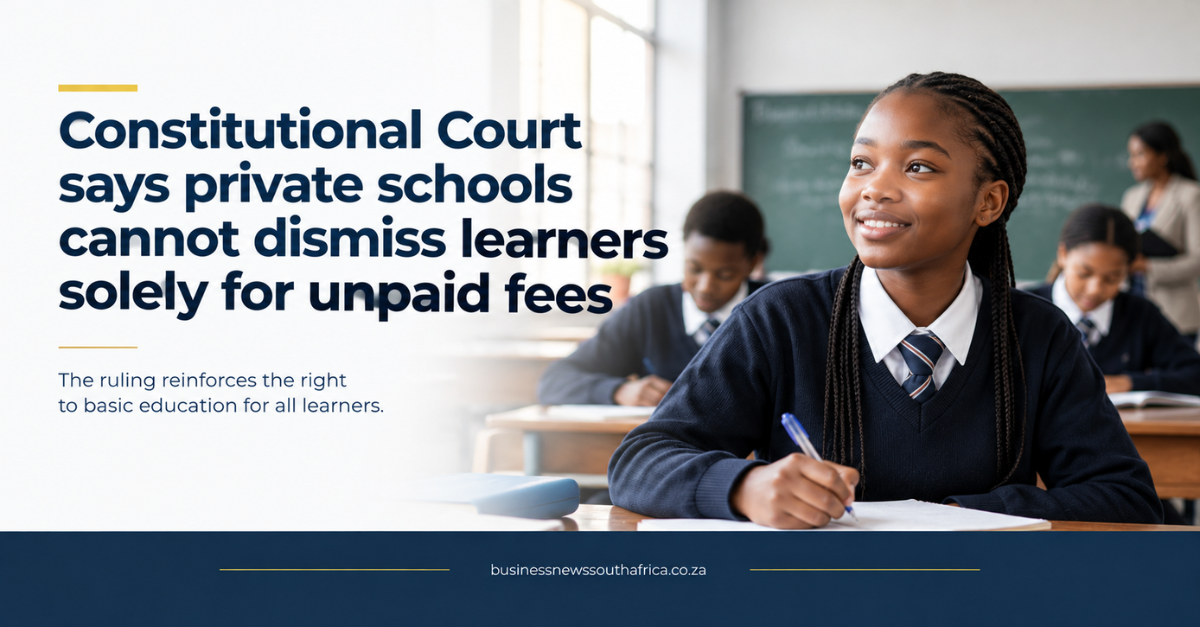
However, the Court has ruled that even a private-school contract must be exercised fairly. In a recent case involving two learners whose parents could not pay, the Court recognised that independent schools may enforce valid contracts, but it also stressed that they perform an important public function and therefore must respect constitutional duties. As Wright Rose-Innes put it, “contractual rights cannot be exercised in isolation from the Constitution.”
What does this mean for a private-school operator, many of whom run their institutions as small businesses? First, a breach of the fee clause does not give an automatic right to exclude a learner. Schools must follow the notice procedures set out in the enrolment agreement, give parents a reasonable chance to remedy the arrears, and consider the impact on the child’s right to education before taking any action. Ignoring these steps could expose the school to legal challenges, potential damages, and reputational damage.
For parents who are also SME owners, the advice is simple: raise financial difficulties with the school early. The Schools Act allows public-school parents to apply for fee exemptions; private-school parents do not have a statutory safety net, but a negotiated payment plan can avoid the risk of exclusion. The key point is that the enrolment agreement creates a legally enforceable financial obligation, but it is not a free-hand to terminate education without due process.
Practical steps for schools and parents
Schools should draft enrolment agreements that clearly outline:
- the amount and timing of fees,
- the notice period required before termination,
- the opportunity for parents to propose a repayment arrangement, and
- the criteria for assessing the best interests of the child.
Parents should keep records of all communications and, if arrears start to build, contact the school to discuss alternatives before a formal notice is issued. Both parties can benefit from using a compliance document generator to ensure that agreements meet constitutional standards.
The broader lesson for the private-education sector is that revenue protection must be balanced against constitutional obligations. While schools need to collect fees to stay viable, the Court’s guidance makes clear that the right to education is not a negotiable commodity.
For more analysis of how constitutional law intersects with business operations, see our Regulatory & Policy coverage.
Wright Rose-Innes highlighted that previous High Court judgments have affirmed the contractual nature of private-school enrolment agreements while stressing that those contracts remain subject to constitutional principles. The firm noted that the Constitutional Court, in assessing the termination of two learners’ enrolment, balanced the schools’ right to enforce valid contracts against the public function schools perform in delivering education. It further explained that the Court requires schools to act fairly, give appropriate notice of breach and consider the learner’s best interests before any exclusion. This reinforces the view that contractual rights cannot be exercised in isolation from the Constitution, a point the firm reiterated in its recent briefing.
According to Wright Rose-Innes, the South African Schools Act expressly forbids public schools from withholding a learner’s school report or transfer certificate because of unpaid fees, a safeguard that does not automatically extend to independent schools. The firm pointed out that while private schools may seek repayment through legal proceedings, they must not punish the learner for the parent’s failure to pay. This distinction underscores the different regulatory regimes governing public and private education and clarifies that private-school contracts must incorporate procedural fairness to avoid breaching constitutional duties.
In practice, a private-school enrolment agreement functions like any other commercial contract: it sets out the fee schedule, the notice period required for termination and the process for addressing defaults. For a school owner, this means drafting clear terms, issuing formal notices when fees fall behind and offering a reasonable window for parents to remedy the breach, such as a payment plan. Failure to follow these steps can expose the institution to judicial review, potential damages and reputational harm, making procedural compliance as vital as financial recovery.
Business owners should monitor forthcoming guidance from the Department of Basic Education and any amendments to the Schools Act that could affect private-school fee enforcement. Watching court filings in similar disputes will reveal how tribunals interpret “fairness” and “best interests of the child” in future cases. Keeping enrolment contracts up-to-date and maintaining open communication with parents will help schools navigate the balance between revenue protection and constitutional obligations, reducing the risk of costly litigation.