Households across South Africa are tightening their belts, with many pulling back on meals out, streaming services and even medical aid. The shift matters most to owners of restaurants, food-delivery platforms, local retailers and small-scale service providers who rely on discretionary spend.
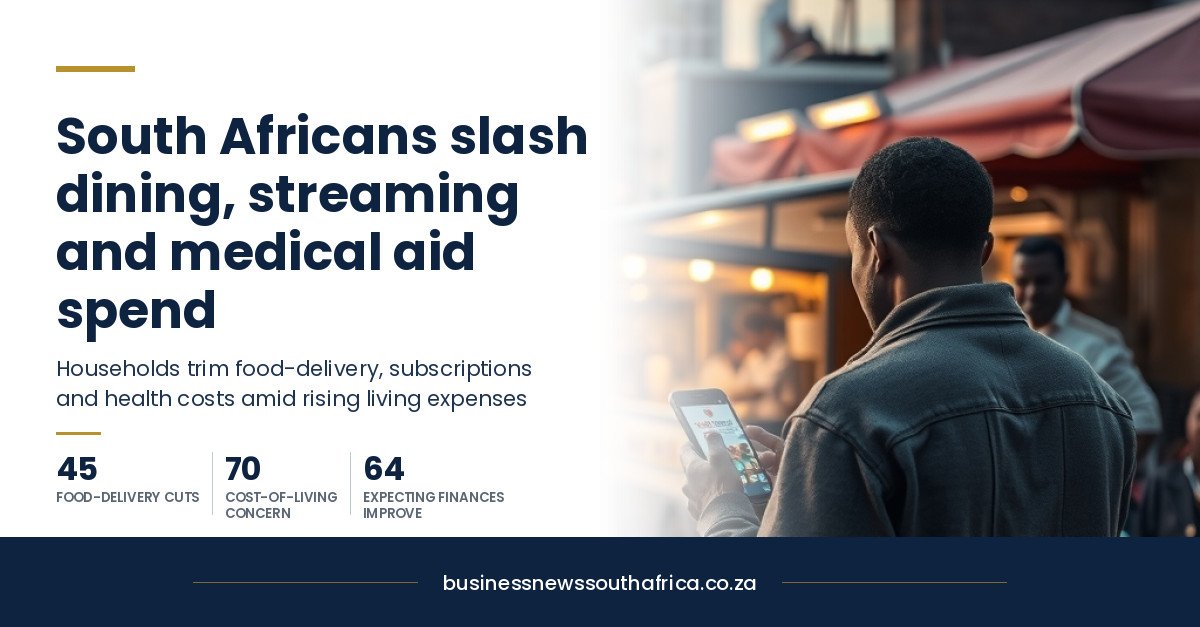
The insight comes from the NielsenIQ (NIQ) South Africa Consumer Outlook: Guide to 2026. The study found that 45% of respondents are cutting food-delivery and take-away orders, while 43% are spending less on dining out. At the same time, 28% have cancelled a subscription or membership and 24% have reduced spending on digital services such as television, internet or wireless plans.
“While inflation has abated and there are some green shoots in the economy, South African consumers are still spending cautiously,” said Zak Haeri, managing director of NIQ South Africa. He added that many households have “cut spending to the bone” and have a low tolerance for further price hikes.
For small businesses, the numbers translate into fewer orders, lower foot traffic and a need to rethink pricing or promotional strategies. NIQ’s Lané Klopper, Consumer Panel Services Lead, noted that brands are now promoting for up to 40 weeks a year, eroding traditional loyalty. “Consumers are more reactive to price increases and promotion than they were last year,” she said.
Beyond food, 43% of shoppers are removing ready-to-eat meals from their baskets and 42% are cutting non-essential groceries such as snacks and confectionery. Appliance purchases are also delayed, with 40% postponing small-appliance buys and 38% putting off major appliances. The trend extends to technology upgrades, including phone contracts.
Healthcare, while still a priority, is not immune. TransUnion’s Q2 2026 Consumer Pulse Study reported that 33% of South Africans plan to reduce spending on medical care and services. Most are downgrading medical-aid plans rather than cancelling outright, and some are postponing elective procedures.
These adjustments are driven primarily by the cost of living, cited by 70% of respondents as the biggest reason for feeling worse off. An economic slowdown (41%) and job insecurity (38%) follow as secondary concerns.
For entrepreneurs, the data suggests two immediate actions: focus on value-oriented offers and consider partnerships with spaza shops or independent retailers that are closer to consumers and can lower transport costs. As Klopper put it, “If I’m able to do my shopping at a place that is a lot closer, that will cost me less in terms of transport, then I would go do my shopping there.”
Retailers and manufacturers will need to grow volumes and market share by delivering affordable options, while service providers may explore flexible, short-term subscription models to match the emerging “subscription cycling” behaviour, signing up for a month, then switching to another platform.
Understanding these consumer trade-offs can help small businesses adapt their pricing, product mix and promotional calendars before the next quarter.
Read more about how consumer trends are shaping the SME & Entrepreneurship sector.
BusinessTech reported that while 64% of South Africans surveyed expect their household finances to improve by early 2026, 37% said they felt worse off than a year ago, an increase from 33% in the previous round. At the same time, the share of respondents who felt better off slipped from 42% to 38%. These shifts underline a growing sense of financial strain even among those who remain optimistic, and they echo the broader narrative of cost-of-living pressure that is reshaping discretionary spending across the economy.
BusinessTech also highlighted that DStv customers are increasingly gravitating toward cheaper packages or turning to free, advertising-supported services and platforms such as YouTube. This migration reflects the “subscription cycling” pattern where households sign up for premium streaming for a short burst, then switch to lower-cost or free alternatives. The trend is not limited to video; it extends to music, gaming and other digital content, amplifying the pressure on traditional pay-TV operators to rethink pricing and value propositions.
Consumer outlook surveys like the NIQ Consumer Outlook: Guide to 2026 combine online panels, telephone interviews and face-to-face questionnaires to capture a cross-section of households. Respondents are asked about current spending, future expectations and the factors influencing their decisions. The data are weighted to reflect national demographics, allowing analysts to extrapolate trends such as the rise in “subscription cycling” or the willingness to trade brand loyalty for price. For South African business owners, these insights act as an early warning system, signalling where demand may contract or shift.
Looking ahead, entrepreneurs should monitor quarterly updates from NIQ and TransUnion for any changes in the proportion of households cutting back on essential categories like medical aid or ready-to-eat meals. Watching the evolution of promotional calendars, especially the length of discount periods, will help gauge whether price sensitivity is deepening. Keeping an eye on the uptake of free, ad-supported streaming options will also be key, as a sustained move away from premium subscriptions could reshape revenue models for both content providers and advertisers.