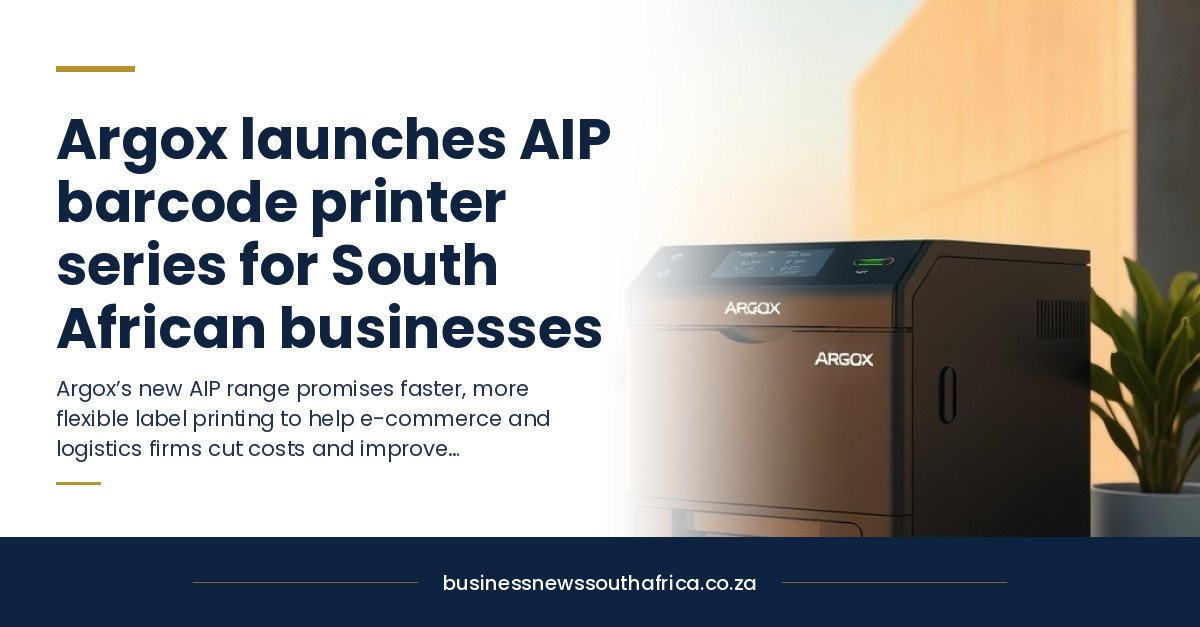
In a busy distribution centre, a forklift driver pauses to scan a freshly printed label before loading a pallet. The printer that produced the label is part of Argox’s newly announced AIP series, a line of barcode printers aimed at South African companies that need reliable, quick labelling for fast-moving inventory.
According to TechCentral, Edward Lee, senior manager at Argox and project lead for the AIP range, said the two-year development effort was driven by direct feedback from Argox customers. Lee describes the printers as built for “future-proof integration, connectivity, flexibility and ease of use”. That description is a company claim; independent testing of the devices has not yet been published.
The AIP printers combine several features that matter to small and medium-size enterprises. Speed and reliability are taken as a given, while the price discussion now focuses on total cost of ownership, the overall expense of running the printer over its life, not just the sticker price. Each model offers a choice of resolution measured in dots-per-inch (DPI, the number of printed dots in a line of one inch), allowing businesses to match detail level to their needs and avoid over-specification. Connectivity is plug-play, meaning the printer can be linked to existing systems without complex setup, and drivers work with Windows and BarTender software, a popular label-design program.
Beyond the basics, the printers support direct font downloading to memory, which saves time compared with converting fonts to bitmap images. Built-in support for a range of label stocks and optional RFID (radio-frequency identification) encoding lets users add electronic tags to labels for enhanced traceability. Advanced status monitoring alerts operators to performance issues before they cause downtime.
For South African SMEs, these capabilities address real pressures. The country’s e-commerce sector has been expanding rapidly, pushing logistics firms to handle higher SKU (stock-keeping unit) volumes and faster turnover. Accurate, quick labelling helps manage inventory, reduces shrinkage, and combats counterfeit products that can erode brand value. By choosing a printer that balances cost with the right specifications, a business can avoid paying for features it will never use while still having room to grow.
The AIP series will be demonstrated at the Kemtek GT 2026 Connected Intelligence Tour in Durban, Cape Town and Johannesburg in October 2026. Interested parties can contact Riaan de Koker, auto-ID product manager at Kemtek, by e-mail or phone. For more background on how barcode technology fits into broader digital transformation, see our Tech & Telco coverage.
TechCentral reported that the two-year development cycle for the AIP range was driven by continuous feedback loops with Argox’s client base, a practice the company says has become “a new generation of barcode printers designed with multiple sectors very much in mind”. Lee’s team used that input to embed features such as plug-and-play connectivity, driver compatibility with Windows and BarTender and a suite of RFID encoding options. The source adds that Argox’s decades of experience helped shape a portfolio that balances speed, reliability and total cost of ownership, allowing businesses to avoid the trap of over-specifying equipment while still gaining the flexibility to scale as demand grows.
The AIP series illustrates how modern label printers have shifted from a final-step, static device to an active node in a company’s information flow. Rather than printing a one-off label, the printer now receives real-time data from inventory systems, applies the chosen DPI setting and can embed RFID tags before the label leaves the machine. This integration reduces manual handling, shortens the time between order receipt and dispatch and gives managers immediate visibility into performance metrics through advanced status monitoring. For South African owners, that means less downtime, lower labour costs and a clearer audit trail for compliance purposes.
When evaluating a purchase, Lee advises buyers to adopt a three-to-five-year horizon, weighing how the printer will support future SKU volumes, faster turnover and tighter traceability requirements. The ability to download fonts directly to printer memory, rather than converting each to a bitmap, saves the “most precious commodity of all: time”, as the source notes. Companies that choose a model with the appropriate DPI can avoid paying for unnecessary detail while still meeting regulatory labeling standards, a balance that directly influences the total cost of ownership over the device’s lifespan.
South African SMEs should also monitor the upcoming Kemtek GT 2026 Connected Intelligence Tour, where the AIP printers will be demonstrated in Durban, Cape Town and Johannesburg in October 2026. Attending the tour offers a chance to see live how the status-monitoring dashboard flags potential issues before they cause disruption, and to discuss integration scenarios with Riaan de Koker, auto-ID product manager at Kemtek. Engaging with the demo can help firms confirm that the chosen model aligns with their current software stack and future expansion plans.
Looking ahead, the broader e-commerce surge and expanding logistics networks will keep pressure on label accuracy and speed. As the source material highlights, manufacturers like Argox are responding by refining plug-and-play functionality and enhancing RFID capabilities, which together improve traceability across the supply chain. Business owners should therefore keep an eye on updates to driver support and firmware upgrades that may unlock new features, ensuring their investment remains relevant as industry standards evolve and new regulatory requirements emerge.