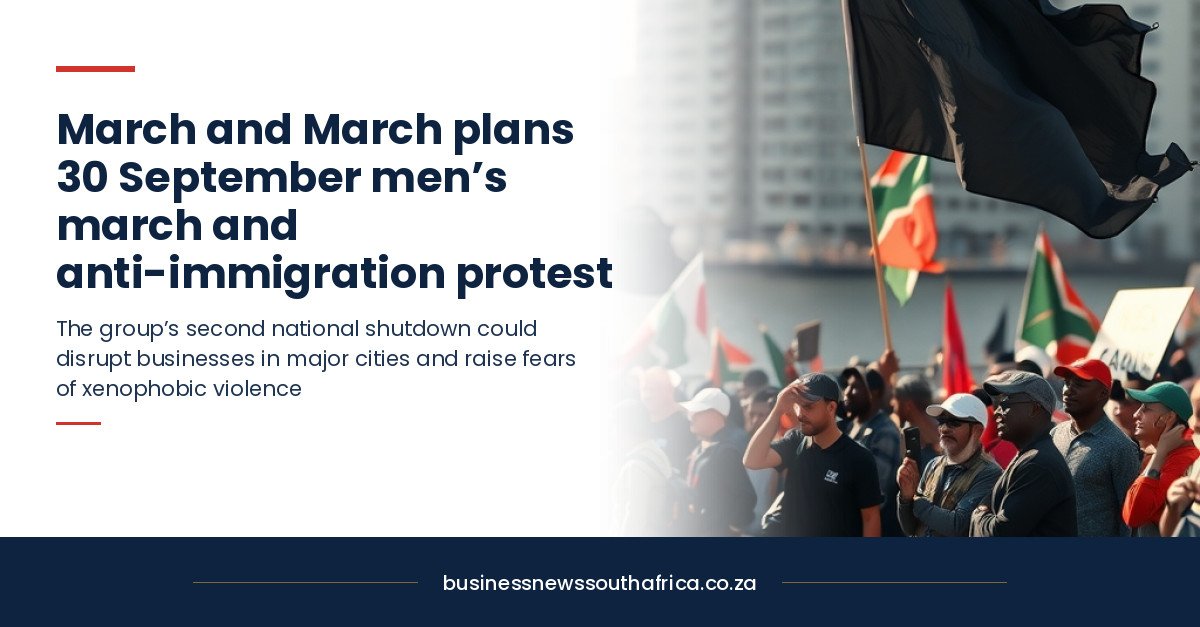
On Wednesday, 30 September, streets in Pretoria, Johannesburg, Durban and Cape Town are expected to fill with men marching against gender-based violence and a second nationwide protest against illegal immigration, organised by the group March and March. The protest is being billed as a “Men’s March” and a “national shutdown”, a term the group uses to describe coordinated street actions that aim to bring the country to a standstill.
The group’s leader, Jacinta Ngobese-Zuma, told supporters that the day is a chance for men to “speak in one voice and claim our society back from criminals”. She also linked the march to the recent murders of 12 women, urging participants to protest against gender-based violence (GBV) as well as what the group describes as illegal immigration.
According to the announcement, marches will take place in the major cities and several other towns. The South African Police Service (SAPS) has said that the deadline is “arbitrary” and that it will continue its normal policing operations, focusing on law and order and responding to incidents as they arise.
What this means for small and medium-size enterprises
For owners of small and medium-size enterprises (SMEs), the prospect of a national shutdown raises practical concerns. The June 30 protests earlier this year saw at least one fatality, more than 900 arrests and “millions of rands” in business losses, largely in township economies. While the exact figure was not disclosed, the loss of sales, damage to premises and the need for additional security can quickly erode thin profit margins.
SME owners in the affected cities should consider the following steps:
- Review insurance policies to confirm coverage for civil unrest and vandalism.
- Plan for possible staff shortages if employees choose not to travel.
- Secure supply chains, especially if deliveries are expected to be delayed.
- Communicate with customers about any changes to opening hours or service availability.
These measures are not new, but the timing of the protest, a weekday during business hours, makes them more urgent. The president’s weekly letter to the nation, published on the President’s website, called for calm and unity, warning that violence would damage the country’s reputation and its economy.
President Cyril Ramaphosa’s statement highlighted two separate issues: the rise in GBV and the perception of South Africa as unfriendly to foreigners. He stressed that migration must be managed within the law and that the country will not be “defined by xenophobia and intolerance”. While the president’s remarks are political, they also signal that the government does not intend to change its policing approach for the protest.
March and March has framed the protest as a response to resource strain, arguing that South Africa “is falling apart” and lacks sufficient schools, hospitals and housing. The group’s narrative shifts the focus from xenophobia to a broader debate about African migration, but the language used has nonetheless reignited fears of targeted attacks on foreign workers.
For business owners, the key question is not whether the protest will turn violent, that remains uncertain, but how to mitigate risk if disruptions occur. The cost of hiring private security, for example, can run into tens of thousands of rands per day for a small retailer, a figure that may outweigh any short-term loss of sales.
In the weeks leading up to the protest, the SAPS allocated R600 million to peace-keeping operations, of which R306 million had been spent. The remaining budget suggests that authorities expect to deploy additional resources on the day, but the exact deployment plan has not been disclosed.
SME owners can also look to the Business News South Africa Regulatory & Policy section for updates on any official guidance that may be issued in the hours before the march. Keeping an eye on local radio and municipal alerts can provide real-time information about road closures or curfews.
In summary, the 30 September protest is likely to create a climate of uncertainty for businesses in the major metros. While the group claims the day is a peaceful call to action, the history of recent protests suggests that preparation and risk management are essential for any SME hoping to stay afloat.