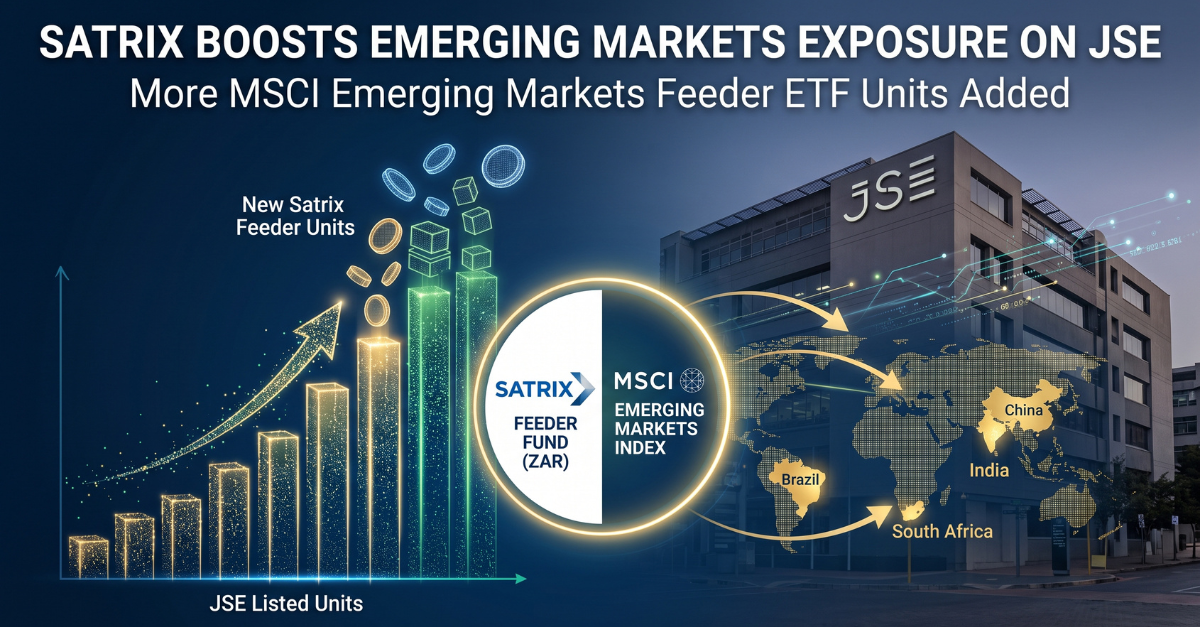
Satrix has quietly made it easier to buy into emerging markets from a South African brokerage account, listing additional units of its MSCI Emerging Markets Feeder fund on the JSE according to Moneyweb. The practical effect is simple: investors can now buy more of the unit trust tracking the MSCI Emerging Markets index, the benchmark measuring stock performance across developing economies.
For a small business owner or entrepreneur, the appeal lies in exposure to genuinely fast-growing markets like China, India and Brazil, economies that often post higher growth rates than South Africa’s own, and a single diversified fund offers a way to hedge against local economic swings without the hassle of picking individual overseas stocks one by one.
What a feeder fund actually does, and why more units matter
A feeder fund pools investor money and channels the bulk of it into a master fund, here the MSCI Emerging Markets index itself, so the Satrix version mirrors that index’s performance minus the cost of running the local vehicle. Because it trades on the JSE, investors buy and sell units through an ordinary brokerage account, exactly like a share. The additional listing exists to solve a specific problem: when a fund runs low on available units, its price can drift away from the underlying index, making it a worse deal for anyone trying to buy in. Expanding the pool of tradable units keeps the fund’s price closely aligned with what it is actually meant to track.
New units are typically offered at the prevailing net asset value, the per-unit worth of the fund’s holdings after fees, so investors should check the current NAV on the JSE website or their broker’s platform before buying rather than assuming yesterday’s price still holds. Satrix’s fee structure for index-linked funds has historically undercut actively managed alternatives, a real consideration for a small business trying to keep investment costs down.
It is worth knowing the MSCI Emerging Markets index rebalances quarterly, meaning the underlying basket of stocks shifts regularly as market capitalisation and eligibility change, and the feeder fund inherits those changes automatically, sparing investors from having to adjust holdings by hand every few months. Listed unit trusts like this one have become a genuinely popular route for South African retail investors seeking global exposure, partly because the JSE’s listing rules demand transparent, regular disclosure, a level of confidence some offshore platforms simply do not offer.
For entrepreneurs weighing where to park surplus cash, this fund offers a relatively liquid, diversified option accessible through the same channels used to buy shares. As with any investment, though, the value moves in both directions, and emerging-market performance tends to swing harder than developed markets do, so the decision to invest should still rest on individual risk tolerance and time horizon rather than the simple fact that more units are now available to buy.
South Africa itself sits inside the same MSCI Emerging Markets universe this fund tracks, which creates an interesting wrinkle worth knowing: a South African investor buying this feeder fund is not purely diversifying away from home risk, since the index includes South African shares alongside China, India and Brazil among others. The genuine diversification benefit comes from the other markets in the basket rather than the South African slice, which investors already hold plenty of through their existing local portfolios, a distinction worth keeping in mind rather than assuming the fund is a clean, total escape from domestic exposure. Emerging-market allocations also tend to move in cycles tied to global risk appetite generally, doing well when investors are chasing growth and falling out of favour quickly when sentiment sours, a volatility pattern worth expecting rather than being surprised by after the fact.