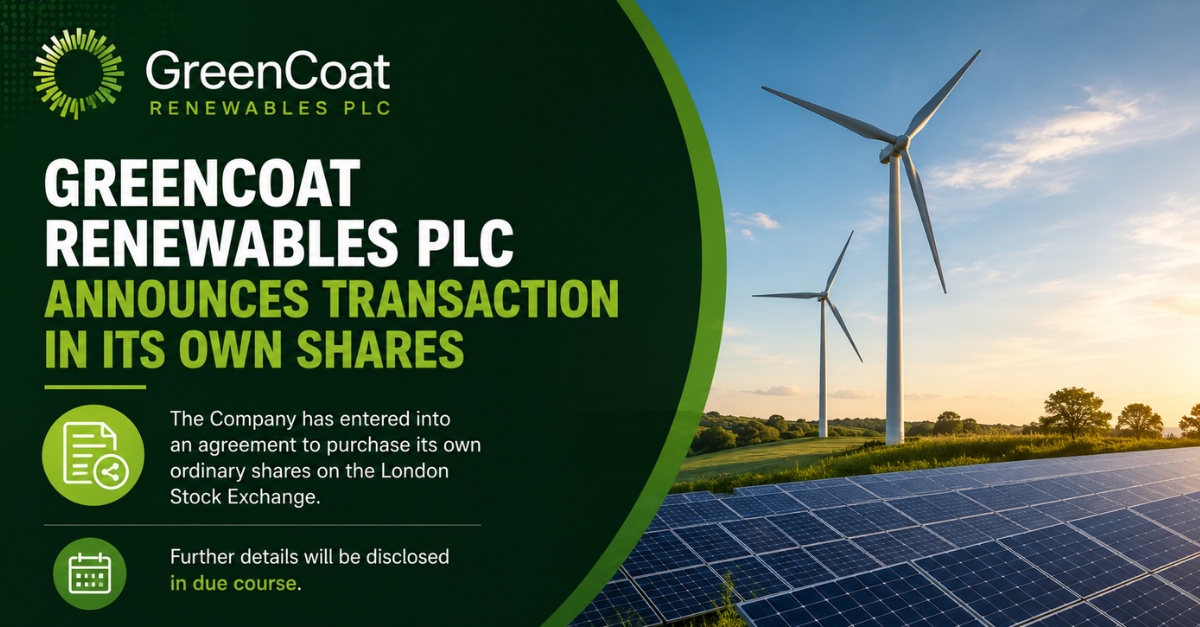
In a modest filing that landed on the JSE newswire, GreenCoat Renewables PLC confirmed it has entered into a transaction involving its own shares, according to Moneyweb. The brief announcement does not give the size of the deal, the price paid, or the timing beyond the filing date, leaving the exact financial impact genuinely open to interpretation for now.
When a listed company buys back its own equity, the move is recorded as a transaction in own shares under JSE reporting rules. In plain terms, the firm uses cash on its balance sheet to purchase shares from the market or from specific shareholders, and the purchased shares are usually cancelled, reducing total shares outstanding. Fewer shares mean each remaining one represents a slightly larger slice of the company, often nudging earnings per share upward without the business having grown at all.
Why a renewable-energy firm might choose a buyback specifically
GreenCoat Renewable’s core business is developing, owning and operating solar and wind farms across South Africa, a genuinely capital-intensive sector where projects require significant upfront engineering, procurement and construction spend before any revenue starts flowing. A buyback in this context raises a real question about cash allocation: it can signal management believes the stock is undervalued and that attractive new acquisition or development opportunities are scarce right now, or it can simply be a smaller, tactical adjustment sitting alongside continued investment in existing and new projects.
For investors, the immediate effect is often a modest lift in share price as the market reads the buyback as a signal of confidence. Over the longer term, the impact depends on whether this is part of a broader capital-return policy or a one-off adjustment, and since the filing does not state GreenCoat’s rationale, analysts will lean on past board statements and the broader pattern among South African renewable firms to fill in the gap. Several listed renewable developers have announced similar buybacks over the past twelve months, citing strong operating cash flows and a desire to improve return metrics, moves generally welcomed by shareholders in a market where dividend yields remain fairly modest, though critics note buybacks can also mask underlying cash-flow constraints if a company later runs into unexpected cost overruns on new projects.
For small and medium enterprises, the direct relevance of GreenCoat’s transaction is limited: it does not alter the regulatory environment for independent power producers, nor does it change electricity pricing under the national tariff framework. What the episode does illustrate is how listed firms manage capital in a sector where financing can be genuinely volatile, a trade-off worth noting for any SME weighing equity financing against simply retaining cash for its own growth.
What remains unknown from this filing is the exact amount of cash deployed, the proportion of shares repurchased relative to total issued shares, and whether GreenCoat intends to repeat the exercise, details the JSE requires in a subsequent, more detailed announcement still to come. In summary, this is a share buyback in substance if not yet confirmed in exact scale, and the market will need that fuller disclosure before it can properly weigh how significant a move it actually is.
South Africa’s renewable-energy sector has matured considerably from its earlier, purely growth-focused phase, where every available rand went into new capacity, into one where established operators with a base of already-operating wind and solar assets increasingly have to make the same capital-allocation decisions as any other mature industrial business. A buyback like this one is, in that sense, a small but genuine signal that at least part of the sector has reached the stage where returning cash to shareholders is a real option sitting alongside building new projects, rather than growth capital being the only thing on the table.