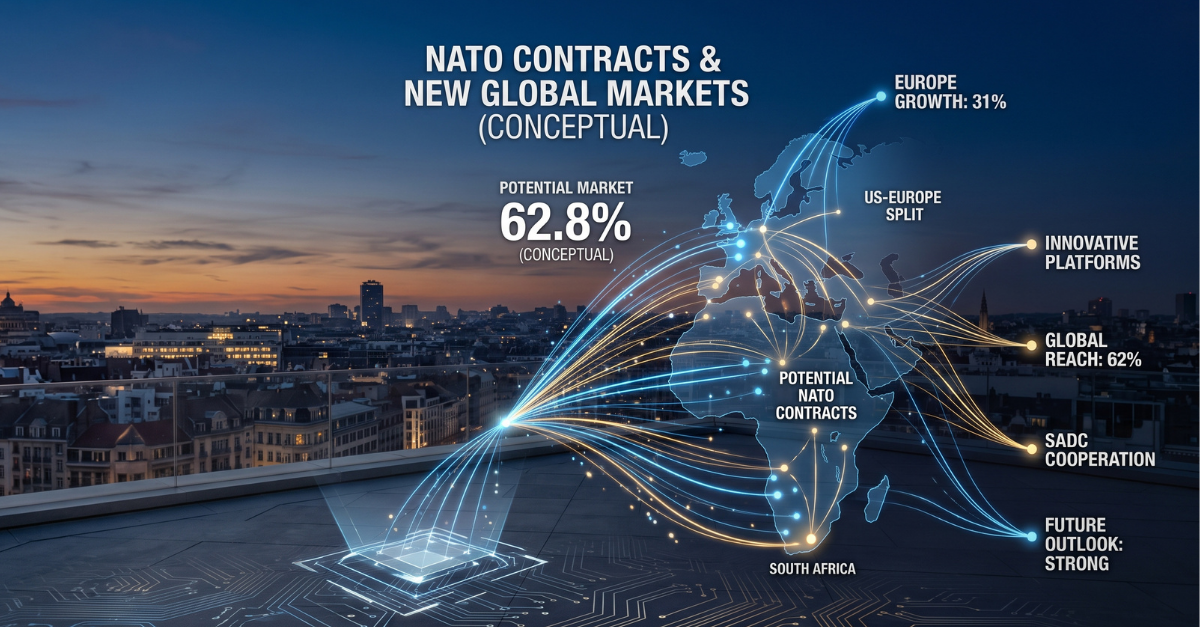
At the Gerotek testing facility west of Pretoria, Deon Grobler, head of Paramount Group’s international vehicle business, pointed to a shifting geopolitical landscape as a catalyst for growth. “We are definitely seeing shifts,” Grobler said on Wednesday. “There were no NATO markets two years ago. That has definitely opened up.” The comment came in a statement from Paramount Group, the South African-founded defence company, which sees the widening rift between the United States and its European allies as a genuinely new sales avenue rather than a passing headline.
NATO, the North Atlantic Treaty Organisation, a military alliance of 31 North American and European countries, has traditionally sourced equipment from its own members. Growing mistrust of US policy among some European states is prompting them to diversify suppliers, creating openings for firms that can offer proven, locally produced platforms, exactly the gap a South African defence manufacturer with decades of export experience is positioned to fill.
What Paramount is actually building, and for whom
Paramount, now active in about 30 nations, has historically sold armoured vehicles to African customers and developing markets such as Jordan, Ecuador and Kazakhstan. The company’s portfolio includes the Mbombe 4 Infantry Combat Vehicle, a four-wheel, 16-ton mine-protected truck capable of 140 kilometres per hour and an 800-kilometre range, alongside the six- and eight-wheel Mbombe series, the Marauder and Maatla armoured cars, and the Maverick and Marshall public-order vehicles.
Through its Greek subsidiary, Paramount is already collaborating with local partner MAC HUB in Ukraine to produce the MAC OWL armoured vehicle, certified for Ukrainian armed forces in June and based on the Mbombe 4 platform. The same partnership is developing the MAC Dead Fly interceptor drone, designed to neutralise hostile drones, and the KATRAN uncrewed surface vessel, a remotely operated boat for maritime security, a genuinely broad product line for a company that started out building armoured trucks for African militaries.
Grobler added that the company is increasingly focusing on protection against drones as well as mines, reflecting a broader industry shift toward counter-unmanned-air-system capabilities that aligns closely with NATO members’ recent procurement programmes prioritising electronic and kinetic counter-drone solutions. Other overseas projects include a joint venture with a Czech partner to manufacture armoured cars, and a forthcoming light armoured multipurpose vehicle to be unveiled at a Pretoria exhibition next month in partnership with an Indian firm.
Mathews Phosa, chairman of Paramount’s South African unit, described the firm’s portable production model as a way to combine South African technology and intellectual property with local manufacturing capacity abroad. In practice, design work and core components stay in South Africa while final assembly and integration happen with partners in the target market, reducing export barriers and creating local jobs on both ends of the arrangement.
The timing coincides with a genuine collapse in South African defence spending, which has forced Paramount to look outward for revenue in the first place. The new NATO opportunities could meaningfully boost turnover, but they also expose the company to the volatility of foreign defence budgets and to compliance requirements considerably different from those in its traditional markets. For South African suppliers and service providers, Paramount’s export push may translate into real subcontracting work in component machining, electronics and logistics, though the actual scale of that opportunity depends entirely on the size of the contracts Paramount secures from NATO members and its ability to meet the alliance’s genuinely stringent standards.
South Africa’s own defence industrial base has a long, if uneven, history of exporting despite domestic budget constraints, built originally during the apartheid-era arms embargo when the country had little choice but to develop everything itself. Paramount’s current pivot toward NATO markets is, in that sense, a continuation of a decades-old pattern rather than a genuinely new phenomenon, a domestic industry using export markets to sustain capability the local defence budget alone has rarely been able to fund on its own.