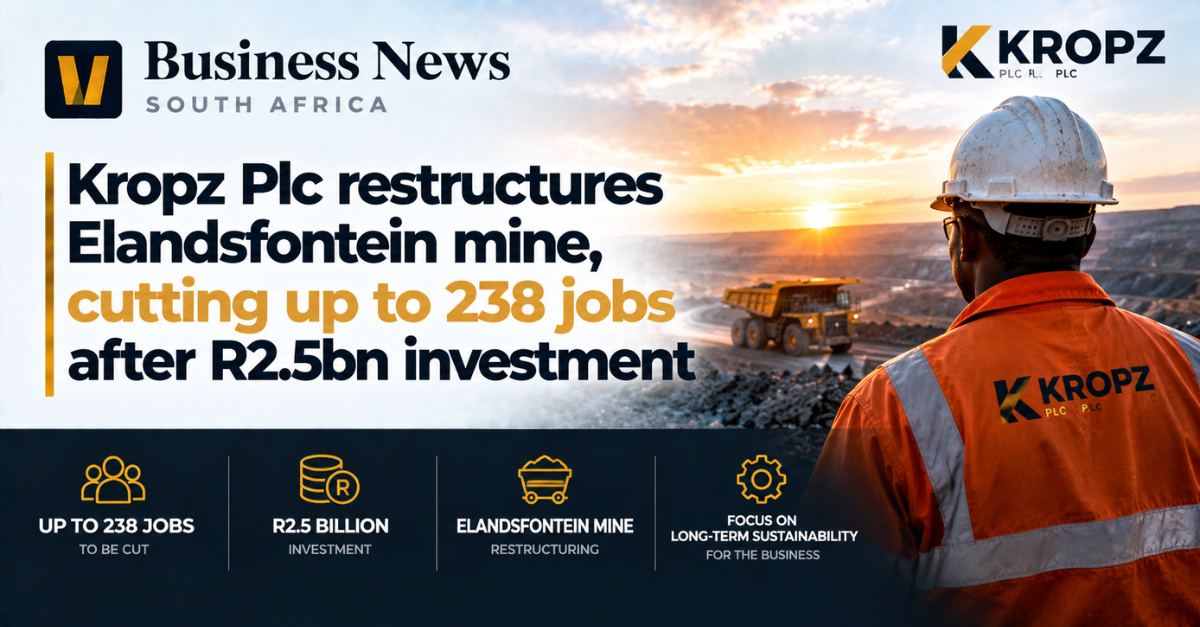
London-listed Kropz Plc announced on Monday that it will restructure its sole operating asset, the Elandsfontein phosphate mine, effectively halting production of its main product. The move follows a R2.5 billion (US$160 million) investment that has not delivered the expected profit, and it comes with a warning from contractor Trollope Mining Group that up to 238 jobs could disappear by the end of November.
For South African investors and anyone watching the country’s mining sector, the stakes are clear: the near-decade-long backing of billionaire Patrice Motsepe’s African Rainbow Capital Ltd. (ARC) is now at risk of losing a substantial portion of its capital. ARC holds roughly 90 % of Kropz, meaning any loss in the miner’s value directly hits Motsepe’s balance sheet.
Restructuring, in this context, means the company will change the way the mine is operated and financed. Kropz said it will cease output of phosphate rock, the raw material used to make fertiliser, and will sell down its existing stockpiles. Instead, it will focus on producing “nanophos”, a softer rock that releases phosphate more gradually. The term nanophos refers to a low-grade phosphate material that can be processed into a more controlled fertiliser product.
The decision is tied to two external pressures that have been documented in the industry. First, the ongoing conflict between the United States and Iran has disrupted the global fertiliser supply chain, limiting the availability of key inputs such as phosphoric acid. Second, the broader Middle East conflict has pushed up prices for fertiliser inputs, squeezing margins for producers worldwide. Kropz’s own statement linked “significant financial pressure” to these geopolitical factors.
From a broader perspective, the Elandsfontein mine has struggled to meet production targets since ARC took control in 2018. The mine’s location, about 70 miles northwest of Cape Town, has also been controversial because part of the operation sits near a national park, raising environmental concerns that have occasionally slowed progress.
For small-to-medium enterprises that rely on fertiliser, from grain growers to horticultural suppliers, the reduction in phosphate rock output could tighten local supply. While Kropz’s shift to nanophos may eventually open a niche market, the immediate effect is a contraction in the amount of conventional fertiliser available from a domestic source.
Share price reaction underscores the market’s alarm. Kropz’s shares fell 39 % on the London Stock Exchange, leaving the company with a market capitalisation of roughly £9.1 million (R196 million), a steep drop from the £120 million (R2.59 billion) peak recorded in 2022. Market capitalisation is the total value of a company’s shares, calculated by multiplying the share price by the number of shares outstanding.
ARC declined to comment beyond the statement released by Kropz, and both Kropz and Trollope Mining Group did not respond to requests for further comment. The lack of additional detail means the full extent of the financial hit to Motsepe’s portfolio remains uncertain.
What the restructuring means for the sector
The move highlights a growing vulnerability in South Africa’s fertiliser value chain. Local producers have historically depended on imported inputs, and any disruption abroad quickly ripples through to domestic prices. Companies that have invested heavily in single-commodity operations, like Kropz, are now facing the reality that geopolitical shocks can outweigh even large capital injections.
For entrepreneurs in the agribusiness space, the story serves as a reminder to diversify supply sources and to monitor global political developments that can affect input costs. It also points to a potential opportunity: the emerging nanophos market may attract niche buyers looking for slower-release fertiliser solutions, though the scale of that market is still unclear.
The particular fragility of a single asset producer
A mining company with one operating mine has no internal shock absorber. A diversified producer can carry a loss making operation on the earnings of another, or slow one project while another funds the group. A single asset company has only the one set of numbers, so a fall in the commodity price, a grade problem, a processing difficulty or a cost shock arrives at the group’s accounts undiluted. Investors price that concentration knowingly, which is why single asset developers tend to trade at a discount to diversified peers and why they rely more heavily on a supportive anchor shareholder to bridge difficult periods.
The stage of the life cycle matters as much as the concentration. Bringing a new mine into steady production is the point at which most of the capital has been spent and none of the assumptions have yet been fully tested at scale. Recovery rates, ore hardness, water handling and the consistency of the ore body frequently behave differently in commercial operation from how they behaved in a feasibility study, and the gap between the two is where a great deal of mining capital has historically been lost. A period of underperformance after commissioning is common enough to be an expected risk rather than a surprise.
What a restructuring of this kind involves
Ceasing production of a main product does not necessarily mean closing a mine, and the distinction has real consequences for the people affected. An operation can be placed on care and maintenance, where the workings are kept safe, dewatered and legally compliant so that production could restart, which preserves the option at a continuing cost. Full closure triggers a separate and expensive set of obligations, including rehabilitation of the site funded from provisions the company is required to hold.
Where jobs are at risk, South African law sets out a consultation process that an employer must follow before retrenching, covering the reasons, alternatives to dismissal, selection criteria and severance. It is a process obligation rather than a guarantee of an outcome, and it takes time, which is why an announced number of positions at risk and a final number of jobs lost are usually different figures.
Contract workers are also generally the first affected in a downturn of this kind, because a contractor’s workforce is the part of the cost base an operator can reduce fastest. That is the commercial logic of using contractors in the first place. It also means the employment impact of a restructuring is frequently borne by people who are not on the mine owner’s payroll and do not appear in its headcount.