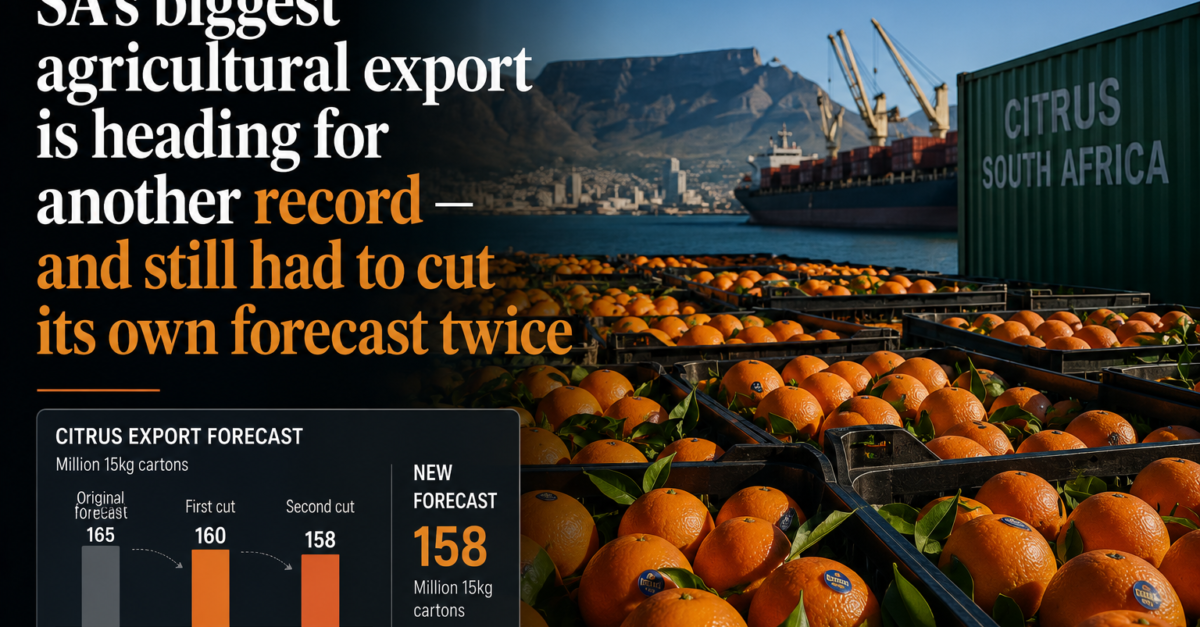
South Africa’s single largest agricultural export by value is not wine, not maize and not table grapes. It is citrus, and it earned the country R44.9 billion, about $2.74 billion, in 2025 on record shipments of 203.4 million cartons. The 2026 season is on course to beat that. It is also a useful case study in how a record year can arrive while the people producing it keep revising their expectations downwards.
Two forecast cuts on the way to a record
The Citrus Growers’ Association of Southern Africa opened the season pointing at 210 to 215 million cartons. That came down to 209.4 million, then to 205.3 million, and reporting from FreshPlaza tracked a further cut to 197.9 million cartons as the season progressed. Even at the lower end of that range the crop sits close to last year’s record; at 205.3 million it clears it by roughly 1%, against an early-season hope of 5% growth.
Two things drove the trimming. Weather in key growing regions came in worse than assumed. And the war in the Middle East has made a significant export destination materially harder to reach.
Why the Middle East problem is a logistics problem, not a demand problem
This is the distinction that matters for anyone reading the numbers, and it is easy to miss. Demand for South African citrus in the Gulf has not collapsed. The difficulty is getting fruit there: conflict-affected shipping routes mean longer voyages, rerouting, higher insurance and freight costs, and more days in a container for a product whose entire commercial value depends on arriving in good condition within a fixed window.
Citrus is unusually exposed to that specific kind of disruption. It is a perishable, seasonal, counter-cyclical export — South Africa sells into the northern hemisphere precisely when northern growers are out of season, which is a genuine structural advantage but also a hard deadline. A shipment that arrives late does not simply earn less; it can miss its market window entirely, and there is no option to hold inventory until conditions improve.
What it means further down the chain
Citrus at this scale is not just a farming story. A 200-million-carton export season pulls in packhouses, cold storage, carton and packaging manufacturers, phytosanitary inspection services, container logistics, port capacity and a large seasonal labour force, much of it in the Eastern Cape, Limpopo and the Western Cape where alternative formal employment is thin.
That makes the forecast revisions worth watching for reasons beyond grower income. Packhouse and cold-store capacity, transport contracts and seasonal hiring are all committed in advance against an estimate. When the estimate moves 12 million cartons between the opening projection and the working number, the businesses that geared up for the higher figure carry the cost of the gap, and they are typically much smaller and much less able to absorb it than the exporters at the top of the chain.
It also sharpens a strategic question the industry has been circling for years. Being the counter-seasonal supplier to Europe and, increasingly, Asia and the Gulf is what makes South African citrus valuable, but it concentrates risk in shipping lanes the country does not control and cannot influence. Diversifying destination markets spreads that risk; it also means more routes, more phytosanitary protocols and more compliance overhead, which favours large exporters over small ones.
For now, the headline stands: South Africa is heading for another record citrus season, holding its position among the world’s top exporters alongside Spain. The more informative number is the distance between what growers thought the season would deliver in April and what they expect it to deliver now, because that gap is where the weather, the freight rates and the war actually show up.