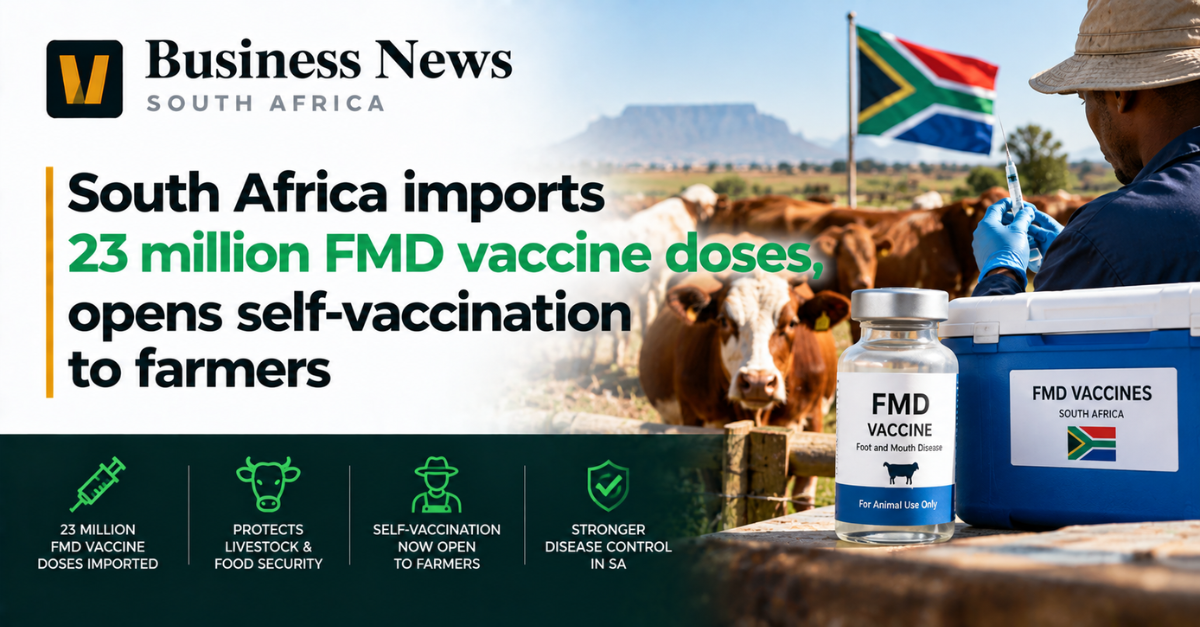
At a recent TLU SA Congress in Pretoria, Agriculture Minister Willie Aucamp announced that the government and private sector have together imported more than 23 million doses of Foot-and-Mouth Disease (FMD, a contagious viral disease that attacks cattle, sheep and goats) into South Africa. The minister said the first round of vaccinations has already covered every commercial dairy cow, roughly 1.38 million animals, and that booster shots are now being distributed.
For the average livestock farmer, the announcement marks a shift from a system where only the state could purchase and give out vaccines to one where farmers can obtain and administer the shots themselves. Aucamp explained that the Department of Agriculture has created a legal pathway for farmers to register as authorised persons, meaning they are recognised by the department as able to vaccinate their own herds. To date, more than 1 000 farmers have completed the online registration.
Why does this matter to a small-scale cattle owner? First, it removes a bottleneck that previously forced every farmer to wait for government-run vaccination campaigns, which often suffered from delays and limited coverage. Second, it gives farmers the flexibility to protect their stock on their own timetable, reducing the risk of losing animals to an outbreak that can wipe out a herd in weeks.
The change follows a series of legal and policy steps that began in early 2025 when a severe FMD outbreak spread from KwaZulu-Natal to Mpumalanga and Gauteng after infected cattle were sold at auction. At the time, the disease was classified as state-controlled, meaning only the government could procure and distribute vaccines. Former Agriculture Minister John Steenhuisen initially denied that the situation was out of control, but later admitted the response had failed and pledged to vaccinate all cattle starting February 2026.
Experts warned that the 2025 plan was unlikely to succeed because the government’s monopoly slowed vaccine delivery. In May 2026, the Gauteng High Court granted an interim order that allowed livestock owners to buy and use vaccines privately, after a challenge by groups such as the South African Agricultural Industry (SAAI), Sakeliga and Free State Agriculture. By July 2026, the Department of Agriculture and those farming groups reached a settlement that formally lifted the monopoly. The settlement permits private import, distribution and administration of FMD vaccines, provided that traceability and bio-security rules are followed.
Following the settlement, the department launched an online self-vaccination portal. The portal lets farmers register, upload proof of vaccine purchase and record each administration, creating a digital trail that satisfies the new regulatory requirements. According to Aucamp, the portal is already being used by the first batch of registered farmers, and the speed of booster distribution reflects the new system’s efficiency.
From a business perspective, the move could open export opportunities for South African beef and dairy products. International buyers often require proof that livestock are disease-free, and a robust, farmer-led vaccination programme can provide the documentation needed to meet those standards. Aucamp hinted that the partnership between government and private sector could “unlock incredible potential” for the industry, cutting through red tape and streamlining strict regulations.
Nevertheless, the situation is not without risk. The North West province reported no new cases of FMD for the first time since December 2025, but other provinces are still monitoring for outbreaks. The success of the programme will depend on how quickly farmers can access vaccines, maintain proper storage conditions and follow the traceability protocol. If a farmer fails to register or skips the booster, the herd remains vulnerable, and a single missed animal could reignite an outbreak.
What farmers should do now
1. Register on the department’s online portal if you have not already done so. The process requires basic farm details and proof of vaccine purchase.
2. Purchase approved vaccine doses from a licensed supplier. The legal change means you no longer need a government-issued voucher.
3. Follow the booster schedule announced by the department. The first dose has already been given to commercial dairy cows; the second round is moving forward rapidly.
4. Keep records of each vaccination in the portal. The digital trail will be essential for any future export certification.
For small-scale producers, the ability to act quickly could mean the difference between a healthy herd and a costly loss. For larger commercial operations, the streamlined process may reduce reliance on government-run campaigns and lower overall vaccination costs.
In the broader picture, South Africa’s response to FMD illustrates how a crisis can drive regulatory reform. By moving from a state-monopoly model to a hybrid system that blends public oversight with private initiative, the country hopes to protect its livestock industry while positioning itself for stronger trade ties. The next few months will test whether the new framework can deliver on that promise.