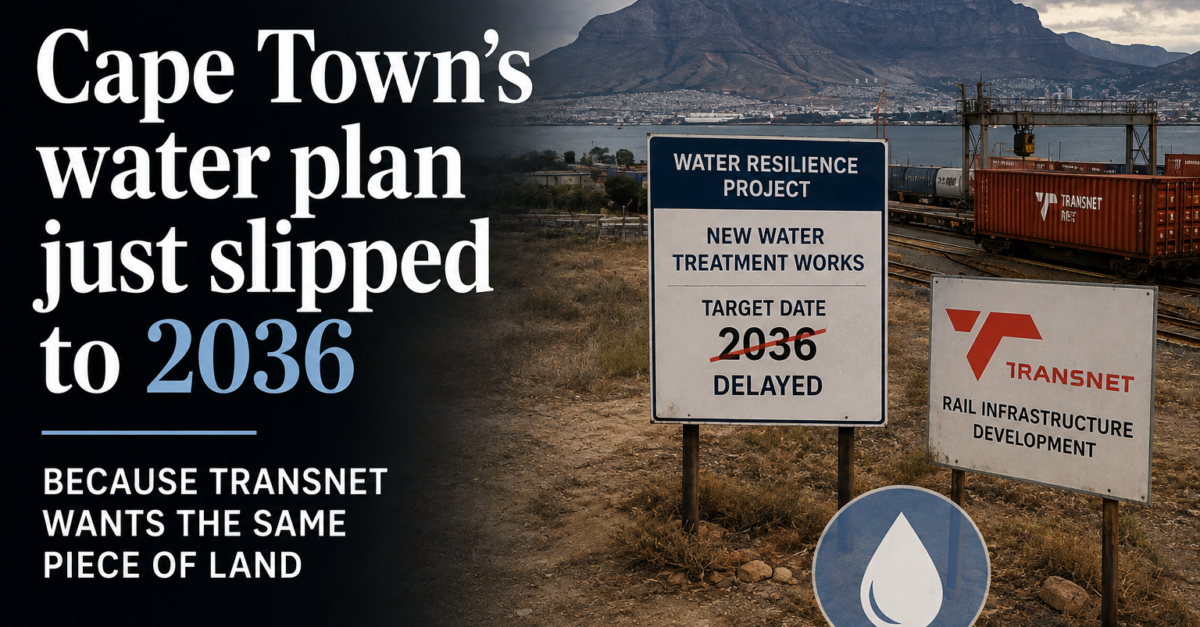
Two pieces of South African infrastructure planning have collided in Cape Town, and water security lost. The city’s planned desalination plant, the single largest component of its New Water Programme, was to be built at Paarden Eiland. Transnet intends to expand the port onto the same ground. The city is now hunting for an alternative site and starting a fresh environmental impact assessment, a process that GroundUp reported on 31 August 2026 will set the plant back five years.
The arithmetic underneath that delay is the part business should read twice. Cape Town’s New Water Programme is designed to add 300 million litres a day on top of the six supply dams, and is now expected to be fully operational only in 2036. Demand is expected to exceed the current dam allocation within two years.
What the programme was supposed to deliver
The 300 million litres is not one project but four: the 70-million-litre-a-day desalination plant now looking for a home, groundwater extraction, wastewater reuse, and a scheme pumping water from the Berg River into Voëlvlei Dam worth another 40 million litres a day.
That last one has its own history worth noting, because it establishes the pattern. The Berg River–Voëlvlei build, costed at R1.85 billion, was originally due for completion in 2023. It was revised to 2027. It is now expected in 2030. A seven-year slip on the most conventional engineering component of the programme, a pump station and pipeline, is a reasonable basis for scepticism about the harder ones.
Demand is going the wrong way
Consumption tells the other half of the story. In the last week of August 2026 the city was using roughly 850 million litres a day. For comparison, at the height of the drought in September 2017, under Level 5 restrictions, that figure was about 570 million litres. The 2015 peak, before the crisis, was 1.2 billion.
In other words, Cape Town has given back a substantial share of the savings the drought forced on it, and is climbing back toward pre-crisis consumption while the supply-side projects meant to catch up have moved further away. The city’s own Water Outlook does not hedge on this: “The 2025/26 rate of water demand growth is unsustainable.”
Dam levels sat at 77% on 24 August 2026, which sounds comfortable and is officially classified as an “early drought caution stage” — a reminder that dam percentages describe the present and say nothing about whether the next dry cycle arrives before 2036.
Why a business in Gauteng should care about a Cape Town site dispute
The specific lesson here generalises well beyond the Western Cape. This was not a funding failure, a procurement scandal or a capacity shortfall. It was two public-sector infrastructure plans, a municipal water programme and a national port expansion, competing for the same land with no mechanism to resolve the clash before one of them had already selected the site and begun work toward approval. That is a coordination failure, and coordination failures are the hardest kind to price into a business plan, because nothing in either organisation’s public reporting would have flagged it in advance.
For any business whose operations depend on municipal bulk services — manufacturing, food processing, hospitality, cold chain, laundries, breweries — the practical implication is that a published municipal delivery date for new supply capacity is a planning assumption, not a commitment, and the gap between the two can be measured in years. Zahid Badroodien, the mayoral committee member for water and sanitation, confirmed the city is searching for “alternative locations”, which is the honest position but not a date.
The defensive moves available are the unglamorous ones: understanding your own actual daily consumption rather than your invoice, knowing whether your site can take borehole or greywater reuse and what the payback period looks like at current tariffs, and treating water like electricity was treated from 2008 onwards — as an input whose reliability is a business risk to be managed on site rather than a utility problem to be absorbed.
Cape Town spent 2018 as the global case study in how quickly a major city can approach the end of its water. The current position is less dramatic and, in one specific respect, more concerning: the supply-side response to that crisis has now slipped a decade out, and the reason the largest piece of it slipped had nothing to do with water at all.