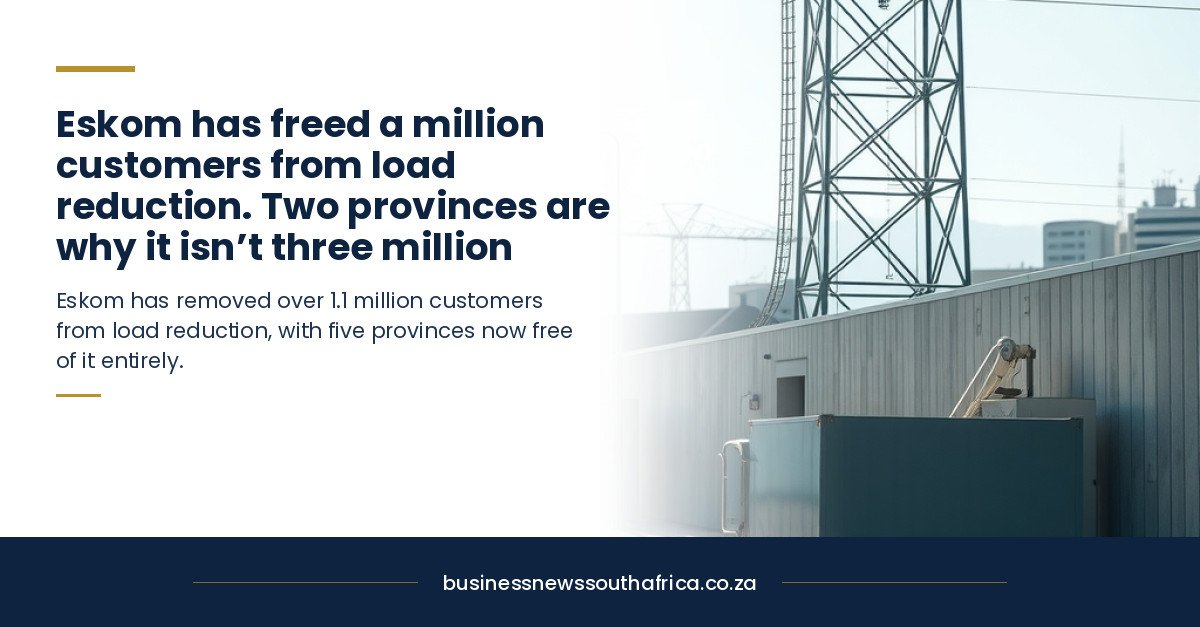
Eskom has quietly hit a milestone that gets far less attention than load shedding, but matters just as much to the businesses it affects: more than 1.1 million customers have now been removed from load reduction, and five of South Africa’s nine provinces are entirely free of it.
Load reduction is a different problem from load shedding, and it is worth being precise about the distinction. Load shedding is a nationwide response to a shortage of generation capacity; South Africa has now gone more than 413 consecutive days without it. Load reduction is local: a temporary, targeted cut to specific feeders in areas where illegal connections, electricity theft, meter tampering or ageing infrastructure mean the network is being asked to carry more demand than it was built for. Cutting supply to an overloaded feeder protects the equipment from failing entirely, at the cost of scheduled outages for everyone on that feeder, including legitimate paying customers.
The numbers
Eskom reported 1,104,225 customers removed from load reduction schedules, 65.17% of its target, and 545 feeders freed nationally, Eskom said. The Western Cape, Northern Cape, Free State, North West and Mpumalanga are now entirely load-reduction free. Eskom Group Executive for Distribution Junaid Munshi called it evidence the programme is working: “Reaching the milestone of more than one million customers removed from load reduction demonstrates that the programme is delivering tangible results.”
Why Gauteng and KwaZulu-Natal are the hard part
Gauteng and KwaZulu-Natal carry the largest remaining burden, with Limpopo and the Eastern Cape also still affected. Eskom’s stated target is for seven provinces to be free of load reduction by October 2026, with full national eradication by March 2027, but Gauteng in particular is showing slow progress, and KwaZulu-Natal’s issue is specifically the pace of installing prepaid smart meters, a prerequisite for lifting load reduction sustainably in areas where illegal connections and meter tampering are the underlying cause.
The reason these two provinces are the hardest is structural, not just a matter of resourcing. They combine the country’s densest urban populations, its most complex distribution networks, and its highest concentration of the illegal connections and infrastructure theft that drive load reduction in the first place. Fixing a feeder in a rural North West town is a smaller, more contained project than untangling an overloaded network serving a dense informal settlement adjacent to a formal Johannesburg suburb.
What this means for business
For a business operating in one of the five now-clear provinces, the practical effect should already be visible: fewer unscheduled outages tied to network overload, on top of the national load-shedding-free run. For businesses in Gauteng or KwaZulu-Natal, especially those on feeders in areas with a history of illegal connections, load reduction remains a live operational risk that generic load-shedding schedules will not capture, since it applies to specific feeders rather than the whole grid.
Businesses uncertain whether their premises sit on an affected feeder should check directly with Eskom or their municipal distributor rather than assume national progress applies to their specific area. A retailer, workshop or office in an affected Gauteng feeder could still face scheduled outages well after load shedding itself has become a memory, simply because their local network carries a legacy of illegal connections that has not yet been resolved.
The broader signal for planning purposes is that Eskom’s generation-side recovery, reflected in the load-shedding-free run, and its distribution-side cleanup, reflected in load reduction, are two different projects on two different timelines. A business that has stopped budgeting for generator diesel because load shedding has ended should not assume every form of power interruption risk has disappeared with it, particularly if it operates in one of the two provinces still working through the harder end of the load reduction programme.
For more on power and infrastructure in South Africa, see our Energy & Infrastructure coverage.