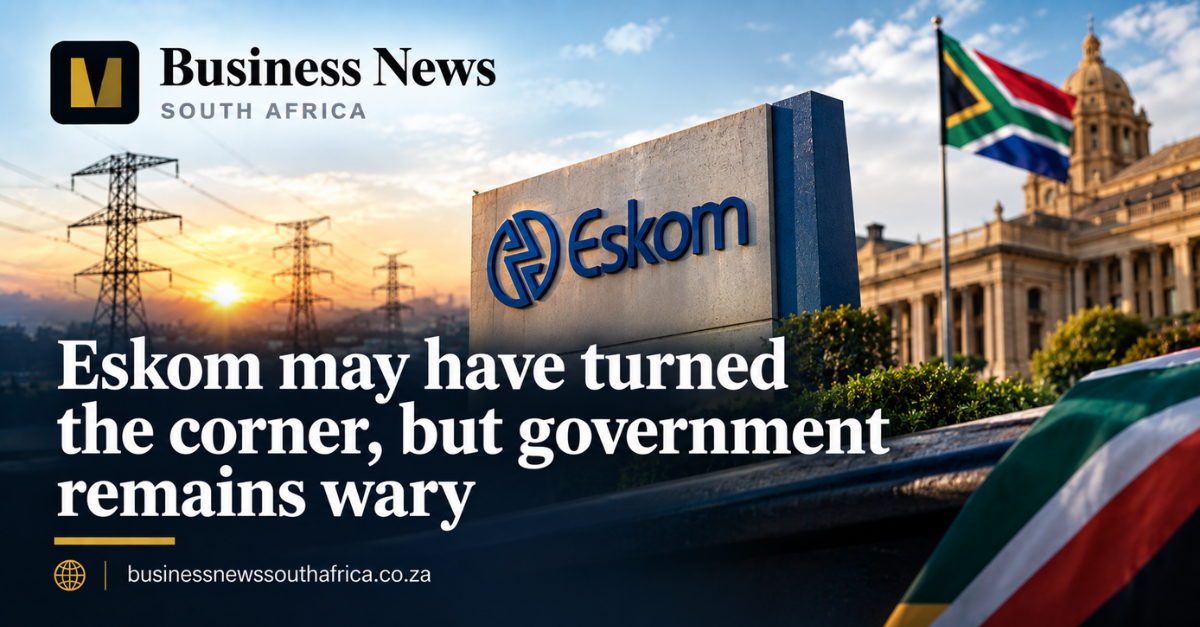
The IOL headline “Eskom has turned the corner. Government is waiting with a knife” signals a possible shift in the power utility’s fortunes, but it also warns of a cautious, perhaps confrontational, stance from the state. The headline itself is the only information supplied, so the claim that Eskom has “turned the corner” is not yet backed by detailed data.
What does “turned the corner” mean for an SME owner or a small manufacturer that relies on a stable electricity supply? In plain terms it suggests that Eskom may have moved past the worst of its load-shedding cycles, that generation capacity could be more reliable, and that the financial strain on the utility might be easing. For a business, fewer blackouts translate into lower operating costs, less downtime, and a more predictable cash flow.
However, the second part of the headline, “Government is waiting with a knife”, implies that the state is prepared to act decisively if Eskom slips back. In South Africa the government holds a majority share in Eskom and has repeatedly stepped in with guarantees, bail-outs and policy directives. A “knife” in this context is a metaphor for possible intervention, ranging from stricter oversight to renewed funding commitments, or even a restructuring of the board.
To understand why this headline matters, a brief look at Eskom’s recent trajectory is useful. Over the past few years the utility has struggled with ageing coal plants, a backlog of maintenance, and a debt pile that topped R400 billion. Load-shedding, the scheduled power cuts that have become a familiar backdrop for factories, shops and households, peaked in 2022 and 2023. Since then, Eskom has reported modest improvements in plant availability and has begun to retire some of its most inefficient units. The utility also secured a syndicated loan in 2024 to fund urgent repairs and to invest in renewable capacity.
For small and medium enterprises, the key question is whether these technical and financial fixes will translate into fewer interruptions. The answer is not yet clear. Eskom’s own quarterly reports have shown a slight reduction in the number of load-shedding stages, but the utility still warns that supply constraints could return if rainfall fails to replenish hydro reservoirs or if coal deliveries are delayed.
The government’s role is pivotal. The Department of Public Enterprises (DPE) oversees Eskom and has the power to approve major capital projects, to appoint board members, and to allocate state guarantees. In recent budget statements the finance ministry hinted at a possible new capital injection, but also warned that Eskom must meet strict performance targets to qualify for further support. This dual approach, offering a safety net while demanding results, is what the headline alludes to with the image of a knife.
What should an entrepreneur take away from this ambiguous headline? First, keep monitoring Eskom’s operational updates. If the utility can sustain a lower load-shedding level for several months, it may be safe to plan modest expansions or to invest in backup generators with a longer payback horizon. Second, stay alert to any policy announcements from the DPE or the treasury. A sudden change in tariff structures or a new funding programme could affect operating costs.
In the meantime, the lack of concrete details in the IOL piece means the claim remains unverified. The headline captures a hopeful turn but also a warning that the government is prepared to intervene if the utility falters. Until more data emerges, such as actual generation figures, load-shedding schedules, or a formal government statement, businesses should treat the news as a tentative signal rather than a guarantee of stable power.
Reading the metaphor for what it signals about incentive design
The government holding “a knife” while also being Eskom’s primary financial backer is a genuinely awkward incentive structure, and it is not unique to South Africa: state utilities that depend on their own shareholder for bail-out capital are structurally different from privately financed ones, where a lender’s leverage comes from the threat of withholding new credit rather than political intervention. That difference matters for how durable any improvement is likely to be. A privately financed turnaround that fails typically triggers a straightforward, mechanical response, tighter loan covenants or a change of management installed by the lender. A state utility’s turnaround failing instead becomes a political question, decided through budget cycles and cabinet-level negotiation, which is slower and less predictable for a business trying to plan around the outcome.