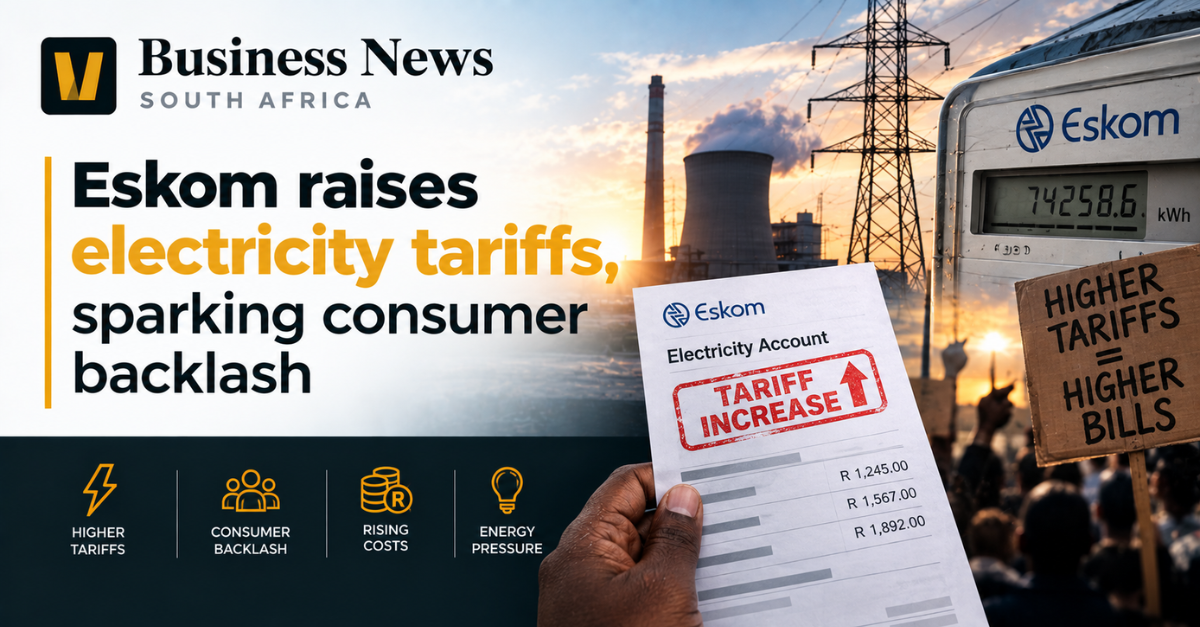
A typical South African household opened its latest electricity bill to find a noticeable jump in the amount due. The surprise was not a one-off error but the result of a tariff increase announced by Eskom, the state-owned power utility.
According to citizen.co.za, Eskom said the new tariff will raise the price per kilowatt-hour for residential customers. The utility described the adjustment as necessary to cover rising operating costs, debt repayments and the funding of new generation projects. Until independently verified, this remains Eskom’s own claim.
A tariff is the price charged for each unit of electricity consumed. When a tariff increase outpaces the overall rise in consumer prices, known as inflation, households feel the pinch more sharply because their electricity costs grow faster than wages and other expenses.
Eskom has been under financial pressure for several years, grappling with ageing infrastructure, frequent load-shedding and a large debt burden. Past tariff hikes have been used to plug revenue gaps, but the current proposal arrives at a time when inflation in South Africa is hovering around five percent, according to the latest statistics from Statistics South Africa.
The announcement has drawn criticism from consumer advocacy groups, which warn that higher electricity costs could squeeze disposable income and increase operating expenses for small businesses that rely heavily on power. While the tariff change is aimed at residential users, the ripple effect may be felt across the broader economy.
Public reaction on social media has been swift, with many users describing the increase as “above-inflation shock” and calling for the regulator, the National Energy Regulator of South Africa, to intervene. The regulator has not yet issued a response.
Why an above-inflation increase compounds rather than resets
Because electricity tariffs are typically raised through a multi-year determination process rather than a single annual adjustment, an increase that outpaces inflation in one year does not simply create a one-off higher bill, it resets the base a household or business pays from going forward, meaning next year’s increase, even at a more modest rate, compounds on top of an already elevated cost. That compounding effect is a large part of why South African households and SMEs have experienced total electricity cost growth far outstripping headline inflation over the past decade even in years when any single increase looked individually manageable, and it is the specific mechanic consumer advocacy groups are pointing to when they warn that this increase will be felt well beyond the current billing cycle.
For small businesses specifically, electricity is often one of the few input costs that cannot be renegotiated, deferred or substituted the way a supplier contract or a lease sometimes can be. A retailer facing a lease renewal can shop for a cheaper location; a business facing a tariff increase generally cannot shop for a cheaper grid, since Eskom remains the only realistic supplier for the vast majority of the country outside a handful of municipalities running their own distribution. That lack of alternatives is a large part of why above-inflation tariff increases draw a sharper public reaction than comparable increases in most other input costs.
How much of the increase actually reaches a household’s or a small business’s bill also depends on the regulator’s own review process, since NERSA’s approval is not automatic and has, in past years, trimmed Eskom’s requested increase before signing off on a final figure. Until that review concludes, the tariff Eskom has announced is best read as an opening position rather than a certainty.
Until then, the safest planning assumption for an SME budgeting for the year ahead is that the final approved increase lands somewhere close to what Eskom has proposed, rather than assuming NERSA’s review will meaningfully soften it.