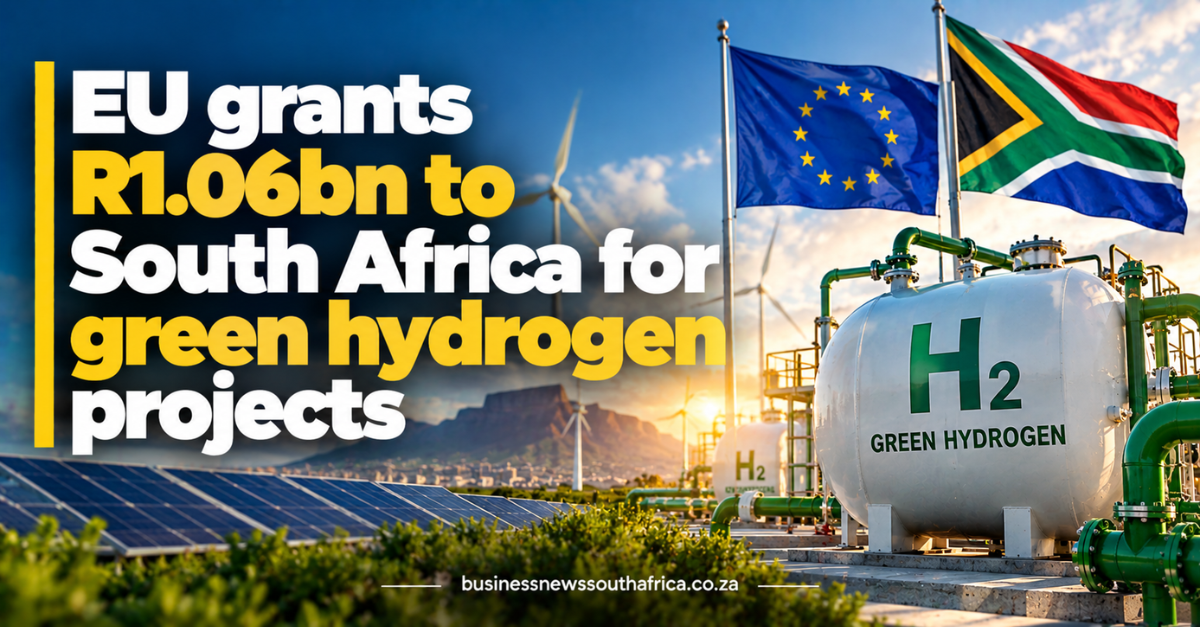
At the African Green Hydrogen Summit in Cape Town on 15 September, the European Union unveiled two new projects worth a combined R1.06 billion. The money will flow into South Africa’s fledgling green hydrogen sector, a field that promises to turn renewable electricity into hydrogen fuel that can be stored, shipped and used in industry.
Green hydrogen, simply put, is hydrogen produced by splitting water with electricity that comes from wind, solar or other clean sources. The term “value chain” refers to every step from extracting raw materials, through production, to the final product that reaches a customer. By funding both the raw-material side and the downstream processing, the EU hopes to create a full-stack industry in South Africa.
The first grant, worth R690 million, will be administered by the Department of Electricity and Energy. It is designed to build an environment where companies can develop raw-material supply chains and downstream products such as hydrogen derivatives and batteries. The EU highlighted three provinces, the Northern Cape, Limpopo and Mpumalanga, as priority zones for these activities.
The second grant, of R370 million, is a joint effort between the EU, KfW Development Bank and the Development Bank of South Africa. Its aim is to unlock further capital for both public and private investors, essentially acting as a catalyst that could bring additional money into the sector.
Why the funding matters for South African businesses
South Africa has abundant solar and wind resources, but converting that potential into export-ready hydrogen has required large upfront investment. For small and medium-sized enterprises (SMEs) that specialise in components such as electrolyzers, storage tanks or battery modules, the grants could mean access to a clearer market and, potentially, to financing that was previously out of reach.
However, the EU’s statements are still claims until projects are fully operational. The department has not yet released a timetable for when the first commercial plants will be running, nor how much of the grant will be allocated directly to private firms versus government-run pilots.
In the broader picture, the EU frames the grants as part of its “Team Europe Global Gateway Investment Package”, a programme announced in October 2025 that totals more than R200 billion across Africa. The intention is to create jobs, increase local value addition in minerals and battery chains, and position South Africa as a leading producer of green hydrogen.
For South African entrepreneurs, the announcement signals that Europe is willing to put money on the table, but it also underscores the need to be ready to meet the technical and regulatory standards that come with international funding. Companies that can demonstrate a viable product, a solid business plan and compliance with local labour and environmental rules will be best placed to benefit.
As the projects move from concept to construction, the Department of Electricity and Energy will likely publish procurement notices and partnership opportunities. SMEs interested in the green hydrogen space should keep an eye on those releases and consider using the commercial funding suite to prepare applications.
While the EU’s money is a welcome boost, South Africa still faces challenges such as load-shedding, skills shortages and the need for reliable grid capacity. The success of the grants will ultimately depend on how well these systemic issues are addressed alongside the new projects.
In short, the R1.06 billion represents a concrete step toward a greener energy mix, but the real impact will be measured by the number of jobs created, the amount of private capital attracted and the speed at which commercial hydrogen can be exported.
Source: BusinessTech
European Union climate and development funding for South African green hydrogen projects forms part of a broader EU strategy to secure future green hydrogen supply chains from partner countries with strong renewable energy potential, positioning South Africa as a prospective exporter of green hydrogen and its derivatives such as green ammonia to European industrial buyers over the coming decade. For South African businesses in the renewable energy and industrial gas value chain, funding of this kind can help de-risk early-stage projects that would otherwise struggle to attract commercial financing before a track record of successful production and export exists. The Department of Electricity and Energy’s own green hydrogen strategy sets out the broader policy framework this funding supports. For related coverage, see this site’s Energy and Infrastructure coverage.