Power lines stretch across the horizon, but for many South African small-business owners they still represent an unreliable cost centre. The latest signal from government could change that picture. The National Treasury, working through the Development Bank of Southern Africa (DBSA), has issued a request for proposals (RFP) for advisers to guide the unbundling of Eskom’s transmission assets into an independent transmission system operator (ITSO). An ITSO is a stand-alone company that owns and operates the high-voltage network, separate from generation and retail, allowing multiple electricity generators to use the grid on equal terms.
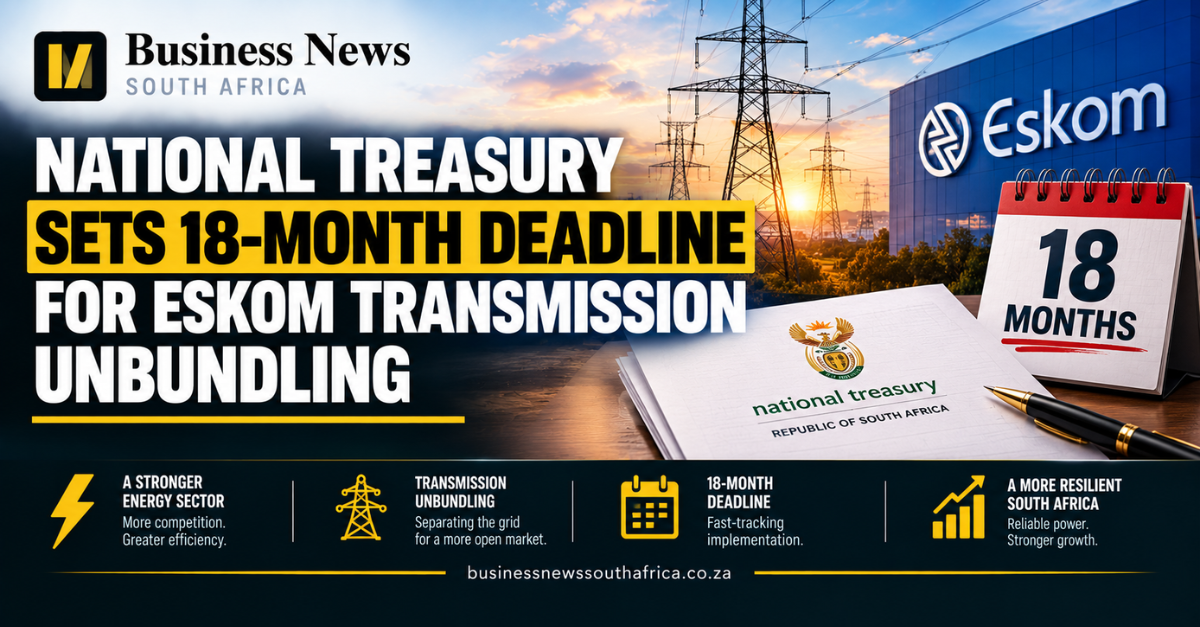
The RFP sets an ambitious timetable: the entire transaction must be concluded within the next 18 months. That deadline is not a suggestion; it is a contractual target built into the proposal documents. According to the Treasury spokesperson, the deadline reflects the urgency of moving the electricity sector from a single-owner model to a competitive market framework.
Why does this matter to the owner of a boutique manufacturing firm or a tech start-up? In the current arrangement, Eskom controls generation, transmission and retail, which can lead to bottlenecks, price volatility and frequent load-shedding. An independent transmission operator would be regulated to provide open access, meaning more generators, including renewable projects, could feed power into the grid. Competition at the generation level should, in theory, drive down wholesale prices and improve reliability, both of which are critical cost inputs for small and medium enterprises (SMEs).
What the deadline means for businesses
The transaction is complex. It will need the approval of Eskom’s lenders, banks and bondholders that have financed the utility for years. The source notes that Eskom’s lenders have signalled willingness to engage on workable solutions, a positive sign that financing hurdles may be cleared quickly. BLSA (Bureau for Economic Research) and Eskom have both issued a joint statement confirming their support for the reform programme after a meeting with Eskom chairman Mteto Nyati and group chief executive Dan Marokane.
For SMEs, the key risk is timing. If the unbundling stalls, the status quo, characterised by load-shedding and high tariffs, persists. If the 18-month schedule is met, the market could see the first competitive electricity contracts within a few years, potentially lowering input costs for manufacturers, retailers and service providers. The source stresses that the plan has faced resistance in some quarters, but the alignment of “key role players” suggests the major obstacles have been cleared.
Beyond electricity, the article links the grid reform to broader infrastructure upgrades. An updated rail network statement, expected by the end of September, aims to open the national rail system to private operators, unlocking billions of rand in investment. Both electricity and logistics are described as “growth enablers”, the preconditions for the investment needed to reach the government’s 3 %-plus growth target and the associated job creation.
Business confidence, however, remains low. The latest RMB/BER index fell to 38 in the third quarter, indicating that most firms still feel the operating environment is unfavourable. The source argues that confidence will only improve once competitive markets for electricity and logistics are fully functional and firms start to see lower input costs and more reliable services.
In short, the 18-month deadline is a benchmark for the entire electricity reform agenda. If met, it could set in motion a cascade of changes that benefit SMEs through cheaper, steadier power. If missed, the sector may remain mired in the same challenges that have hampered growth for years.
Why financing terms, not politics, may be the real constraint
Big-bang infrastructure unbundlings of this kind are usually gated less by political will than by whether existing lenders will accept a restructuring of the entity they’ve already extended credit to, since bondholders and banks that financed Eskom as a single, government-backed utility took on that credit risk with the current structure in mind, and any change to it can trigger covenant reviews or demands for revised terms. The Treasury and DBSA choosing to lead with an RFP for transaction advisers, rather than a unilateral government announcement, signals an approach built around getting lender buy-in methodically before the legal separation happens, which is generally the slower but more durable way to execute a restructuring of this scale without triggering a funding crisis partway through.