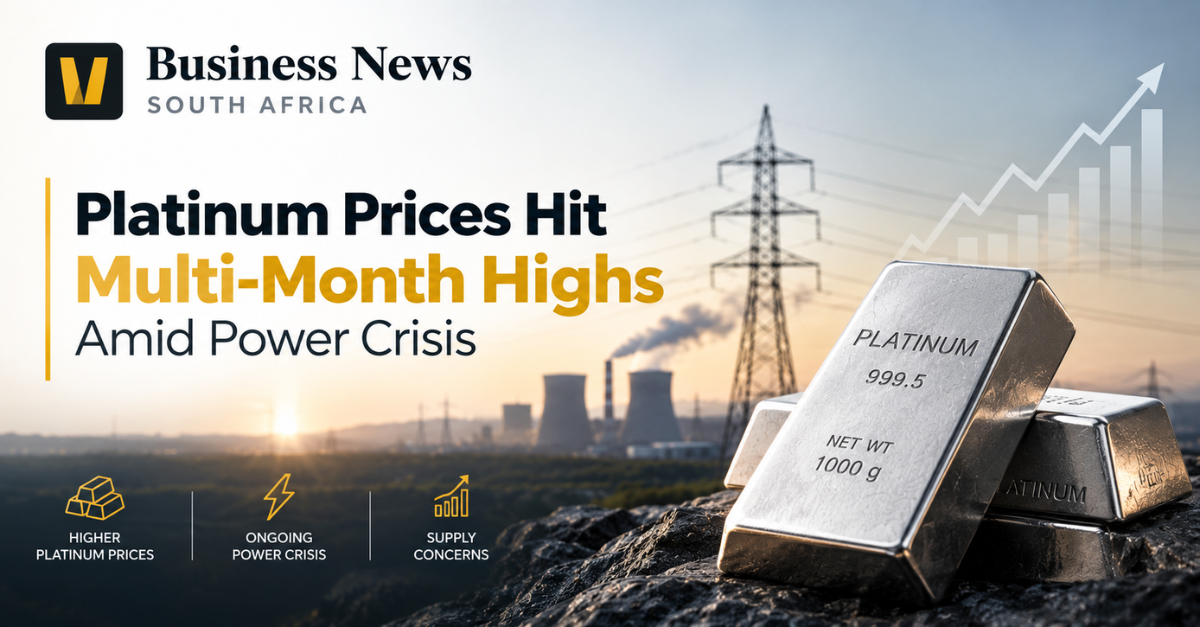
According to startupfortune.com, platinum prices have climbed to multi-month highs as South Africa‘s power crisis bites. The headline move was reported without detail, but the jump is already being watched by miners, investors and businesses that rely on the metal.
Platinum price (the market price per ounce of the metal) is a key barometer for a range of industries. The metal is prized for its resistance to corrosion and its catalytic properties, which make it essential in automotive catalytic converters, jewellery and emerging hydrogen-fuel technologies. When the price rises, mining companies see higher revenue, while downstream users face tighter margins.
South Africa is the world’s largest producer of platinum, accounting for roughly 70% of global output. The country’s mines are concentrated in the Bushveld Complex, a geological formation that supplies most of the world’s supply. Because of that dominance, any disruption to South African production can ripple through global markets.
Why the power crisis matters for platinum
The power crisis refers to the chronic shortage of electricity that has forced the utility Eskom to implement load shedding (planned power cuts to manage supply shortfalls). Load shedding can last from a few hours to an entire day, depending on the severity of the shortfall. For energy-intensive operations like platinum mining, the loss of power means reduced grinding capacity, slower ore processing and higher diesel consumption for backup generators.
Analysts suggest that the current load-shedding schedule is squeezing the amount of ore that can be processed each month. When processing capacity falls, the amount of platinum that reaches the market drops, tightening supply. In a market where demand remains steady, a tighter supply tends to lift prices. That chain of reasoning explains why the price rally is being linked to the power crisis, even though the headline itself does not provide the details.
For mining companies, higher platinum prices can offset the extra cost of running generators and the lost productivity caused by load shedding. Companies with more resilient power arrangements, such as on-site solar farms or contracted diesel generators, may see their profit margins improve. Investors in mining stocks are therefore likely to view the price rise as a short-term upside.
Conversely, businesses that purchase platinum as an input face a different reality. Auto manufacturers that source catalytic converters may see component costs rise, which could be passed on to consumers or erode profit margins. Jewellery makers, especially small-scale artisans, may also feel the pinch, as higher raw-material costs reduce their ability to price competitively. For SMEs that cannot lock in long-term supply contracts, the price volatility adds a layer of financial risk.
The power crisis is not limited to platinum. Other commodities that rely on heavy electricity, such as iron ore, coal and manganese, have also reported production slowdowns. The broader effect is a strain on South Africa’s export earnings, which can influence the rand’s exchange rate and the cost of imported inputs for local businesses.
Looking ahead, the trajectory of platinum prices will depend on how quickly the power supply stabilises. If Eskom can reduce load-shedding frequency, mining operations may return to full capacity, easing supply pressure and potentially tempering the price rally. If shortages persist, the market could see further price gains, especially if global demand for platinum-based technologies continues to grow.
For small and medium-sized enterprises, the key takeaway is to monitor both the platinum price and the load-shedding schedule. Companies that use platinum should consider hedging strategies or alternative materials where feasible. Mining-related SMEs, such as equipment suppliers or logistics firms, may find opportunities in the higher-price environment, but they must also plan for the operational disruptions that power cuts bring.