At a diesel pump in Johannesburg the price display reads higher than it did a year ago, a reminder that fuel costs are rising for everyone who drives a truck, a delivery van or a tractor. The Reserve Bank, South Africa’s central bank, says that the rise is not just a market wobble, it is the result of a long-term loss of refining capacity.
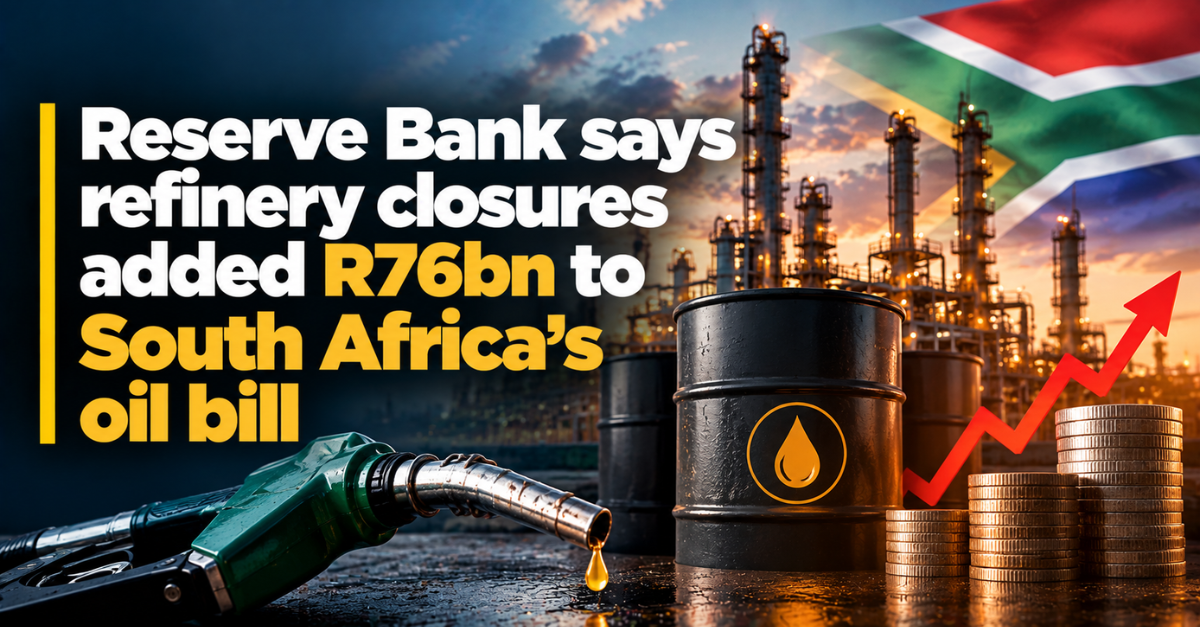
In an economic note released last week the Reserve Bank calculated that the country’s oil-import bill, the total amount spent on buying refined petroleum from abroad, could have been R76 billion lower if the country had not shut a large part of its refinery capacity. Over the four years to the end of 2024 that would have meant spending about 6.1% less on imported fuel.
For small and medium-size enterprises that rely on transport, the extra R76 billion translates into higher operating costs. A delivery company that burns 10 000 litres of diesel a month can see its fuel bill rise by several thousand rand when global prices move up, and that pressure is passed on to customers in the form of higher prices or reduced margins.
The note also points out that refinery closures have trimmed petroleum-related manufacturing output by roughly 20% since 2019. The loss of that output has displaced an estimated 5 400 jobs, both directly in the plants and indirectly in supporting services such as logistics and maintenance.
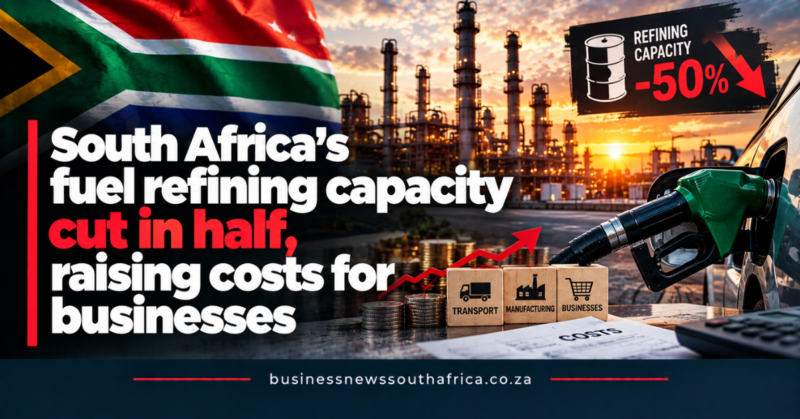
South Africa’s refining capacity has been halved over the past decade. Today only two crude-refining facilities remain operational: Sasol’s Natref plant and Astron Energy’s refinery in Cape Town. Together they can process about 208 000 barrels of crude a day, barely a third of the capacity that existed ten years ago.
What the numbers mean for small businesses
With domestic refining cut in half, more than half of the country’s fuel demand now comes from imports. That dependence makes the economy vulnerable to two external forces. First, global oil price spikes, such as those triggered by the war in Iran earlier this year, flow straight through to local pump prices. Second, fluctuations in the rand against major currencies affect the cost of each barrel bought on the world market.
The Reserve Bank warns that this exposure can amplify the impact of any future price shock or shipping disruption. For an SME that runs a fleet of trucks, a sudden 10% jump in diesel price could erode profit margins by a similar margin, unless the business has hedged its fuel purchases or can pass the cost onto customers.
On the supply-side there is a glimmer of hope. The Central Energy Fund announced last week that it intends to rebuild the Sapref refinery south of Durban, which was idled after the 2022 floods in KwaZulu-Natal. The plan targets a throughput of 400 000 barrels per day, nearly double the current combined capacity of Natref and Astron Energy. If the project proceeds on schedule, the country could regain some of the lost domestic refining and reduce its import bill in the longer term.
Until that capacity returns, the immediate reality for South African SMEs is higher fuel costs and greater price volatility. Business owners may need to review transport routes, consider fuel-efficiency upgrades, or explore short-term contracts that lock in price. The Reserve Bank’s figures underline that the cost of imported fuel is not a distant macro-economic statistic, it is a line item that can decide whether a small business stays profitable or has to tighten its belt.
South Africa’s refining capacity has shrunk sharply in recent years, as ageing plants have closed or converted to fuel import terminals rather than been upgraded to meet cleaner fuel specifications, leaving the country more exposed to global shipping costs and currency swings. The Reserve Bank’s own quarterly bulletins carries further detail. For related coverage, see this site’s Energy and Infrastructure coverage.