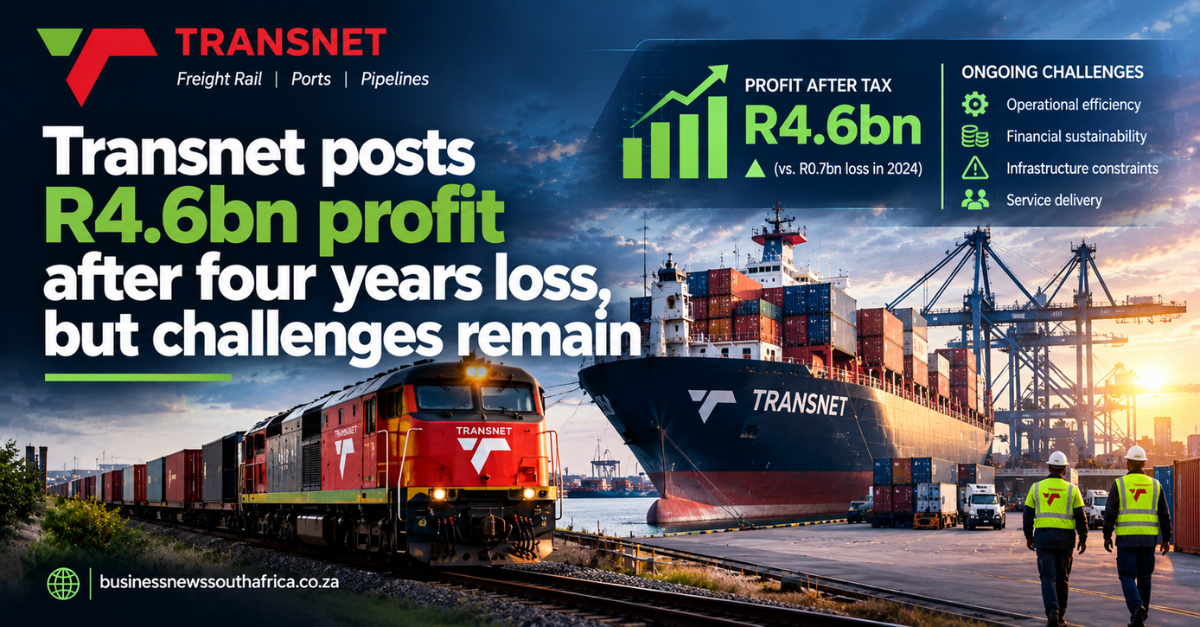
At the Durban container terminal a crane swung its arm over a line of stacked containers as a diesel-powered locomotive hissed into the yard. The scene, familiar to anyone who ships goods in and out of South Africa, now sits against a headline that the state-owned transport group Transnet posted a profit after tax of R4.6 billion for the year ended 31 March 2026.
The figure marks a swing from a loss of R1.9 billion in the previous financial year and is the first positive bottom line since the 2022 financial year, when the company reported an R8 billion profit. The profit number comes directly from Transnet’s own results release, which the company says reflects improved performance across its rail and port divisions.
Transnet’s financial statements received an unqualified audit opinion, meaning the Auditor-General believes the accounts give a true and fair view of the entity’s financial position. That audit conclusion is a factual statement from the independent auditor, not a claim by Transnet.
Group chief executive Michelle Phillips welcomed the turnaround but warned that “the business still has to be financially sustainable”. The quote is a company statement and has not been independently verified beyond the press conference where it was delivered.
Rail volumes moved 167.9 million tonnes (Mt) in the year, up from 160.1 Mt the year before. The increase is modest but pushes the figure closer to the 170 Mt target set by Transnet’s board. Transnet Freight Rail, the division that moves most of the country’s iron ore and coal to export ports, relies on volume growth to generate cash. For small manufacturers and agricultural exporters, a stable rail service can mean lower freight costs and fewer shipment delays.
Despite the volume gain, the rail network still battles a shortage of heavy-haul locomotives, a backlog of maintenance work, frequent derailments and a wave of vandalism. Cable theft alone cost the company an estimated R2 billion, according to the company’s own estimate. Those losses are a claim by Transnet and have not been confirmed by any external audit.
On the port side, Transnet handled 4.580 million TEUs, a TEU is a twenty-foot equivalent unit, the standard measure for container traffic, a 7 percent rise on the previous year. The increase follows upgrades to ship-to-shore cranes, mobile harbour cranes and other handling equipment. For SMEs that import raw materials or export finished goods, higher container throughput can translate into shorter dwell times at the quay.
The profit figure is heavily influenced by the sale of Durban Pier 2 to a special-purpose vehicle (SPV) called DCT, which generated a recognised profit of R12.5 billion. Transnet itself notes that without that transaction the profit would have been considerably lower. This is a company-reported accounting effect, not a cash profit from core operations.
Transnet is also opening its rail network to private operators who will bring their own locomotives and run trains independently. The move aims to boost capacity and reduce reliance on ageing state-owned assets. If private operators can deliver more reliable service, small businesses that depend on timely freight may see a reduction in logistics costs.
In summary, the profit headline is encouraging, but the underlying challenges, locomotive shortages, maintenance backlogs, vandalism and reliance on one-off asset sales, mean the turnaround is far from complete. For entrepreneurs who ship goods across the country, the key takeaway is that while the rail and port network is improving, the risk of disruption remains until the structural issues are fully addressed.
Why the market separates a profit from a good profit
Transnet’s own acknowledgement that the headline figure leans on the Pier 2 transaction is the most useful sentence in the results, and it points at the question analysts ask before any other: whether a profit was earned or realised. A profit earned from operations is repeatable, because the trains and the cranes will still be there next year doing the same work. A profit realised from selling an asset is not, because the asset can only be sold once.
This is why a single year’s bottom line tells you less about a logistics business than the volume lines underneath it. Tonnes moved and containers handled are the numbers that recur. They are also the numbers a customer actually feels, which is why an exporter reading these results should weigh the tonnage and container throughput more heavily than the headline profit.
What opening a rail network to private operators actually involves
Third-party access to a freight rail network is a longer process than the announcement of it suggests, and the delay is often mistaken for reluctance. A network carrying trains from more than one operator needs a way to decide who runs when, because two trains cannot occupy the same section of track at the same time. That means slot allocation, published access charges so competing operators pay on comparable terms, and a safety regime holding every operator to the same standard regardless of who owns the locomotive.
Building that apparatus takes time in every country that has attempted it, and doing it badly produces disputes that end up in a regulator’s office rather than on the tracks. The practical consequence for a business planning around cheaper freight is that capacity gains from private participation tend to arrive gradually, in specific corridors, rather than across the network at once.