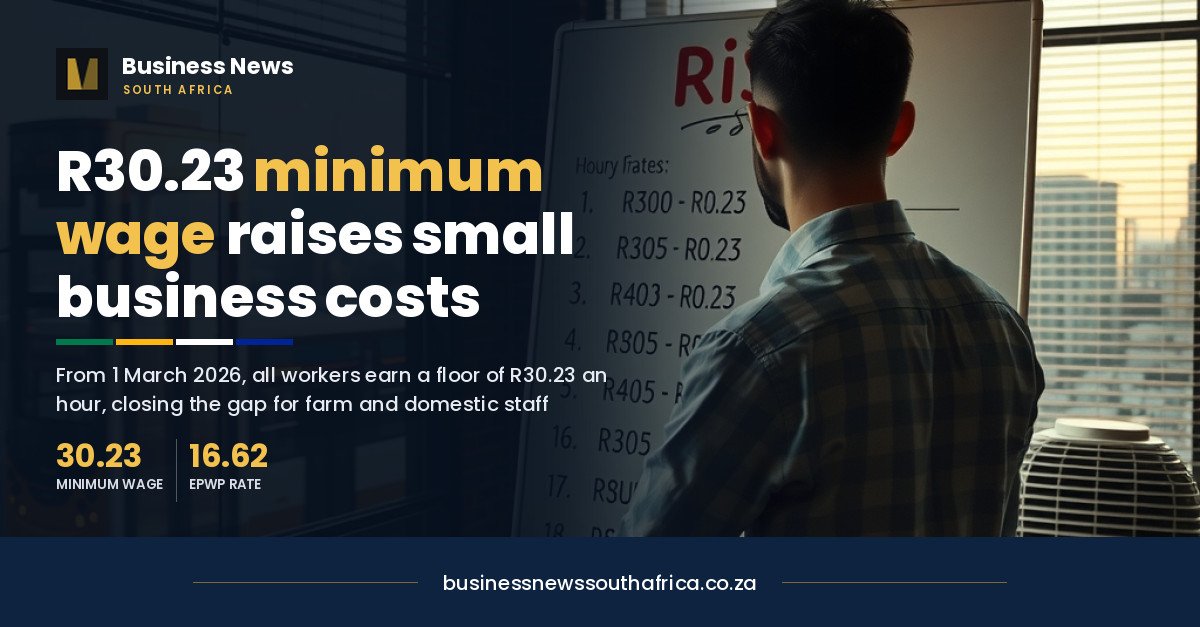
Every ordinary hour worked in South Africa now has a floor under it: R30.23. From 1 March 2026, the national minimum wage rose from R28.79 an hour, a R1.44 increase, Employment and Labour Minister Nomakhosazana Meth announced on 4 February. For a small business paying several workers by the hour or the week, that increase compounds fast, and for the first time farm workers and domestic workers move onto exactly the same rate as everyone else.
The new rates
- General workers, farm workers and domestic workers: R30.23 an hour, all on one rate for the first time.
- Expanded Public Works Programme workers: R16.62 an hour, up from R15.16.
- Learnerships: weekly allowances set by NQF level, ranging from roughly R455 to R2,654 depending on level and credits.
“The R1.44 upward adjustment will benefit all workers, including vulnerable farm workers and domestic workers,” Minister Meth said in announcing the increase. Ending the separate, lower tiers that farm and domestic work used to sit on is the bigger structural change here, not just the number itself.
What this actually costs a small employer
A worker on a standard 45-hour week, paid strictly at the new minimum, now costs R1,360.35 a week before any other deduction, contribution or benefit, up from R1,295.55 at the old rate. Multiply that across a small team and the increase is real money, not a rounding error, which is exactly why the National Minimum Wage Commission’s own review acknowledged that SMMEs “face disproportionate pressure in absorbing wage increases” against slow demand and rising input costs. The rate applies to cash wages for ordinary hours actually worked; transport allowances, meals and accommodation in kind do not count toward it, so an employer cannot argue those benefits make up the shortfall on an underpaid cash wage.
Some sectors already pay more
The general minimum is a floor, not the rate that necessarily applies. Sectoral determinations for industries including security, contract cleaning, and wholesale and retail set differentiated rates by job category and, in some cases, by geographic area, per the amended wage notices. A business in one of those sectors needs to check its specific sectoral determination rather than assume R30.23 is the number that applies.
What underpaying actually triggers
This is not a rule that goes unenforced. A labour inspector who finds an employer has failed to comply with the National Minimum Wage Act can issue a fine equal to twice the value of the underpayment or twice the affected worker’s monthly wage, whichever is greater, for a first offence, rising to three times either figure for a repeat one. Before that, inspectors can issue a compliance order, and both compliance orders and written undertakings can be turned into a binding CCMA arbitration award if ignored. The Department of Employment and Labour is required to publish, every quarter, the names of employers issued with compliance orders for non-compliance, and in persistent or deliberate cases, underpayment becomes a criminal offence rather than a civil one.
Workers do not need a lawyer to start this process. The Department of Employment and Labour has said any worker can complain directly to a trade union representative or a labour inspector, and inspections happen as routine visits, not only in response to a complaint.
A four-step compliance check
- Calculate the real hourly rate. Divide monthly cash salary by hours actually worked in the month, not a notional figure, and compare it against R30.23 (or R16.62 for EPWP workers).
- Strip out non-cash benefits before comparing. Transport, meals and accommodation do not count toward the minimum; only cash wages for ordinary hours do.
- Check your sector’s own determination. Security, cleaning, and wholesale and retail, among others, may set a higher floor than the general minimum.
- Update payroll systems and budgets now, rather than at the next payroll cycle discovering an underpayment has already accrued.
If the increase is genuinely unaffordable
The Act does allow for exemption from the minimum wage, but it is not a box an employer ticks on a form. An exemption application has to go to the Department, with financial disclosure showing the business genuinely cannot afford the current rate, and it is assessed, not automatically granted, precisely because the exemption system exists for real financial distress rather than as a routine way to avoid the increase. A business that expects to struggle is better off starting that conversation with the Department, or restructuring hours and roles within the law, than simply paying under the rate and hoping an inspection does not happen.
What comes next
This is not a once-off adjustment. The 2026 increase itself was calculated as inflation (CPI) plus 1.5% on the previous R28.79 rate, and the National Minimum Wage Commission weighs inflation, cost of living, collective bargaining outcomes and the wider employment picture every year before recommending the next adjustment to the Minister. In practice that means an annual increase is now the rule rather than the exception, closer to the adjustment small businesses see in municipal rates or medical aid contributions than a rare event. Building a yearly wage-bill review into the business’s own budgeting cycle, rather than reacting to each announcement individually, is the practical response to that.
Getting HR documentation, contracts and disciplinary records aligned with the current rates is exactly the kind of paperwork our free HR & Labour Relations Generator produces on demand, and our guide to key business compliance requirements covers the other obligations that sit alongside payroll.