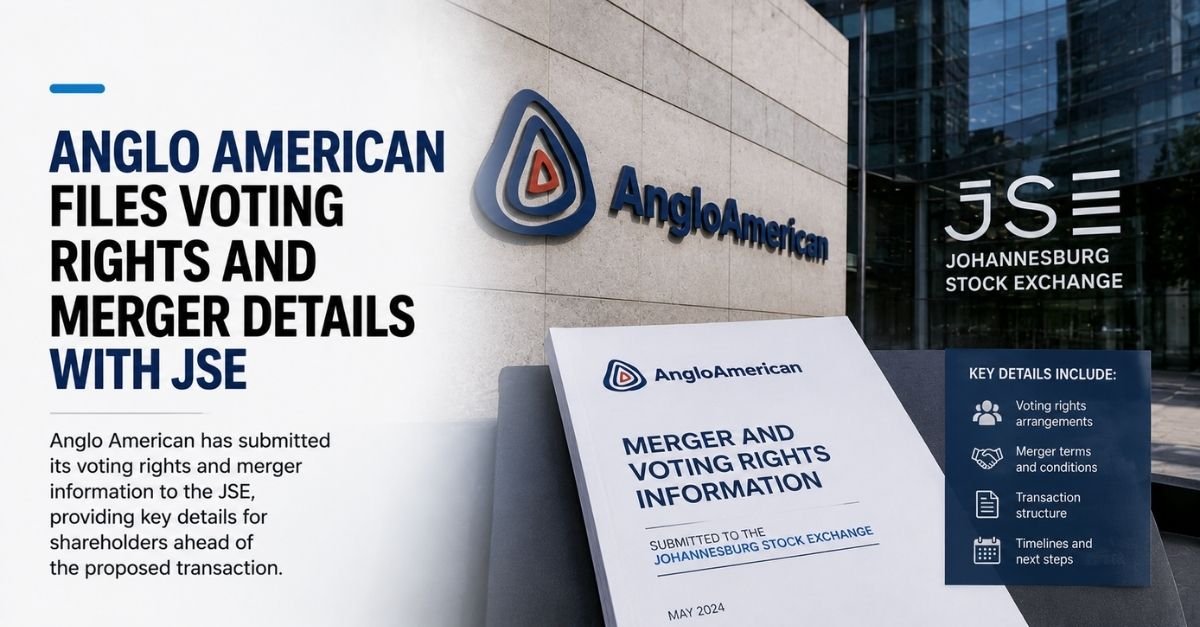
A routine filing on the Johannesburg Stock Exchange’s website this week revealed that Anglo American PLC has submitted its total voting rights schedule together with merger-related information, as required by JSE listing rules. The company’s statement, published by Moneyweb, simply notes that the disclosure satisfies regulatory obligations and provides shareholders with a snapshot of who controls the voting power behind the listed shares.
Voting rights, in plain terms, are the ability of shareholders to influence corporate decisions, from electing directors to approving major transactions such as mergers. When a miner of Anglo American’s size files a total voting rights statement, it tells investors how much of the company is held by large shareholders, management, and the broader public. The filing does not, however, give a detailed breakdown of percentages or name the specific holders, those details are typically found in the accompanying annexes, which the Moneyweb summary does not reproduce.
The second part of the filing references “merger-related information”. In practice, this means Anglo American is either considering a merger, has entered into a merger agreement, or is required to disclose any material discussions that could affect the share price. The company’s brief note does not confirm that a deal is imminent; it merely acknowledges that any such activity will be disclosed in accordance with the Companies Act and JSE regulations.
Why this matters to small-business owners
While the filing is a corporate housekeeping matter, its ripple effects can reach the supply chain that many South African SMEs rely on. Anglo American’s portfolio today is built around copper and premium iron ore, with manganese alongside them, sectors where local contractors compete for equipment, logistics and services work. A merger that expands its footprint could tighten demand across those categories. Conversely, a merger that leads to asset divestments might open up new opportunities for smaller firms to win contracts for mine closure, rehabilitation or the supply of specialised components.
The concentration in that portfolio is worth understanding, because it changes what a merger would actually be about. Copper accounted for roughly 70% of the group’s earnings before interest, tax, depreciation and amortisation in the first half of 2026, on a portfolio the company has spent two years deliberately simplifying: the steelmaking coal and nickel businesses have been put up for sale, the platinum unit was demerged, and the De Beers diamond business is being separated out. A group that concentrated is far more exposed to a single commodity price than the sprawling conglomerate Anglo American used to be, which is exactly why any further structural change draws the attention it does. Readers following the wider reshaping can see the scale of it in the reported $50bn restructuring and Glencore’s potential $1.4bn share of the proceeds.
From a financing perspective, any merger news tends to move the share price. A higher share price can improve the company’s borrowing capacity, potentially leading to larger capital projects. Those projects often require financing from local banks, which in turn may tighten or loosen credit conditions for other businesses in the mining-related ecosystem.
For investors, the filing is a reminder that control of a listed company can be concentrated. If a handful of shareholders hold a majority of voting rights, they can steer strategic decisions without broad shareholder consent. That concentration can affect the volatility of the stock, which matters to anyone holding Anglo American shares in a retirement fund or a personal portfolio.
In the broader South African context, Anglo American’s disclosure comes at a time when the mining sector is navigating a mix of challenges, fluctuating commodity prices, ongoing load-shedding, and a regulatory environment that is increasingly focused on sustainability and local beneficiation. Any merger that reshapes the company’s asset base could influence how these challenges are addressed, with downstream effects on employment and local procurement.
In short, the filing does not announce a new deal, but it signals that Anglo American is keeping the market informed about who holds the reins and whether a merger could be on the horizon. For SMEs that supply the mining industry, the news is a cue to watch for any subsequent announcements that could reshape the market landscape.