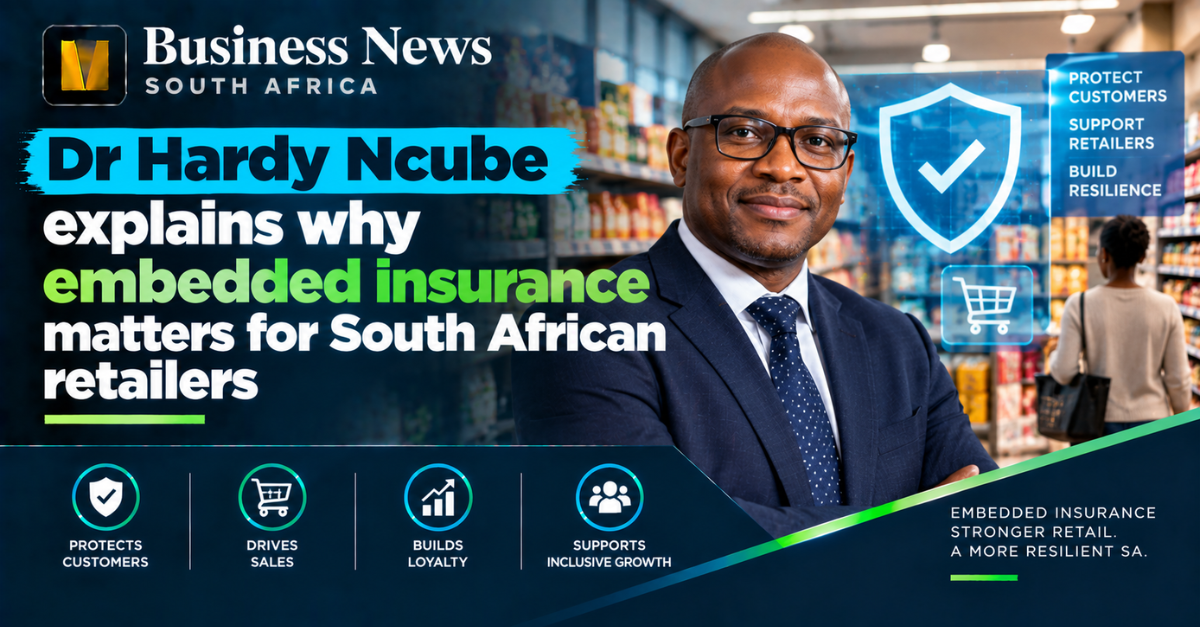
In a Business Talk interview hosted by Michael Avery, Dr Hardy Ncube, head of personal lines insurance at Standard Insurance Limited, talked about embedded insurance and why it matters for South African businesses.
Embedded insurance is an insurance product that is sold together with another product or service at the point of purchase. For example, a customer buying a new smartphone might be offered device protection as part of the checkout process. The insurance is built into the transaction rather than being a separate, after-the-fact purchase.
According to Dr Ncube, the main advantage of this model is that it can reach people who normally do not buy insurance. By using behavioural analytics, the study of how customers act, and predictive modelling, statistical techniques that forecast risk, Standard Insurance can design policies that fit the actual usage patterns of individuals, even in underserved communities.
He also said that Standard Bank Insurance, the banking arm that partners with Standard Insurance, has a competitive edge because it already enjoys a high level of trust among its customers. Trust, in his view, is essential when insurance moves from a stand-alone product to something that is automatically added to a purchase.
When asked whether embedded insurance threatens the role of financial advisers and brokers, Dr Ncube argued that it does not replace them but changes the conversation. Advisers can still add value by helping clients understand the coverage, compare options and manage claims, while the embedded product handles the initial purchase.
Looking ahead, he predicts that over the next five years more retailers, fintech platforms and service providers will embed insurance in their offerings. The trend will be driven by digitalisation, cheaper data processing and the need for convenient, on-the-spot protection.
His key message was simple: embedded insurance can make protection more accessible, but it must be delivered with clear information and the trust that customers expect from their financial partners.
Why distribution is the whole argument
The economics of retail insurance are unusual, and they explain why embedding has become the growth story rather than pricing or product design. The cost of the risk itself, the claims an insurer expects to pay, is only part of what a customer pays for a policy. A substantial portion covers the cost of getting the policy sold: finding the customer, explaining the product, completing the application, and paying whoever did those things. On small policies that acquisition cost can approach or exceed the value of the cover.
Selling at the point of purchase collapses most of that. The customer has already been found, the need is self evident because they are holding the thing being insured, and the sale takes one additional screen. That is a genuine efficiency rather than a marketing claim, and it is why cover on items that were never economic to insure through a broker can suddenly be offered profitably.
The same efficiency creates the risk that regulators watch. A product sold in three seconds alongside something the customer actually came to buy is a product almost nobody reads. Where that leads is well documented across several markets: cover the buyer already held through another policy, exclusions that remove most of the practical value, and claim ratios so low that the arrangement looks less like insurance and more like a commission stream attached to a retail transaction.
What a retailer takes on by offering it
A business adding insurance at checkout is not simply passing a customer to an insurer. In South Africa, intermediating or advising on an insurance product is a regulated financial service, which generally requires being an authorised financial services provider or operating formally under one, with the training, disclosure and record keeping that carries. Product governance rules also place obligations on the distributor and not only on the underwriter, on the reasoning that whoever designs the point of sale largely determines whether the customer understood what they bought.
The questions worth asking before signing a partnership are therefore commercial and regulatory at once. What proportion of premium is expected to be paid out in claims, which is the clearest single measure of whether a product offers value. Whether the cover duplicates protection the customer is likely to hold already. Whether the customer actively chooses it or has to notice and decline it, since a pre ticked box produces impressive take up figures and poor outcomes. Who handles a claim, and whose brand the customer blames when it is declined.
That last question is the one retailers most often underestimate. Commission arrives monthly and is easy to model. A declined claim arrives once, at the counter, and is attached to the shop rather than to the insurer whose name is in the policy wording.