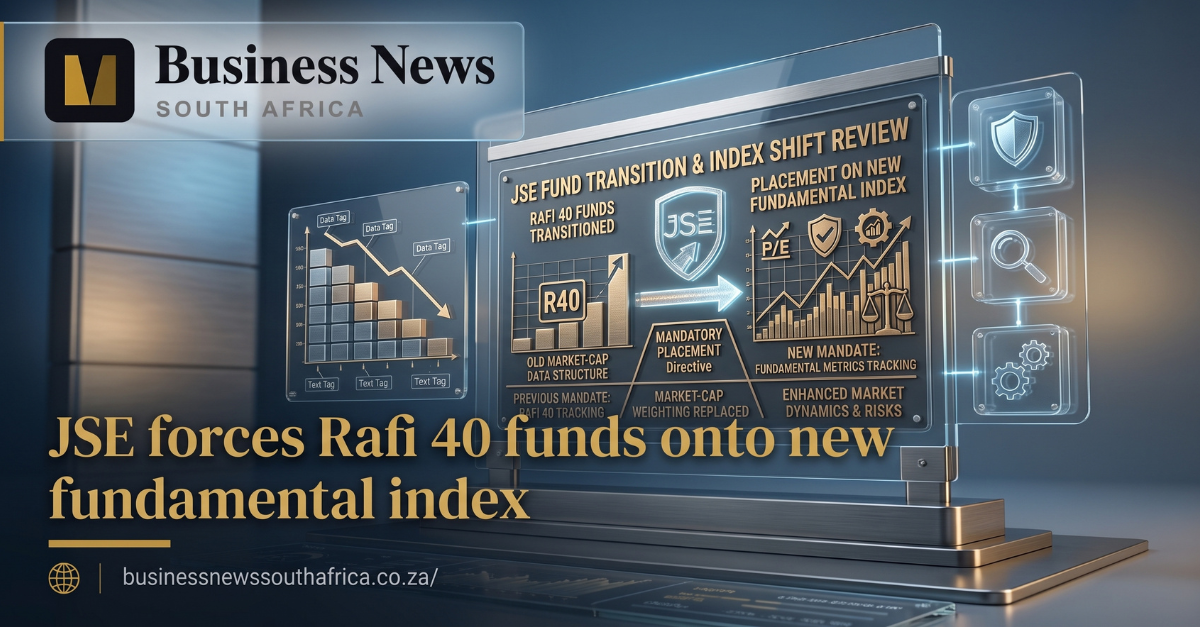
The Johannesburg Stock Exchange (JSE) told index-linked funds that the Research Affiliates Fundamentals Indexation (Rafi) 40 index would cease at the end of August 2026. That forced managers of several South African exchange-traded funds (ETFs) and unit trusts to find a replacement benchmark.
Satrix, which runs the Satrix Rafi 40 ETF, announced in June that the fund would switch from tracking the FTSE/JSE Rafi 40 (J260) Index to the new Rafi Fundamental Select South Africa 40 Index. The change was implemented on 20 July 2026. Satrix said the switch required a slight amendment to the investment policy and a one-off revaluation of the ETF units on the change date to keep shareholders on an even footing.
Old Mutual used the same moment to review its whole range of fundamentally weighted products. Ziyaad Parker, portfolio manager for Old Mutual’s unit trusts, told Moneyweb that the firm is moving its Old Mutual Rafi 40 unit trust to a refined Rafi index built directly by Research Affiliates. He described the new index as incorporating “more refined fundamental measures” and adding safeguards against concentration risk, the danger that a handful of large holdings dominate a fund’s performance.
Why the shift matters
Both the JSE Top 40 index and the Rafi 40 index are used as benchmarks for a large share of South African equity funds, but they are constructed very differently. The Top 40 is market-value weighted, meaning a company’s share of the index is based on its share price multiplied by the number of shares outstanding. In practice that gives giants such as Naspers and Prosus a huge influence on the index’s movement.
By contrast, the Rafi methodology weights companies by five-year averages of sales, cash flow, dividends and book value, measures of a firm’s actual economic footprint. Parker explained that this approach “anchors the portfolio back to fundamentals rather than letting winners keep compounding their weight purely on price strength.” The result is a portfolio that leans toward value-oriented stocks and away from those that have become expensive purely because of market hype.
Because the Rafi index is rebalanced only at set intervals, annually or in quarterly tranches, its composition changes more slowly than the Top 40, which adjusts continuously as share prices move. That slower turnover can reduce turnover costs for fund managers and give investors exposure to sectors that are under-represented in a pure market-cap index, such as resources and financials.
Performance data from Old Mutual’s fact sheets for July 2026 show that the Rafi-based fund outperformed its Top 40 counterpart over the past year, without taking on higher risk. The Rafi fund held a higher proportion of mining stocks, Valterra Platinum, Anglo American, Sibanye-Stillwater and Gold Fields, while the Top 40 fund was weighted more heavily toward Naspers and banking shares. Both funds were rated as “moderate to high risk”, suggesting that the better return did not come from a riskier profile.
For investors who own units in these funds, the switch means a change in the underlying stock mix and a different exposure to sector cycles. For fund managers, it means revisiting portfolio construction, re-balancing schedules and communication with shareholders. The broader market may see a modest shift in capital flows as funds that previously chased market-cap momentum move toward a value-oriented, fundamentals-driven approach.
While the change does not directly affect small-business owners, it does illustrate how index methodology can shape where capital is allocated. A fund that favours fundamentals may allocate more money to mining and financial firms, which could influence the availability of financing for suppliers and service providers in those sectors.
Why index construction choices are rarely neutral
The methodology debate underlying this switch, market-cap weighting versus fundamentals weighting, is not a technical footnote; it is a genuine philosophical disagreement about what an index should actually measure. A market-cap index answers the question of what the average investor currently owns, since it mirrors aggregate market prices exactly, which is precisely why it becomes dominated by whichever stocks have already risen the most. A fundamentals-weighted index instead answers a different question, what does the underlying economic activity of the index’s constituent companies actually look like, which is why it structurally tilts away from expensive, popular stocks and toward companies whose size is grounded in sales, earnings and dividends rather than market sentiment. Investors choosing between the two are, whether they realise it or not, choosing between tracking the market as it currently is versus tracking the market as its fundamentals would suggest it should be weighted.