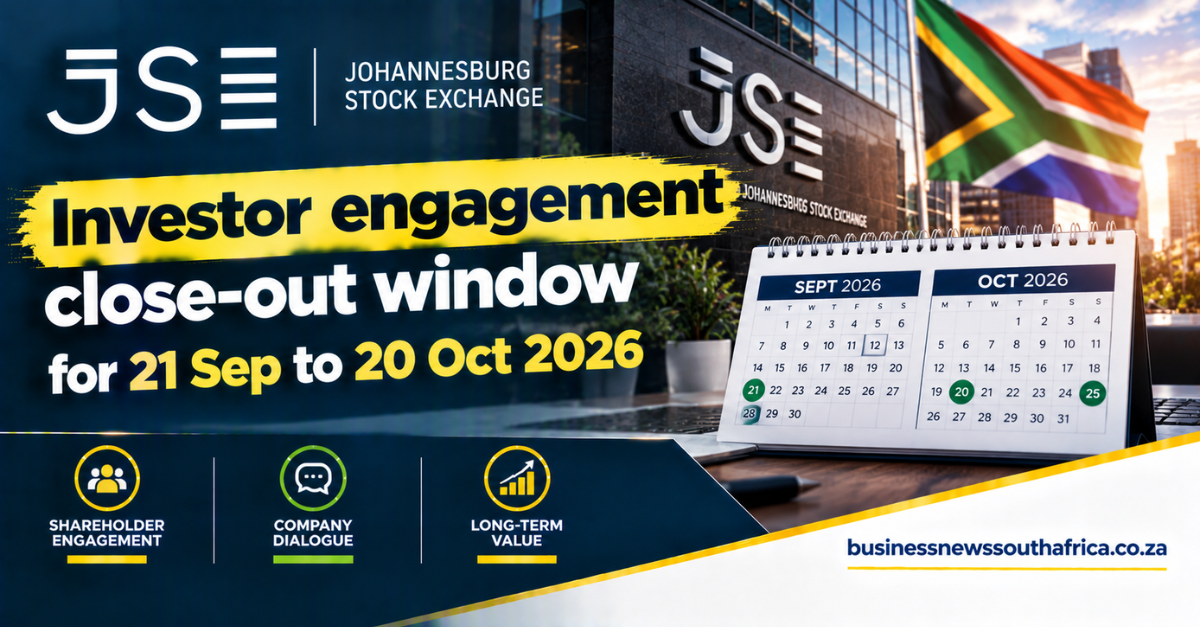
Moneyweb notes that the Johannesburg Stock Exchange (JSE) has announced its investor engagement close-out period for this year, running from 21 September 2026 to 20 October 2026. The notice is a routine reminder that listed companies must finish responding to investor queries within that window.
What does this mean for a business? In plain terms, the close-out period is the final month in which a listed company can field questions from shareholders, analysts and potential investors before it publishes its audited results. The JSE requires companies to keep the dialogue open for at least 30 days after the financial year-end, so that investors have a chance to seek clarification on performance, strategy and risk factors.
For owners of small or medium-sized enterprises that are not listed, the direct impact is limited. However, the same principle applies when a private firm is courting venture capital or a bank loan, investors will expect a clear, time-bound window for questions before a deal is finalised. Understanding the JSE’s timetable can help SME owners plan their own disclosure calendars if they ever move onto a public market.
The JSE’s Investor Engagement Programme was introduced to improve market transparency after a series of high-profile earnings surprises. Companies that miss the deadline may face a compliance notice from the exchange, and repeated breaches can lead to sanctions such as a temporary suspension of trading. While the Moneyweb notice does not mention any penalties, the exchange’s rulebook makes clear that timely responses are a condition of continued listing.
From a practical standpoint, the close-out period forces senior management to allocate resources to the investor relations (IR) function. IR teams must collate financial data, draft answers to likely questions and coordinate with legal and finance departments to ensure that no material information is disclosed prematurely. For a mining company, for example, that could mean explaining commodity price assumptions; for a tech firm, it could involve clarifying product road-maps.
For investors, the window offers a predictable schedule. Analysts can plan earnings calls and research updates around the close-out period, knowing that most companies will have answered the most pressing queries by 20 October. This reduces the risk of surprise price movements when results are finally released.
In the broader South African economy, the timing aligns with the end of the fiscal year for many companies, which runs to 31 March. By setting the close-out period in September-October, the JSE gives companies a six-month buffer to finalise their accounts, audit them and then address investor concerns before the next financial year begins. The schedule also avoids the peak of the rainy season, when logistics and power supply issues can disrupt corporate communications.
In summary, the JSE’s 21 September to 20 October 2026 close-out period is a compliance deadline that ensures listed companies keep the lines of communication open with their shareholders. While the notice is brief, the implication is clear: firms that ignore the window risk regulatory censure, and investors can count on a structured period for asking the questions that matter most.
An investor engagement period gives listed companies a formal, disclosed window in which management and major shareholders can meet without falling foul of insider trading rules around price sensitive information, typically used to gauge shareholder sentiment ahead of annual general meetings. The JSE’s own listing requirements carries further detail. For related coverage, see this site’s Markets and Finance coverage.
Companies use the engagement window differently depending on their circumstances: some focus on explaining recent results to analysts, while others use the period to sound out major shareholders on more sensitive matters such as a proposed corporate action, ahead of a formal announcement once the window closes.